Freedom251 › Newsletter Platforms
Sympa
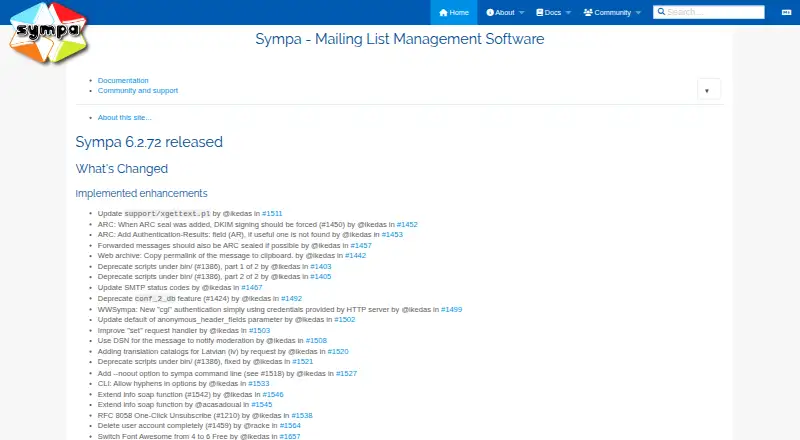
What Sympa is
Sympa is mailing list management software for administering mailing-list services. It provides a web interface and supports email, command-line and SOAP interfaces. List owners can manage members and list settings, while moderators can review messages on lists set up for moderation. Membership can be populated dynamically from local or remote files, other Sympa lists, LDAP searches and SQL queries. Sympa keeps text and web archives with search, access controls, message removal and ZIP export. Its SOAP/HTTP service supports operations such as listing lists, checking memberships and managing subscriptions, with access controls. Security options include DKIM verification and signing, plus ARC seals for forwarded messages on version 6.2.72 or later. Sympa is open source and free, and supports Linux, macOS and other POSIX-based Unix-like systems, but not Windows. A self-hosted setup needs Perl and a mail server; the web interface also needs an HTTP server. Documented database choices include MySQL or MariaDB, PostgreSQL, Oracle Database and SQLite.
Who it suits
Sympa suits system administrators deploying and maintaining a mailing-list server and listmasters managing the service. It is intended for teams able to manage its mail, database and web server requirements.
What it does well
- Open-source mailing-list management software is free.
- Supports web, email, command-line and SOAP interfaces.
- Membership can come from files, lists, LDAP or SQL.
- Archives offer search, access controls and ZIP export.
- Documented databases include PostgreSQL, Oracle and SQLite.
What to know first
- Requires administrators to manage mail and server components.
- Needs Perl and a mail server for self-hosting.
- The web interface requires an HTTP server.
- Microsoft Windows is not supported.
Limits
Sympa is free, but a self-hosted server requires administrator-managed mail, database, and web server components. It does not support Microsoft Windows; the web interface requires an HTTP server.
Plans
| Plan | Billed and limits | Price |
|---|---|---|
| Sympa | No paid tiers stated; server software requires administrator-managed mail, database, and web server components | Free |
| Free/open-source Sympa | No licence fee stated; self-hosted infrastructure is required · Self-hosted · POSIX systems · mail, database and web-server dependencies | Free |
As sympa.community lists them, read 4 Oct 2026. The maker's own page has the final word.
Getting started
- Visit https://www.sympa.community/.
- Prepare a POSIX-based system such as Linux or macOS.
- Install and configure Perl and a mail server.
- Provide a database such as MySQL or MariaDB, PostgreSQL, Oracle Database, or SQLite.
- Set up an HTTP server if you need the web interface.
- Restrict unnecessary inbound network access as the documentation recommends.
Sympa is mailing-list administration software for organizations that need to manage lists, memberships and message moderation. It is best suited to system administrators and listmasters comfortable running server infrastructure. Its strength is flexible, self-hosted list management; its cost is the operational work and Unix-like environment it requires.
Overview
Sympa combines list-owner controls with moderation tools for lists configured to require review. Membership can draw on local or remote files, other Sympa lists, LDAP searches and SQL queries, which suits organizations whose lists reflect changing directories or databases rather than manual sign-ups alone.
Archives include text and web views, search, access controls, message removal and ZIP export. The SOAP/HTTP service can list lists, check memberships and manage subscriptions, with operations governed by access controls. These capabilities make Sympa a strong fit for institutional or organizational mailing-list services, but not a turnkey choice for users who want to avoid administering mail and web infrastructure.
Key features
Members and list configuration are managed by list owners, while moderators can review messages on moderated lists. This division gives list administrators control without making moderation universal; teams should configure it where their communications need review.
Sympa supports web, email, command-line and SOAP interfaces. Its SOAP/HTTP service exposes subscription and membership operations for integration, subject to access controls. Documentation also covers configurable DKIM signing and verification, and ARC seals for forwarded messages on version 6.2.72 or later.
Archives offer useful control over both access and retention: administrators can set access rules, remove messages and export archives as ZIP files. That combination is valuable when a list needs a searchable record but not every archive should be public or permanent.
Pricing
Sympa: free. The software is open source, and no paid tiers are stated. There are no per-seat or subscriber caps in the plan details, but free software does not remove the infrastructure burden: administrators must provide mail, database and web server components.
This is a practical fit for organizations able to operate those services and seeking control over list management without a software subscription. It is less suitable for a small team looking for a hosted newsletter product with managed delivery and minimal administration.
Platforms
Sympa supports Linux distributions and macOS, along with web access and API availability. It supports POSIX-based Unix-like systems and explicitly does not support Microsoft Windows. Deployments require Perl and a mail server; the web interface also requires an HTTP server. Documented database choices include MySQL or MariaDB, PostgreSQL, Oracle Database and SQLite. Documentation recommends restricting unnecessary inbound network access, so deployment includes security and network-administration responsibilities.
Who it's for
Sympa is aimed at system administrators who deploy and maintain servers and listmasters who operate a mailing-list service. It makes sense where dynamic membership sources, controlled archives, moderation and integration matter enough to justify maintaining the stack. It is a poor fit for teams without Unix-like server expertise or those seeking a Windows deployment.
Pros and cons
- Pros: Membership can be sourced from files, other lists, LDAP and SQL, helping keep organizational lists aligned with existing data.
- Pros: Multiple interfaces, archive controls and SOAP/HTTP operations support varied administrative workflows and integrations.
- Cons: Mail, database and web server components must be administered, increasing deployment and maintenance work.
- Cons: Microsoft Windows is unsupported, and security configuration requires administrator attention.
Alternatives
For a self-hosted, open-source option with Windows support, consider listmonk; its free plan also requires PostgreSQL. Mailtrain is another free self-hosted option, with a recommended minimum of 2 vCPU and 4096 MB RAM for Mailtrain v2.
If a hosted, cross-device publishing option is a better fit, Substack offers a free-to-start plan with no platform fees, tiers or contracts. Audienceful has a free plan capped at 1,000 contacts, one team collaborator and one automated journey. Curated offers a free monthly plan for 0–1,500 subscribers.
Dada Mail is another freemium option for readers comparing mailing-list software. Email Fast may suit senders wanting a free plan with 2,500 emails per month and unlimited contacts and subscribers. LetterBucket offers a free plan for up to 1,000 subscribers and unlimited posts. Browse more options in Newsletter Platforms.
Verdict
Choose Sympa if your organization needs configurable mailing lists, dynamic membership sources and controlled archives, and has administrators able to run its server components. Its open-source, no-cost plan is compelling for that use case. Look elsewhere if you need Windows support or a hosted service that avoids infrastructure and ongoing administration.
Verdict
Sympa offers mailing-list management, flexible membership sources, archives and multiple interfaces. Its self-hosted setup depends on administrator-managed server components and Unix-like systems.
Questions
Is Sympa free and open source?
Yes. Sympa is open source, and its listed plan is free.
Which operating systems does Sympa support?
Sympa supports POSIX-based Unix-like systems, including Linux distributions and macOS. It does not support Microsoft Windows.
What is needed to self-host Sympa?
A self-hosted installation requires Perl and a mail server. The web interface also requires an HTTP server, and a database is among the server components to manage.
Which databases are documented for Sympa?
Documented options include MySQL or MariaDB, PostgreSQL, Oracle Database, and SQLite.
What interfaces does Sympa provide?
Sympa provides a web interface and supports email, command-line, and SOAP interfaces.
Where can users find community support?
The community support page links to Sympa mailing lists and GitHub.
Facts from Sympa's own pages
- API clients
- The project documents sample Perl and PHP SOAP clients and notes Java Axis interoperability. · sympa.community, 21 Oct 2026
- API limitation
- The same RENATER paper describes the SOAP interface as limited for remote administration and notes that Sympa lacks a REST API. · conf-ng.jres.org, 21 Oct 2026
- Archives
- Web archives support access controls, search and spam-harvester protection settings. · sympa.community, 21 Oct 2026
- Authentication
- The web interface supports built-in accounts, LDAP, CAS, Shibboleth, generic SSO and TLS client authentication. · sympa.community, 21 Oct 2026
- Containerization limitation
- RENATER reports that Sympa’s spool and filesystem architecture makes multi-container deployment difficult and that NFS workarounds caused severe response-time degradation. · conf-ng.jres.org, 21 Oct 2026
- Database support
- Documented database options include MySQL or MariaDB, PostgreSQL, Oracle Database, and SQLite. · sympa.community, 4 Oct 2026
- DKIM and ARC
- Configuration supports DKIM signing and verification and ARC sealing for list mail. · sympa.community, 21 Oct 2026
- Documentation
- The documentation site provides an administration manual and security-advisory index, while the general Help and FAQ sections are marked as forthcoming. · sympa.community, 21 Oct 2026
- Dynamic membership
- Subscribers, owners and moderators can be populated from local or HTTPS files, other Sympa lists, LDAP searches, SQL queries and CSV-backed databases. · sympa.community, 21 Oct 2026
- Dynamic memberships
- List subscribers, owners, and moderators can be included from local or remote files, other Sympa lists, LDAP searches, and SQL queries. · sympa.community, 4 Oct 2026
- Email security
- Sympa documents S/MIME signature verification plus decryption and re-encryption using user certificates. · sympa.community, 21 Oct 2026
- Extensibility
- Administrators can extend behavior with authorization scenarios, message hooks, template plugins and custom web-interface actions. · sympa.community, 21 Oct 2026
- Governance
- RENATER states it stopped being the project guarantor in 2017, after which governance moved to a developer community. · conf-ng.jres.org, 21 Oct 2026
- Independent limit
- FAUN.dev says setup requires coordinating Sympa with a mail server, database and web server, and that advanced scenarios take time to learn. · faun.dev, 21 Oct 2026
- Independent praise
- FAUN.dev’s review credits Sympa’s portability, GPL licensing, LDAP and SQL integrations, SOAP automation and large-scale list-management capabilities. · faun.dev, 21 Oct 2026
- Independent score
- Argus du Libre gives Sympa an overall score of 2.8 out of 5, with technical documentation scored 3.0 and security 2.3. · argusdulibre.linagora.com, 21 Oct 2026
- Integration
- The SOAP/HTTP service exposes functions for listing lists, checking memberships, managing subscriptions, and other operations, subject to access controls. · sympa.community, 4 Oct 2026
- Intended users
- The administration manual is aimed at system administrators who deploy and maintain servers and listmasters who manage the mailing-list service. · sympa.community, 4 Oct 2026
- Interfaces
- Sympa provides a web interface and supports email, command-line, and SOAP interfaces. · sympa.community, 4 Oct 2026
- Latest release
- The GitHub release page lists Sympa 6.2.78, released on 28 March 2026, with fixes, dependency changes and Perl-version support updates. · github.com, 21 Oct 2026
- Licence
- The public source repository identifies Sympa as GPL-2.0 licensed. · github.com, 21 Oct 2026
- Limit: learning curve
- Zoftware says reviewers report a substantial learning curve for advanced features. · zoftwarehub.com, 21 Oct 2026
- Limit: performance
- Zoftware notes that some reviews describe slowdowns with very large lists or peak workloads. · zoftwarehub.com, 21 Oct 2026
- Limit: setup
- Zoftware summarizes complaints that installation and setup can be complicated for organizations unfamiliar with mailing-list systems. · zoftwarehub.com, 21 Oct 2026
Where Sympa stands on Freedom251
- Newsletter Platforms#2 of 30