Freedom251 › Peer Assessment Software
Student Peer Review
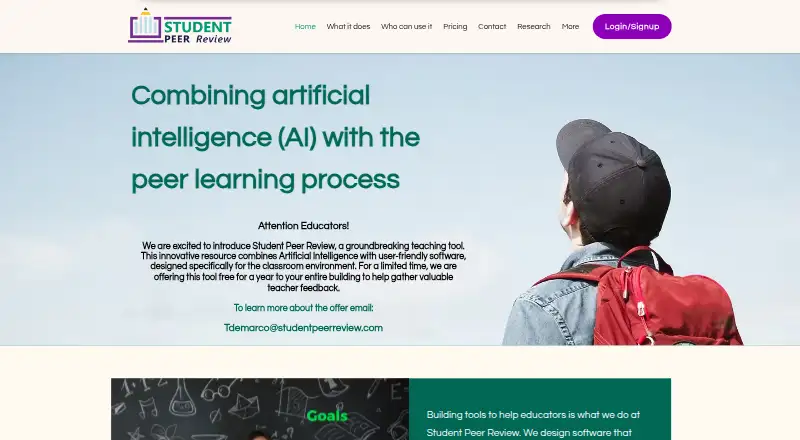
What Student Peer Review is
Student Peer Review is a web-based assessment tool for schools and other organizations that combines peer learning with artificial intelligence. It is designed to assess students, gauge their understanding, and support learning of curricular concepts while reducing teacher clerical work. Instructors can create assessments in formats such as essays, videos, graphics, and multiple-choice questions. AI tools can generate assessments, quizzes, questions, rubrics, passages, and sample answers; the product also describes using ChatGPT to help instructors create assessments. Listed instructor controls include managing an AI robot, restricting student use of selected AI tools, comparing individual results collaboratively, and identifying concepts students have misunderstood. Its described audiences include K-12 schools, colleges, trade schools, businesses, corporations, and government organizations. The free plan covers one course, 50 students, and 10 assessments for six months, with unlimited features and no credit card requirement. AI generation has a 30-day trial with a 10,000-word allowance. The AI Subscription costs $3 a month and allows 600,000 generated words with no expiration.
Who it suits
It suits educators and organizations that want peer assessment alongside AI-assisted assessment content creation. The listed audiences range from K-12 schools and universities to trade schools, businesses, and government organizations.
What it does well
- Supports essays, videos, graphics, and multiple-choice assessments.
- AI can generate rubrics, questions, and sample answers.
- Free plan includes up to 50 students.
- Free plan includes unlimited features.
- AI Subscription costs $3 a month.
What to know first
- Free plan is limited to one course.
- Free plan is valid for six months.
- AI trial allows 10,000 words for 30 days.
- Platform listed is web only.
Limits
The free plan is valid for six months and allows one course, 50 students, and 10 assessments. The separate AI trial lasts 30 days and includes 10,000 words; the $3 a month AI Subscription allows 600,000 generated words with no expiration.
Plans
| Plan | Billed and limits | Price |
|---|---|---|
| Free | No credit card · Up to 1 course · Valid 6 months · 50 students · 10 assessments · Unlimited features | Free |
| Artificial Intelligence TRIAL | 10,000 words · 30 days validity · Assessment, passage, question, sample answer, and rubric generation | Free |
| $ 25 / yr | $ 25 / yr · Up to 10 courses · Valid 1 year · 500 students · 100 assessments · Unlimited features | $25 a year |
| AI Subscription | $3 Per Month · 600,000 words can be generated using AI · No expiration · Assessment, passage, question, sample answer, and rubric generation | $3 a month |
| $ 8 / yr | $ 8 / yr · Up to 2 courses · Valid 1 year · 100 students · 50 assessments · Unlimited features | $8 a year |
| Enterprise | Institutional purchase · Request a demo | On request |
As studentpeerreview.com lists them, read 7 Oct 2026. The maker's own page has the final word.
Getting started
- Open the Student Peer Review website.
- Use its online login and signup application; the page requires JavaScript.
- Choose the free plan, an AI trial, or a paid plan based on course and AI-generation needs.
- Create assessments in formats such as essays, videos, graphics, or multiple-choice questions.
- Contact support at [email protected] or 412-849-8556 if needed.
Student Peer Review is a web-based assessment platform that brings peer review together with AI-generated teaching materials. It is best suited to educators who want varied assessment formats and can work within course, student, and assessment caps. Its inexpensive course plans are appealing, but meaningful AI generation requires a separate subscription.
Overview
The platform aims to measure students’ understanding while reducing teachers’ clerical work. Instructors can create assessments in formats including essays, videos, graphics, and multiple-choice questions, combining peer learning with AI-assisted preparation.
Student Peer Review describes use across K–12, higher education, trade and other post-secondary schools, as well as corporations, businesses, and government. That breadth gives it potential beyond conventional classrooms, although its small-group plan limits make it a more natural fit for individual courses than broad deployments.
Key features
Peer assessment and instructional follow-up
Rubric scoring and collaborative measurement of individual results connect peer review to student assessment. The ability to pinpoint misunderstood concepts is a useful instructional complement: teachers can identify where students are struggling rather than treating reviews as the end of the process.
Instructors can control an AI robot and limit student use of various AI tools. These controls may matter to educators seeking to manage AI use in a course, though they are described as capabilities rather than a detailed policy or monitoring system.
AI-generated materials
AI tools can generate assessments, quizzes, questions, rubrics, passages, and sample answers. This is a broad set of starting points for course preparation, but the AI allowance is separate from the course plans. The trial provides 10,000 words for 30 days; the subscription provides 600,000 words with no expiration. Educators with occasional needs may find the trial sufficient, while frequent generation calls for the additional monthly cost.
Pricing
The free course plan costs nothing and requires no credit card. It allows one course, 50 students, and 10 assessments for six months, with unlimited features. That is a useful way to run a small, time-bounded course, but the student and assessment ceilings rule it out for larger cohorts or ongoing use.
The annual course plans preserve unlimited features while raising those limits. The $ 8 / yr plan costs $8 a year and covers up to two courses, 100 students, and 50 assessments for one year. The $ 25 / yr plan costs $25 a year and covers up to 10 courses, 500 students, and 100 assessments for one year. The higher tier is the more practical choice for educators managing several courses or larger groups; neither plan expands the stated AI word allowance, which is purchased separately.
The Artificial Intelligence TRIAL is free, with 10,000 words and 30 days of validity for assessment, passage, question, sample-answer, and rubric generation. The AI Subscription costs $3 a month, billed $3 Per Month, for 600,000 generated words with no expiration and the same generation categories. The trial is a short test of the AI workflow; the subscription suits ongoing use, but its recurring charge is in addition to any course plan.
Enterprise pricing is custom pricing, with institutional purchase and a demo request. The product also advertises a limited-time offer of a year free for an entire building in exchange for teacher feedback, which could interest schools able to participate. A 30-day trial is offered for AI generation; the separate course plan is free but capped as described above.
Platforms
Student Peer Review is available on the web. Signup runs through an online application that requires JavaScript to work properly, so access depends on a JavaScript-enabled browser.
Who it's for
It is a sensible option for teachers and education providers who want rubric-based peer assessment, several assessment formats, and AI materials in one platform. Small classes can start without a credit card, while educators coordinating a handful of courses can use the low-cost annual plans. Institutions considering wider use should look at the enterprise route or the building offer rather than assume the individual caps will fit.
It is less suitable for users who need a large student roster or many assessments within a single course plan, or who want substantial AI generation included in the course price. The public contact channels are [email protected] and 412-849-8556.
Pros and cons
- Pros: The free plan includes unlimited features and needs no credit card, making it possible to assess the workflow within a one-course, 50-student, 10-assessment limit.
- Pros: Essay, video, graphic, and multiple-choice assessments, together with rubric scoring and concept-level insight, support more than a quiz-only approach.
- Pros: Annual course plans cost $8 a year or $25 a year, with higher course, student, and assessment limits at the second tier.
- Cons: The free course plan expires after six months and its 50-student and 10-assessment limits constrain sustained or larger classes.
- Cons: AI generation has its own word quotas and pricing, so the low annual course price does not cover ongoing AI use.
- Cons: Signup requires JavaScript, which may complicate access in restricted browser environments.
Alternatives
For a wider comparison, see Peer Assessment Software.
- Marka is worth considering if an Android option matters; its free plan supports up to three classes and 50 students per class, with full report preview only.
- CrowdGrader may suit assignment-based use: its instructor-sponsored free plan is capped at 20 students per assignment, and it also offers a student-supported assignment plan at $1.99 a year.
- Eli Review is an alternative for instructors seeking free access to all platform features across unlimited courses; student access is sold by term, with a one-term option at 28.95 USD for four months.
- Kritik360 may be preferable to professors who want free educator access with course activation, instructional design, and ongoing support; its Kritik Scholar plan costs 29.00 USD.
- PeerEvals is a free alternative with no paid tier required for its core job.
- TEAMMATES is another free web option, though its service may change or be terminated at its discretion.
- Expertiza is an option for users seeking open-source software, with an MIT license and Linux, macOS, self-hosted, and web platforms.
- ComPAIR is a free option available on the web and for self-hosting.
Verdict
Choose Student Peer Review if you want peer assessment, rubric scoring, and varied assessment formats alongside AI content generation, and your course fits its clear caps. Its inexpensive annual course plans are the main draw; the separate AI subscription and small plan limits are the reasons to look elsewhere for larger deployments or bundled high-volume generation.
Verdict
Student Peer Review pairs peer assessment with AI content generation and tools for instructors to review student understanding. Its free plan has defined course, student, and time limits, while AI generation also has a paid monthly option.
Questions
Is there a free plan?
Yes. It costs nothing, requires no credit card, and provides one course, 50 students, and 10 assessments for six months, with unlimited features.
What does the AI trial include?
The Artificial Intelligence TRIAL is free for 30 days and includes 10,000 words for generating assessments, passages, questions, sample answers, and rubrics.
How much is the AI Subscription?
It costs $3 a month and allows 600,000 words to be generated using AI, with no expiration.
Are annual plans available?
Yes. One plan costs $8 a year for up to two courses, 100 students, and 50 assessments. Another costs $25 a year for up to ten courses, 500 students, and 100 assessments.
Which platforms does it support?
The listed platform is web. Its online login and signup application requires JavaScript to work properly.
Who is Student Peer Review for?
The service describes use by K-12 schools, colleges, universities, trade schools, post-K-12 secondary schools, corporations, government, and businesses.
Facts from Student Peer Review's own pages
- AI and peer learning
- The product combines artificial intelligence with the peer learning process and describes using ChatGPT to help instructors create assessments. · studentpeerreview.com, 7 Oct 2026
- AI content generation
- The AI features generate assessments, quizzes, questions, rubrics, passages, sample answers, and other content. · studentpeerreview.com, 7 Oct 2026
- Assessment formats
- The site says instructors can create assessments such as essays, videos, graphics, and multiple-choice questions. · studentpeerreview.com, 7 Oct 2026
- Company identity
- The site footer identifies the organization as Student Peer Review and shows a 2022 copyright. · studentpeerreview.com, 7 Oct 2026
- Higher education audience
- The site describes the product for colleges and universities. · studentpeerreview.com, 7 Oct 2026
- Institutional offer
- The site advertises a limited-time offer of the tool free for a year to an entire building in exchange for teacher feedback. · studentpeerreview.com, 7 Oct 2026
- Instructor tools
- The system lists controlling an AI robot, limiting student use of various AI tools, measuring individual results collaboratively, and pinpointing misunderstood concepts among its capabilities. · studentpeerreview.com, 7 Oct 2026
- K-12 audience
- The site describes the product for K-12 schools and educational organizations. · studentpeerreview.com, 7 Oct 2026
- Other audiences
- The site also describes use by trade schools, post-K-12 secondary schools, corporations, government, and businesses. · studentpeerreview.com, 7 Oct 2026
- Purpose
- Student Peer Review assesses students, measures their understanding, and helps them learn curricular concepts with minimal teacher clerical effort. · studentpeerreview.com, 7 Oct 2026
- Signup
- The site links to an online login and signup application, whose page says it requires JavaScript to work properly. · app.studentpeerreview.com, 7 Oct 2026
- Support
- The site lists [email protected] and 412-849-8556 as contact details. · studentpeerreview.com, 7 Oct 2026
Where Student Peer Review stands on Freedom251
- Peer Assessment Software#9 of 17