Freedom251 › PCI Compliance Software
Strike Graph
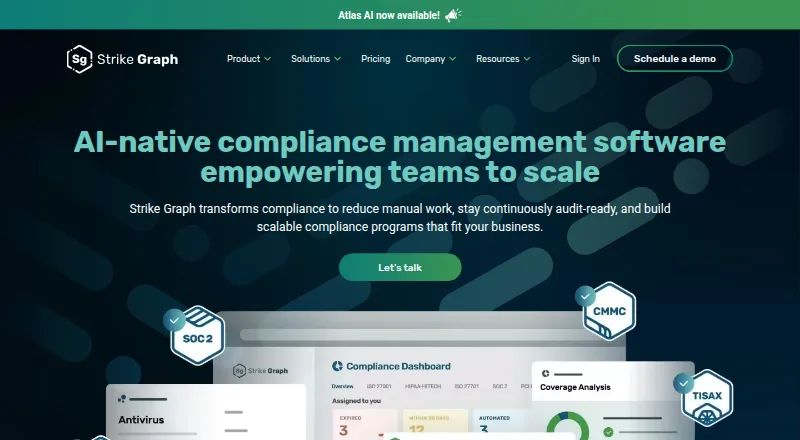
What Strike Graph is
Strike Graph is a governance, risk, and compliance platform for designing, operating, and measuring security programs. It automatically maps controls across more than 30 frameworks and helps organizations identify threats and focus compliance work on critical risks. Its Verify AI feature continuously tests and validates security controls. Compliance Atlas and Security Assistant also support evidence validation and certification work.
Strike Graph says its integrations collect compliance evidence from more than 300 systems and tools. Named connections include AWS, Azure Active Directory, ClickUp, Confluence, GitHub, GitLab, Google Drive, Jira, Office 365, and ServiceNow. The company says integrations use strict authentication, access controls, and encryption. Trust Center centralizes security documents for sharing with prospects, customers, auditors, and investors; Trust Chain provides visibility into vendor and partner risks.
The free Launch plan covers SOC 2 security TSC, limited policy templates, and a specified selection of cloud and document tools. Certify is listed starting at $21,500 per year, and Scale starting at $35,000 per year. Enterprise pricing is available by contacting sales. The pricing note says paid plans start at $10,000 per year. Strike Graph offers a free trial, and is available on web and API. Founded in 2020, the company is headquartered in Seattle, Washington.
Who it suits
Strike Graph suits organizations building security programs and managing compliance across frameworks, controls, and vendor relationships. The company says it supports businesses of all sizes, including organizations with complex regulatory requirements.
What it does well
- Maps controls across more than 30 frameworks.
- Verify AI continuously tests and validates security controls.
- Integrations collect evidence from more than 300 systems and tools.
- Trust Center centralizes security documentation for sharing.
- Trust Chain provides visibility into vendor and partner risks.
What to know first
- Launch covers SOC 2 security TSC and limited policy templates.
- Certify is listed starting at $21,500 per year.
- Scale is listed starting at $35,000 per year.
Limits
Launch is limited to SOC 2 security TSC, limited policy templates, and AWS, Azure RM, or Google Cloud Platform with MS Office or Google Drive. Certify starts at $21,500 per year and covers one Tier 1 framework and one team; Scale starts at $35,000 per year and covers one framework, any tier, and one team.
Plans
| Plan | Billed and limits | Price |
|---|---|---|
| Launch | SOC 2 security TSC · limited policy templates · AWS, Azure RM, or Google Cloud Platform with MS Office or Google Drive | Free |
| Certify | Starting at $21,500/yr · One Tier 1 framework · 1 Team · 50+ cloud integrations | $21,500 a year |
| Scale | Starting at $35,000/yr · One framework, any tier · 1 Team · advanced AI and compliance features | $35,000 a year |
| Enterprise | Contact sales · Custom frameworks · enterprise workspaces · Evidence API · multi-domain reporting | On request |
As strikegraph.com lists them, read 29 Sept 2026. The maker's own page has the final word.
Getting started
- Open the Strike Graph website.
- Start the free plan or begin a free trial.
- Select the Launch plan's supported cloud and document tools, or review paid plans.
- Connect the relevant systems and tools for evidence collection.
- Use control mapping, risk management, and evidence validation for your security program.
Strike Graph is a governance, risk, and compliance platform for organizations building and operating security programs. It suits teams that need to coordinate controls, evidence, and vendor risk across compliance requirements, but its paid plans start at a substantial annual commitment.
Overview
Strike Graph brings control mapping, risk assessments, remediation workflows, evidence collection, and vendor risk management together. It automatically maps controls across more than 30 frameworks, a useful approach for teams working toward multiple certifications: shared controls can reduce duplicated compliance work. Verify AI continuously tests and validates security controls, supporting ongoing compliance rather than a process focused only on audit preparation.
The company says integrations collect evidence from more than 300 systems and tools. Named connections include AWS, Azure Active Directory, ClickUp, Confluence, GitHub, GitLab, Google Drive, Jira, Office 365, and ServiceNow. Strike Graph says these integrations use zero-trust practices, strict authentication and access controls, and encryption. Trust Center centralizes security documents for sharing with prospects, customers, auditors, and investors, while Trust Chain provides visibility into vendor and partner risks.
Key features
Frameworks and control work
Supported frameworks span SOC 1 and SOC 2, ISO 27001, ISO 42001, HIPAA, GDPR, PCI DSS, CMMC, FedRAMP, DORA, and NIS2, among others. The breadth should suit organizations with varied compliance obligations, though the plan a team needs depends on the framework tier: Launch is limited to SOC 2 security TSC, while the paid plans specify broader framework access.
Evidence and AI
Compliance Atlas, Verify AI, and Security Assistant are positioned to automate evidence validation and guide organizations through certification work. Combined with evidence collection from a large set of integrations, these tools could help teams keep control evidence current. Teams should still weigh that breadth against the cost of the paid tiers if they need advanced AI and compliance capabilities.
Risk visibility and sharing
Risk management, assessments, and remediation workflows help direct compliance work toward critical threats. Trust Chain extends risk visibility to vendors and partners, and Trust Center gives teams a central way to share security documentation externally. These capabilities are relevant to organizations that need both internal control operations and a consistent response to customer or auditor requests.
Pricing
The free Launch plan costs nothing and covers SOC 2 security TSC, limited policy templates, and AWS, Azure RM, or Google Cloud Platform with MS Office or Google Drive. It also includes customer support and a 30-minute Audit Advisor Call. This is a defined starting point for a team focused on that SOC 2 scope, not a substitute for broader framework coverage.
- Certify: Starting at $21,500/yr, billed yearly. It includes one Tier 1 framework, one team, and 50+ cloud integrations. This fits organizations that need a paid framework beyond Launch’s scope and broad cloud connectivity, but the entry price is a considerable step up from free.
- Scale: Starting at $35,000/yr, billed yearly. It includes one framework of any tier, one team, and advanced AI and compliance features. It is the more relevant tier for teams needing higher-tier framework coverage and advanced features, at a higher annual commitment.
- Enterprise: Custom pricing. It includes custom frameworks, enterprise workspaces, an Evidence API, and multi-domain reporting. These additions target organizations with more complex structures or reporting needs; the price requires a sales discussion.
Certify and Scale each specify one team, so organizations needing multiple teams should assess whether Enterprise fits their structure. Launch’s narrow framework and integration choices make it useful for a limited SOC 2 program, but not for teams seeking the platform’s broadest coverage without a paid plan.
Platforms
Strike Graph is available on the web and through an API. That combination supports browser-based program work and API access, while the product’s listed platform coverage does not include a mobile app.
Who it's for
Strike Graph is best suited to organizations managing security compliance as an ongoing program, especially those coordinating controls across frameworks, collecting evidence from connected systems, and monitoring vendor risk. Its stated support for businesses of all sizes is tempered by the paid plans’ starting prices: teams with a narrow SOC 2 need can begin on Launch, while broader requirements call for a substantial budget. It is less compelling for a buyer who needs only a low-cost, limited-scope compliance tool.
Pros and cons
- Pro: Mapping across more than 30 frameworks can help teams reuse control work instead of managing each requirement in isolation.
- Pro: Evidence collection from more than 300 systems, plus continuous AI validation, supports a more ongoing approach to compliance.
- Pro: Trust Center and Trust Chain address external security-document sharing and third-party risk alongside core control work.
- Con: Launch is restricted to SOC 2 security TSC, limited policy templates, and a short set of cloud and productivity connections.
- Con: Certify starts at $21,500/yr and Scale at $35,000/yr, which may put broader framework and advanced-feature access beyond reach for smaller budgets.
- Con: Certify and Scale each include one team, a constraint for organizations that need to coordinate multiple teams.
Alternatives
Compliance Management Software is a useful starting point for comparing products in the category. Consider CISO Assistant if a free, self-hosted Community plan with unlimited users is a better fit than Strike Graph’s narrowly scoped free tier. ComplianceOS may suit teams that prioritize a fully open-source Community edition with 30+ frameworks and 1000+ pre-built controls.
ComplyGlobal is worth considering for a smaller compliance setup that fits its free Basic plan’s one user and one legal entity. OpenGRC offers a free self-hosted Community plan with full source code access, which may appeal to teams that prefer that model. IsoMetrix is another paid option for buyers who want to request a demo.
NAVEX EthicsPoint Incident Management is an alternative for organizations seeking incident-management software with pricing tailored to organizational size and program needs. Probo offers a free product and a cloud option for buyers to discuss with its provider. Virtual Auditor is another paid alternative.
Verdict
Choose Strike Graph if your organization needs control mapping, evidence validation, and risk work coordinated across a broad set of compliance frameworks. Its combination of automated mapping, extensive integrations, continuous validation, and vendor-risk visibility is the central reason to choose it. Look elsewhere if your budget cannot support paid plans starting at $21,500/yr or if Launch’s limited SOC 2 scope does not match your needs.
Verdict
Choose Strike Graph if you need a platform for control mapping, evidence validation, and security program compliance. The free Launch plan covers SOC 2 security TSC with limited policy templates; teams needing broader frameworks or advanced features should review the paid plans, which are listed from $21,500 per year for Certify.
Questions
Does Strike Graph have a free plan?
Yes. Launch is free and includes SOC 2 security TSC, limited policy templates, and specified cloud and document tools.
Is there a free trial?
Yes, the pricing page offers a free trial.
What platforms does Strike Graph support?
Strike Graph is available on web and API.
What do the paid plans cost?
Certify starts at $21,500 per year and Scale starts at $35,000 per year. Enterprise pricing is available by contacting sales; the pricing note says paid plans start at $10,000 per year.
Which frameworks does Strike Graph support?
The platform maps controls across more than 30 frameworks. Named examples include GDPR, HIPAA, ISO 27001, NIST CSF, and SOC 2.
Which integrations are named?
Named integrations include AWS, Azure Active Directory, ClickUp, Confluence, GitHub, GitLab, Google Drive, Jira, Office 365, and ServiceNow.
Facts from Strike Graph's own pages
- AI features
- Compliance Atlas, Verify AI, and Security Assistant automate evidence validation and help guide organizations through certification work. · strikegraph.com, 29 Sept 2026
- AI validation
- Verify AI continuously tests and validates security controls to support ongoing compliance. · strikegraph.com, 29 Sept 2026
- Evidence collection
- Strike Graph says its integrations collect compliance evidence from more than 300 systems and tools. · strikegraph.com, 29 Sept 2026
- Founded
- 2020 · strikegraph.com, 28 Sept 2026
- Framework coverage
- The platform automatically maps controls across more than 30 frameworks. · strikegraph.com, 29 Sept 2026
- Headquarters
- Seattle, Washington, United States · strikegraph.com, 28 Sept 2026
- Integrations
- Named integrations include AWS, Azure Active Directory, ClickUp, Confluence, GitHub, GitLab, Google Drive, Jira, Office 365, and ServiceNow. · strikegraph.com, 29 Sept 2026
- Integration security
- The maker says integrations use zero-trust practices with strict authentication, access controls, and encryption. · strikegraph.com, 29 Sept 2026
- Intended users
- The company says Strike Graph empowers businesses of all sizes and supports organizations facing complex regulatory requirements. · strikegraph.com, 29 Sept 2026
- Purpose
- Strike Graph is an AI-native GRC compliance platform for designing, operating, and measuring security programs. · strikegraph.com, 29 Sept 2026
- Risk management
- The platform helps identify and mitigate security threats so compliance work focuses on critical risks. · strikegraph.com, 29 Sept 2026
- Support
- The pricing comparison lists customer support and a 30-minute Audit Advisor Call for Launch. · strikegraph.com, 29 Sept 2026
- Third-party risk
- Trust Chain provides visibility into risks carried by vendors and partners. · strikegraph.com, 29 Sept 2026
- Trial
- The pricing page offers a free trial, but does not state its duration in the visible plan information. · strikegraph.com, 29 Sept 2026
- Trust Center
- Trust Center centralizes security documentation for sharing with prospects, customers, auditors, and investors. · strikegraph.com, 29 Sept 2026
Where Strike Graph stands on Freedom251
- PCI Compliance Software#1 of 16
- Security Compliance Software#1 of 15
- AI Powered Cybersecurity Compliance Software#1 of 13
- Compliance Management Software#6 of 51