Freedom251 › Governance, Risk and Compliance Software
OpenGRC
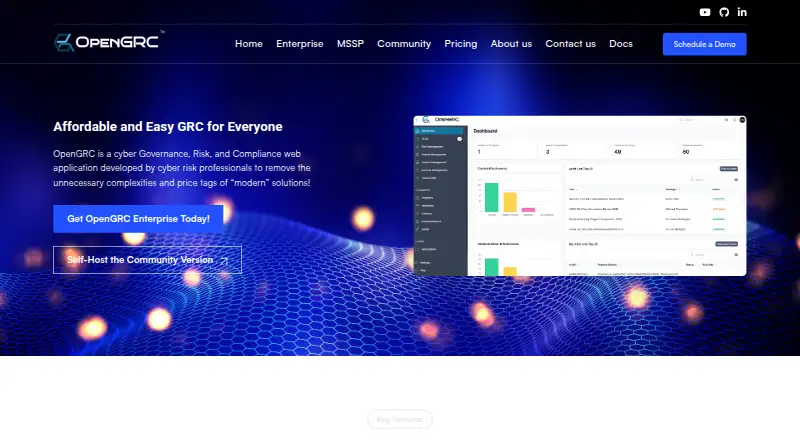
What OpenGRC is
OpenGRC is a web application for cyber governance, risk, and compliance, intended for small and midsized businesses and teams. It covers risk management, controls and implementations, audits, vendor management, incident response, and project management. Audit functions support evidence requests, progress tracking, and report generation. Vendor assessments include a dedicated portal, customizable questionnaires, and weighted scoring. Listed frameworks include NIST 800-171, ISO 27001, SOC 2, CMMC, and PCI DSS. The Enterprise tier adds AI risk assessments, automated vendor survey responses, and AI gap assessments. The platform has no third-party integrations built in, but provides a REST API, limited to 60 requests per minute per user or per IP for unauthenticated requests. Community is free and self-hosted, requiring a web server and database server; installation and upkeep require some technical knowledge. Enterprise Basic costs $4,500/year and Enhanced costs $7,500/year. Hosted plans state a 99.5% monthly uptime commitment and that customer data is not used to train AI models. The maker identifies itself as OpenGRC, LLC.
Who it suits
OpenGRC is intended for small and midsized businesses and teams managing cyber risk, compliance, audits, and vendors. Community may suit technically capable users who can operate a web server and database server.
What it does well
- Covers risk, controls, audits, vendors, and incident response.
- Vendor assessments include questionnaires and weighted scoring.
- Community edition is free and self-hosted.
- Hosted plans state a 99.5% monthly uptime commitment.
What to know first
- Community setup and maintenance require technical knowledge.
- No third-party integrations are built into the platform.
- REST API is limited to 60 requests per minute.
Limits
Community is self-hosted and requires a web server, a database server, and technical knowledge for installation and maintenance. The REST API allows 60 requests per minute per user, or per IP address for unauthenticated requests.
Plans
| Plan | Billed and limits | Price |
|---|---|---|
| Community Package | Free · Self-hosted · full source access · unlimited users and data · community support | Free |
| Community | Free · Self-hosted · full source code access · community support | Free |
| MSSP 11-20 | $1,000 license / quarter · 11-20 client deployments · isolated instances per client | $1,000 |
| MSSP 1-10 | $1,125 license / quarter · 1-10 client deployments · isolated instances per client | $1,125 |
| Enterprise Basic | $4,500 /year · Unlimited internal users · unlimited frameworks · unlimited vendors and applications · AI assessments · MCP integration · dashboards/reports · email support with 24-hour response · hosted | $4,500 a year |
| Enterprise Enhanced | $7,500 /year · Everything in Basic · onboarding training · SMB risk assessment · initial consulting · real-time chat · premium hosting and updates | $7,500 a year |
| MSSP 21-30 | $875 license / quarter · 21-30 client deployments · isolated instances per client | $875 |
As opengrc.com lists them, read 15 Oct 2026. The maker's own page has the final word.
Getting started
- Visit the OpenGRC website
- Choose the free self-hosted Community edition or an Enterprise plan
- For Community, run a web server and database server
- Use the REST API for integrations; the API limit is 60 requests per minute per user
Overview
OpenGRC is a cyber governance, risk and compliance application for small and midsized businesses. It is best suited to teams that want compliance, audit and vendor work in a shared system and can manage a self-hosted installation or pay for Enterprise. Its breadth is useful, but Community requires technical upkeep and the API is rate-limited.
Key features
OpenGRC combines risk management, controls and implementations, audits, vendor management, incident response and project management. It supports NIST 800-171, ISO 27001, SOC 2, CMMC and PCI DSS, with control mapping, evidence collection, risk assessments and remediation workflows. That makes it a practical fit for teams coordinating several compliance activities, rather than those looking for a single-purpose audit tool.
Audit management covers evidence requests, progress tracking and report generation, helping teams follow audit work through to reporting. Vendor Management adds a dedicated portal, customizable questionnaires and weighted scoring, giving supplier assessments a repeatable process. Enterprise adds AI risk assessments, automated vendor survey responses and AI gap assessments; its MCP server works with compatible clients such as Claude, ChatGPT and Cursor, using OAuth 2.1 authentication.
There are no third-party integrations built into the platform. The REST API offers a way to connect other systems, but its limit of 60 requests per minute per user—or per IP address for unauthenticated requests—may constrain frequent automation. Hosted plans state a 99.5% monthly uptime commitment, encryption in transit and at rest, instance-specific data keys and an annual independent SOC 2 Type II examination. OpenGRC also says hosted customer data is not used to train AI models.
Pricing
Community is free and self-hosted, with full source code access and community support. It may suit technically capable teams that can run and maintain a web server and database server. Installation and upkeep require some technical knowledge, and the license is Creative Commons Attribution-NonCommercial-ShareAlike 4.0, with stated exceptions for earlier code and certain commercial use; organizations should check that the terms fit their use.
Enterprise Basic costs $4,500 /year and includes unlimited internal users, frameworks, vendors and applications, plus email support with a 24-hour response. It is the clearer fit for teams that need hosted Enterprise service and predictable support without the additional Enhanced services.
Enterprise Enhanced costs $7,500 /year. It includes Basic features, onboarding training, an SMB Risk Assessment, additional real-time chat support, premium hosting and regular updates. Those additions may suit teams seeking more support during setup and ongoing operation; the higher annual price is harder to justify if those services are unnecessary. OpenGRC's pricing model is freemium, with paid plans from $875, but the two named Enterprise plans are priced at $4,500 /year and $7,500 /year.
Platforms
OpenGRC is available on the web, through self-hosting, and via an API. Community requires users to operate the web and database servers themselves. The API limit of 60 requests per minute per user, or per IP for unauthenticated requests, is worth factoring in before building integrations around frequent calls.
Who it's for
OpenGRC is a reasonable choice for small and midsized businesses that need risk, controls, audits, vendor assessments and incident response in one application. Community is most appropriate when a team has the technical capacity to host and maintain it and the license fits its use. Teams that want hosting, support or AI features should consider Enterprise; those dependent on ready-made third-party integrations should look elsewhere or assess whether the API limit works for their needs.
Pros and cons
- Broad GRC coverage: Risk, controls, audits, vendors, incidents and projects sit alongside support for five named frameworks.
- Structured audit and supplier work: Evidence tracking and reporting pair with vendor questionnaires, a portal and weighted scoring.
- Free self-hosted edition: Community provides full source code access, but requires server operation, technical maintenance and attention to license terms.
- Limited integration options: There are no built-in third-party integrations, and API traffic is capped at 60 requests per minute per user or unauthenticated IP.
- Paid support and AI capabilities: Enterprise adds support tiers and AI tools, at annual prices of $4,500 and $7,500 for the named plans.
Alternatives
CISO Assistant is worth comparing for teams seeking a freemium, self-hosted option with a free Community plan for unlimited users and community support.
ComplianceOS may suit teams prioritizing a Community edition described as fully open source under MIT, with 30+ frameworks and 1000+ pre-built controls.
Strike Graph offers a free Launch plan focused on SOC 2 security TSC, limited policy templates and cloud-provider options paired with Microsoft Office or Google Drive.
NAVEX EthicsPoint Incident Management is an alternative for organizations focused on incident management.
AssurX QMS is another paid option for teams considering a quality management system.
PowerDMS Policy is an alternative for teams focused on policy management.
Riskonnect is another paid risk-management option.
AuditBoard (now Optro) is an alternative for teams seeking audit management with unlimited stakeholder licenses and plans tailored to business needs.
Browse Compliance Management Software or Governance, Risk and Compliance Software for more options.
Verdict
Choose OpenGRC if your small or midsized business wants broad GRC coverage in one system and can either handle Community hosting or budget for Enterprise. Its strongest case is the combination of audit, vendor, risk and compliance workflows; look elsewhere if you need built-in integrations or cannot accommodate its API ceiling and Community maintenance demands.
Verdict
OpenGRC brings several GRC functions into one web application, with a free self-hosted Community edition and paid Enterprise options. Consider the technical requirements and API limit if planning to use Community or connect other systems.
Questions
Is OpenGRC free?
Yes. Community is listed as free and is billed Free. Enterprise Basic is $4,500 a year, and Enterprise Enhanced is $7,500 a year.
What does Community include?
Community is self-hosted, includes full source code access, and has community support. It requires a web server and database server.
What platforms can I use?
OpenGRC lists API, self-hosted, and web platforms.
Does OpenGRC have third-party integrations?
It has no third-party integrations built into the platform, but it provides a REST API.
What AI features are included?
Enterprise includes AI risk assessments, automated vendor survey responses, and AI gap assessments.
What license does OpenGRC use?
The documentation lists a Creative Commons Attribution-NonCommercial-ShareAlike 4.0 license, with stated exceptions for earlier code and certain commercial use.
Facts from OpenGRC's own pages
- AI data policy
- The company says customer data and subprocessors’ processing are not used to train or improve AI models. · opengrc.com, 15 Oct 2026
- AI data use
- OpenGRC states that it does not use hosted-plan customer data to train AI models. · opengrc.com, 30 Sept 2026
- AI gap assessment
- Enterprise AI gap assessment evaluates control effectiveness and prioritizes improvements. · opengrc.com, 15 Oct 2026
- AI integrations
- The Enterprise MCP server supports compatible clients including Claude, ChatGPT, and Cursor, with OAuth 2.1 authentication. · docs.opengrc.com, 30 Sept 2026
- AI risk assessment
- Enterprise Assessor analyzes an organization’s environment, technology stack and implementations against industry risk profiles. · opengrc.com, 15 Oct 2026
- AI tools
- Enterprise includes AI risk assessments, automated vendor survey responses, and AI gap assessments. · opengrc.com, 30 Sept 2026
- API limits
- The REST API is limited to 60 requests per minute per user, or per IP address for unauthenticated requests. · docs.opengrc.com, 30 Sept 2026
- API permissions
- API operations enforce role permissions and return authorization errors when a token lacks the required permission. · docs.opengrc.com, 15 Oct 2026
- Audit management
- The platform creates audits around standards, implementations and programs, assigns evidence and produces reports. · opengrc.com, 15 Oct 2026
- Authentication integrations
- Documentation describes SSO through Microsoft Entra ID, Okta, Google Workspace and Auth0 with automatic user provisioning. · docs.opengrc.com, 15 Oct 2026
- Automated surveys
- Surveyor reads uploaded vendor questionnaires and drafts answers from controls, policies and implementations already in the portal. · opengrc.com, 15 Oct 2026
- Automation engine
- The platform can trigger scheduled or record-change automations performing record changes, tasks, notifications, webhooks, reports, AI steps or waits. · opengrc.com, 15 Oct 2026
- Availability commitment
- Hosted plans commit to 99.5% monthly uptime excluding scheduled maintenance. · opengrc.com, 15 Oct 2026
- Community hosting
- The Community edition is web-based and requires the user to run a web server and database server. · docs.opengrc.com, 30 Sept 2026
- Community limitation
- The maker says Community installation and maintenance require some technical knowledge. · docs.opengrc.com, 30 Sept 2026
- Company
- The maker identifies itself as OpenGRC, LLC and says OpenGRC started as a side project in December 2024. · opengrc.com, 30 Sept 2026
- Company founding
- OpenGRC says it began as a side project in December 2024. · opengrc.com, 15 Oct 2026
- Company profile
- LinkedIn lists OpenGRC in computer and network security, headquartered in Casselberry, Florida, with one employee. · linkedin.com, 15 Oct 2026
- Compliance and frameworks
- Users can import common frameworks and connect standards, controls and their implementations. · docs.opengrc.com, 15 Oct 2026
- Founded
- 2025 · opengrc.com, 28 Sept 2026
- GRC features
- The platform includes risk management, controls and implementations, audits, vendor management, incident response, and project management. · opengrc.com, 30 Sept 2026
- Incident response
- Incident response includes playbooks, timelines, tasks, findings, lessons learned and reports. · opengrc.com, 15 Oct 2026
- Independent listing status
- AlternativeTo reports no comments or reviews and classifies OpenGRC as freemium, source-available Elastic-2.0 software available as SaaS, online, self-hosted or Docker. · alternativeto.net, 15 Oct 2026
- Installation
- Installation supports Docker or install.sh; production deployments require a queue worker for email, imports and scheduled jobs. · docs.opengrc.com, 15 Oct 2026