Freedom251 › AI SQL Generators
SQLer
What SQLer is
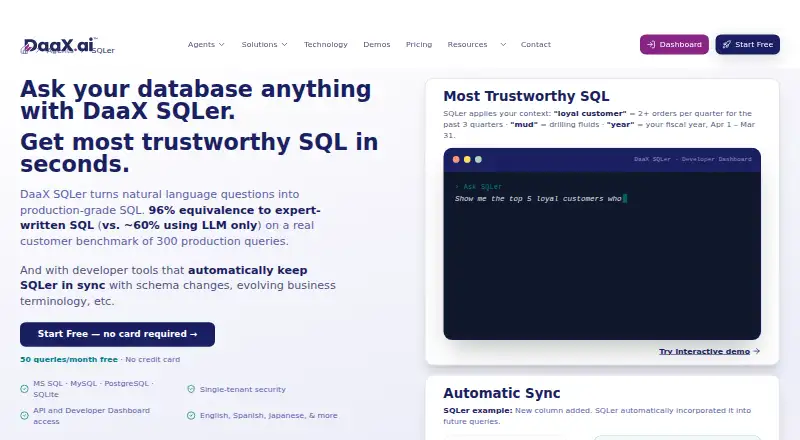
SQLer turns natural-language questions into SQL for relational databases, so developers can let an application translate user questions into queries. It lists support for MS SQL, MySQL, PostgreSQL, and SQLite, and is available through web and API platforms. Developers can provide company vocabulary, business rules, schema descriptions, and examples that pair questions with SQL to guide generation. Schema information can be set up through a direct connection, GATHERer, or manual upload of SQL DDL files, then refreshed as database schemas and metadata change. GATHERer runs as a Kubernetes container in the customer’s application environment and can transfer setup information to SQLer with developer permission. SQLer generates SQL for the application to execute; the product page says results remain in the customer’s environment and lists single-tenant security. DaaX reports 96% equivalence to expert-written SQL on a customer benchmark of 300 production queries. The free plan includes 50 NL2SQL queries per month. Paid plans start at $199 a month for 2,500 total NL2SQL queries, with higher listed tiers at 399.00 USD and $899 a month. DaaX describes itself as an AI startup headquartered in Silicon Valley.
Who it suits
SQLer suits developers building applications that need to translate natural-language questions into queries across supported relational databases. It may also fit teams that want to guide SQL generation with their own vocabulary, business rules, schema details, and examples.
What it does well
- Supports MS SQL, MySQL, PostgreSQL, and SQLite.
- Accepts company vocabulary, business rules, schema descriptions, and examples.
- Offers direct connection, GATHERer, and manual DDL upload for schema setup.
- Lists single-tenant security and says results remain in the customer’s environment.
- Includes a free plan with 50 NL2SQL queries per month.
What to know first
- The free plan is limited to 50 NL2SQL queries per month.
- Schemas split across databases require separate queries for each database.
- Paid plans start at $199 a month.
Limits
The free plan allows 50 NL2SQL queries per month. The lowest paid plan, Lift-Off, costs $199 a month and allows 2,500 total NL2SQL queries per month.
Plans
| Plan | Billed and limits | Price |
|---|---|---|
| Free | $0/month · 50 NL2SQL queries per month | Free |
| Lift-Off | $199/month · 2,500 total NL2SQL queries per month | $199 a month |
| Growth | $399/month · 6,000 NL2SQL queries per month | $399 a month |
| Turbo | $899/month · 15,000 NL2SQL queries per month | $899 a month |
| Custom | Contact Us · Custom query allowance | On request |
As daax.ai lists them, read 7 Oct 2026. The maker's own page has the final word.
Getting started
- Visit the SQLer website.
- Choose web or API access.
- Set up schema information through a direct connection, GATHERer, or manual SQL DDL upload.
- Provide company vocabulary, business rules, schema descriptions, and question-to-SQL examples as needed.
- Refresh schema information through GATHERer, Direct Connection, or Manual Upload when schemas or metadata change.
SQLer is an application-facing service that translates natural-language questions into SQL for relational databases. It suits developers building a governed text-to-query layer who can maintain schema and business context. Its strongest case is context-rich generation with tenant isolation; monthly query quotas and split-database handling are the important constraints.
Overview
SQLer comes from DaaX, a Silicon Valley AI startup, and supports MS SQL, MySQL, PostgreSQL and SQLite across four SQL dialects. DaaX reports 96% equivalence to expert-written SQL on a customer benchmark of 300 production queries. That is a useful quality signal, but teams should still validate generated statements against their own data models and business rules.
Developers can add company vocabulary, business rules, schema descriptions and question-to-SQL examples. This makes the service more suitable for domain-specific terminology than a generic prompt box. SQLer generates SQL for the customer application to execute, while results remain in the customer environment. Single-tenant security is listed for deployments where isolation matters.
Key features
Schema and context management
Schema information can be established through a direct connection, the GATHERer Kubernetes container or manual SQL DDL upload. GATHERer runs in the customer’s application environment and can transfer gathered setup information to SQLer with developer permission, reducing the need to move setup-collection activity outside that environment. Developers can refresh the setup through GATHERer, Direct Connection or Manual Upload as schemas and metadata change. That maintenance path is valuable for production applications, where stale definitions can undermine otherwise accurate generation.
Application workflow and security
SQLer returns SQL rather than executing queries itself; the surrounding application controls execution, and query results stay in the customer environment. This separation fits teams that already have their own authorization, logging and execution layers. Single-tenant security adds an isolation option, although the product still requires separate queries when a schema is split across separate databases. It is therefore a poor fit for workflows that need one generated statement to join data across database boundaries.
Developer resources
Documentation, a REST API reference, a developer dashboard sandbox and a community forum support implementation. The API and sandbox are particularly relevant when SQLer is being embedded into an existing product rather than used as a standalone analyst tool.
Pricing
SQLer uses monthly query allowances rather than seat-based prices. The Free plan costs nothing (billed $0/month) and includes 50 NL2SQL queries per month. It is suitable for proof-of-concept work or a small, low-volume integration, but the cap can be reached quickly in an active application.
Lift-Off costs $199 a month (billed $199/month) for 2,500 total NL2SQL queries per month. Growth is $399 a month (billed $399/month) for 6,000 queries, while Turbo is $899 a month (billed $899/month) for 15,000. Those tiers provide progressively more headroom for production traffic; the cheaper tiers give up capacity rather than a stated feature set. Custom has custom query allowance and custom pricing (billed Contact Us), making it the route for requirements beyond the published quotas.
Platforms
SQLer is offered through an API and web interface. The API orientation favors teams integrating generation into their own applications, while the web option provides a direct workspace for setup and evaluation.
Who it's for
Choose SQLer when developers can supply reliable schema information and business rules, need natural-language input inside an application, and value customer-environment execution with single-tenant isolation. It is less suitable for casual, high-volume querying on the free tier or for systems whose data model spans separate databases and requires cross-database queries.
Pros and cons
- Pros: Four listed SQL dialects cover common relational systems; business vocabulary, rules and examples let teams tailor generation; three schema-ingestion and refresh methods support different deployment practices; SQL execution and results remain in the customer environment; single-tenant security addresses isolation needs.
- Cons: The Free plan allows only 50 queries per month; paid plans start at $199 per month; quotas are fixed by tier; split schemas require separate queries for each database; the benchmark result is a vendor-reported signal rather than a guarantee for every workload.
Alternatives
For a free, open-source local installation, choose Natural Language SQL, which runs on API, Linux, macOS, self-hosted and web platforms. Outerbase AI is a better match if you want a freemium workspace with a free tier for up to five users, one base and ten EZQL queries per month. Choose NatureQuery for a $0 plan with 50 queries per month, one database connection, exports and 30-day history.
QueryPlane fits self-hosted or web deployments needing up to three apps and 50 AI prompts monthly on its free tier. Savvina AI offers a free community tier for one user with PostgreSQL and MySQL support. Choose SQL Mocker when a web-based tool with 50 total AI queries and five saved projects is enough. Wren AI is an alternative with a free open-source context engine for individual developers. IDERA AI SQL Query Generator is a free web option.
See the broader AI SQL Generators list for more choices.
Verdict
SQLer is a strong choice for developers embedding natural-language-to-SQL into applications that can provide detailed business and schema context. Its multi-dialect support, refreshable schema setup and customer-environment execution are the main reasons to choose it. Look elsewhere if monthly quotas do not fit your traffic or if one query must span separate databases.
Verdict
Choose SQLer if an application needs natural-language-to-SQL generation and you want to supply business and schema context. Its free plan provides 50 queries per month, while paid plans add larger monthly allowances. Look elsewhere if a schema spanning separate databases must be queried in a single query.
Questions
Is SQLer free?
Yes. Its Free plan costs nothing and includes 50 NL2SQL queries per month.
What do paid plans cost?
Lift-Off is $199 a month for 2,500 total queries, Growth is $399 a month for 6,000, and Turbo is $899 a month for 15,000. Custom pricing is listed as Contact Us.
Which databases does SQLer support?
It lists MS SQL, MySQL, PostgreSQL, and SQLite.
Which platforms can I use?
SQLer lists web and API platforms.
How does SQLer handle query results and security?
SQLer generates SQL for the customer’s application to execute. Its product page says results remain in the customer’s environment and lists single-tenant security.
Who makes SQLer?
DaaX describes itself as an AI startup headquartered in Silicon Valley and gives an address in Santa Clara, California.
Facts from SQLer's own pages
- Benchmark claim
- DaaX reports 96% equivalence to expert-written SQL on a customer benchmark of 300 production queries. · daax.ai, 7 Oct 2026
- Business context
- Developers can provide company vocabulary, business rules, schema descriptions, and question-to-SQL examples to guide generation. · daax.ai, 7 Oct 2026
- Company
- DaaX describes itself as an AI startup headquartered in Silicon Valley and gives an address in Santa Clara, California. · daax.ai, 7 Oct 2026
- Database support
- The product page lists MS SQL, MySQL, PostgreSQL, and SQLite. · daax.ai, 7 Oct 2026
- GATHERer
- GATHERer is a Kubernetes container that runs in the customer's application environment and can transfer gathered setup information to SQLer with developer permission. · daax.ai, 7 Oct 2026
- Headquarters
- Silicon Valley, United States · daax.ai, 28 Sept 2026
- Limits
- When a schema is split across separate databases, the page says SQLer requires separate queries for each database. · daax.ai, 7 Oct 2026
- Purpose
- SQLer turns natural-language questions into SQL for relational databases. · daax.ai, 7 Oct 2026
- Query handling
- SQLer generates SQL for the user's application to execute, and the page says results remain in the customer's environment. · daax.ai, 7 Oct 2026
- Schema maintenance
- Developers can refresh setup information using GATHERer, Direct Connection, or Manual Upload as database schemas and metadata change. · daax.ai, 7 Oct 2026
- Schema setup
- SQLer supports direct connection, GATHERer, or manual upload of SQL DDL files to set up schema information. · daax.ai, 7 Oct 2026
- Support and resources
- SQLer lists documentation, a REST API reference, a developer dashboard sandbox, and a developer community forum. · daax.ai, 7 Oct 2026
- Tenant security
- The product page lists single-tenant security. · daax.ai, 7 Oct 2026
Where SQLer stands on Freedom251
- AI SQL Generators#8 of 19