Freedom251 › Competitor Price Monitoring Software
SpotRival
What SpotRival is
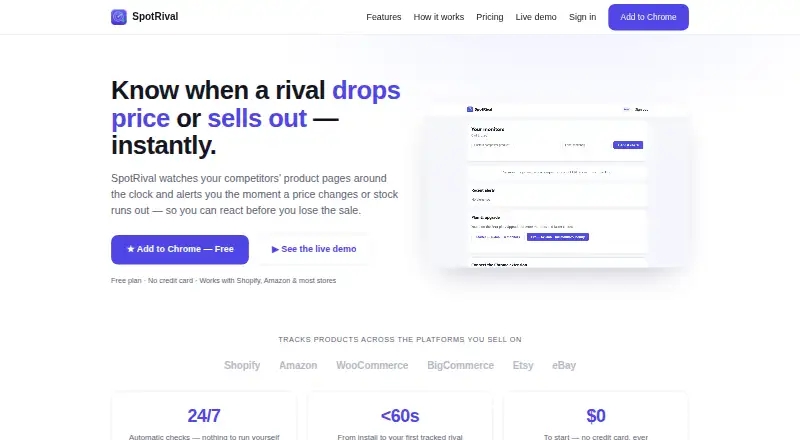
SpotRival helps ecommerce sellers monitor competitors’ product pages for price and stock changes. It sends email and browser alerts when prices change, products sell out, or stock returns; price alerts include the percentage change. It also shows price history over time. Users can begin monitoring from a competitor product page with “Watch this page,” or request a check at any time using “Check now.” Shopify and Amazon work out of the box, and the service supports many standard storefronts, including BigCommerce, WooCommerce, and Squarespace. SpotRival is available as a Chrome extension and on the web, where users can sign in with an email link. It reads publicly visible product pages and does not access private data or log in to sites on a user’s behalf. The Free plan includes three monitors and daily checks. Starter costs $9/mo for 25 monitors and checks every six hours; Pro costs $29/mo for 150 monitors and hourly checks, and adds CSV export to price history.
Who it suits
SpotRival suits ecommerce sellers and small store operators who want to track competitor pricing and stock status across supported storefronts.
What it does well
- Alerts on price changes, sellouts, and restocks.
- Price alerts show the percentage change.
- Includes price history for monitored products.
- Shopify and Amazon work out of the box.
- Manual checks are available at any time.
What to know first
- Free plan allows only three monitors.
- Free plan checks products daily.
- Product matching is manual.
Limits
The Free plan includes 3 monitors and daily checks. Starter, the cheapest paid plan at $9/mo, includes 25 monitors and checks every 6 hours.
Plans
| Plan | Billed and limits | Price |
|---|---|---|
| Free | $0/mo · 3 monitors · Daily checks · Email & browser alerts · Price history | Free |
| Pro | $29/mo · 150 monitors · Hourly checks · Email & browser alerts · Price history + CSV export | $29 a month |
| Starter | $9/mo · 25 monitors · Checks every 6 hours · Email & browser alerts · Price history | $9 a month |
As spotrival.com lists them, read 30 Sept 2026. The maker's own page has the final word.
Getting started
- Open spotrival.com or install the Chrome extension.
- On the web, sign in with an email link.
- Visit a competitor product page and use “Watch this page” to start tracking.
- Choose Free, Starter, or Pro based on monitor capacity and check frequency.
SpotRival is a competitor product-page monitor for ecommerce sellers and small store operators. It suits businesses that need focused price and availability signals on rival products rather than a broad market-intelligence suite. Its free tier is a sensible way to start, while faster checks and larger watchlists require a paid plan.
Overview
SpotRival lets you begin monitoring directly from a rival product page with its “Watch this page” action. It then reports price changes, sellouts, and restocks. Price alerts arrive by email and browser notification and show the percentage change, giving a quick sense of whether a movement is minor or commercially significant. A price-history view adds context by showing how the competitor’s price has changed over time.
The service reads publicly visible product pages. It does not access private data or sign in to sites on your behalf, which makes its scope clear but also means it is not a tool for authenticated or back-office competitor data. Shopify and Amazon work out of the box, with support for many standard storefronts such as BigCommerce, WooCommerce, and Squarespace. Product matching is manual, so you choose the exact pages to watch rather than relying on automatic matching.
Key features
- Price and stock monitoring: Email and browser alerts cover price changes, competitor sellouts, and restocks. That combination is useful when both pricing decisions and availability affect your response.
- Percentage-change alerts: Showing the size of a price move makes each notification more actionable than a simple “changed” message.
- Price history: Historical movement helps you tell a one-off adjustment from a recurring pattern before changing your own price.
- Manual checks: “Check now” lets you request an update between scheduled checks, although it does not replace a plan with frequent automatic checking for time-sensitive markets.
- Broad storefront support: Shopify and Amazon are supported out of the box, and compatibility extends to common platforms including BigCommerce, WooCommerce, and Squarespace.
- Public-page monitoring: Reading visible pages avoids the need to hand over rival-store credentials, while limiting monitoring to information exposed to ordinary visitors.
Pricing
SpotRival uses a freemium model. The Free plan costs $0 per month and includes three monitors, daily checks, email and browser alerts, and price history. It is appropriate for a small shop testing the workflow or tracking a handful of critical rivals, but three products is a tight ceiling and daily refreshes can miss rapid repricing.
Starter costs $9 per month. It raises capacity to 25 monitors and checks every six hours, while retaining email and browser alerts and price history. This is the practical entry point for a small catalog that needs several updates per day, though it still may be slow for highly volatile categories.
Pro costs $29 per month and supports 150 monitors with hourly checks. It includes the same alert channels and history plus CSV export, making it the better fit for a larger watchlist or teams that need to work with monitoring data outside the service. The published plans do not describe extra seats, so buyers should assess the offering as a monitor-based subscription rather than assume multi-user allowances.
Platforms
SpotRival is available as a Chrome extension and on the web. The extension supports starting a watch from a product page, while web access begins with an email sign-in link. Its stated retail compatibility includes Shopify, Amazon, BigCommerce, WooCommerce, and Squarespace.
Who it's for
SpotRival is aimed at ecommerce sellers and small store operators who already know which competitor products matter. The Free plan fits exploratory monitoring; Starter suits a small operating catalog; Pro is aimed at broader coverage and hourly visibility. Manual product matching makes it less suitable for businesses wanting automated competitor discovery or hands-off catalog mapping.
Pros and cons
Pros
- Useful signal mix: Price, sellout, and restock alerts cover the changes most likely to affect competitive decisions.
- Clear price context: Percentage changes and history make alerts easier to interpret.
- Low-risk entry: A free plan provides three monitors without a subscription commitment.
- Credential-free scope: Public-page reading avoids logging into competitor stores.
- Practical upgrade path: Capacity grows from three to 25 to 150 monitors, with hourly checks and CSV export at Pro.
Cons
- Manual matching: Users must identify and add the right rival pages themselves.
- Slowest free refresh: Daily checks can be insufficient for fast-moving prices.
- Small free quota: Three monitors limits ongoing coverage to a narrow set of products.
- Browser emphasis: The listed access is Chrome extension and web, with no stated native mobile application.
Alternatives
Competitor Price Monitoring Software is the broader list to consult when you want to compare several monitoring products.
- ShopSavvy is a better choice for price comparison across mobile, browser, and desktop platforms, with price history and price-drop alerts.
- CompeteTracker suits readers who want competitor-count plans, including a free three-competitor tier and paid 10- or higher-competitor options.
- Pricefy is preferable when SKU limits, competitor discovery, AI Automatch, and feed channels matter more than SpotRival’s page-based workflow.
- Priceva fits users seeking published price-check, competitor, region, product, and user allowances, including a free starter tier.
- Retailgrid is aimed at grid-based retail data workflows, starting with a freemium plan capped at 500 grid rows and seven-day retention.
- SimplePriceMonitor is a narrower option for five products, three competitors per product, daily checks, email alerts, and seven-day history on its free plan.
- VantageDash is worth considering for trend analytics and basic product matching, with a free Scout plan covering two competitors and 50 products.
- Scout provides a one-time competitive pricing snapshot rather than continuous monitoring.
Verdict
Choose SpotRival if you are an ecommerce seller who wants dependable price and stock alerts for a defined set of public competitor pages, with a free way to start and straightforward upgrades. Its strongest reason to choose it is the combination of percentage-based alerts, stock events, history, and manual checks across common storefronts. Look elsewhere if you need automated product matching, mobile-native access, or faster and wider coverage than its monitor quotas and plan-based refresh intervals provide.
Verdict
SpotRival focuses on competitor price and stock monitoring, with alerts and price history. Choose a plan based on how many products you need to watch and how often they should be checked.
Questions
Does SpotRival have a free plan?
Yes. Free includes 3 monitors, daily checks, email and browser alerts, and price history.
How much do the paid plans cost?
Starter costs $9/mo and Pro costs $29/mo. Starter includes 25 monitors and checks every 6 hours; Pro includes 150 monitors and hourly checks.
Which platforms can I use?
SpotRival is available as a Chrome extension and on the web. Web sign-in uses an email link.
Which storefronts does it support?
Shopify and Amazon work out of the box. The site also says it supports standard storefronts including BigCommerce, WooCommerce, and Squarespace.
How does SpotRival track products?
Use “Watch this page” on a competitor product page. You can also trigger a manual “Check now” at any time.
Does it log into competitor sites?
No. SpotRival says it reads publicly visible product pages and does not access private data or log into sites on your behalf.
Facts from SpotRival's own pages
- Browser
- The product is offered as a Chrome extension, and users can also get started on the web with an email sign-in link. · spotrival.com, 30 Sept 2026
- Intended users
- The site presents SpotRival as a competitor-monitoring tool for ecommerce sellers and small store operators. · spotrival.com, 30 Sept 2026
- Manual check
- Users can trigger a “Check now” at any time. · spotrival.com, 30 Sept 2026
- Page access
- SpotRival says it reads publicly visible product pages and does not access private data or log into sites on the user’s behalf. · spotrival.com, 30 Sept 2026
- Price alerts
- Price alerts arrive by email and browser notification and include the percentage change. · spotrival.com, 30 Sept 2026
- Price history
- SpotRival shows how a competitor’s price has moved over time. · spotrival.com, 30 Sept 2026
- Purpose
- SpotRival watches competitors’ product pages and alerts users when prices change or stock runs out. · spotrival.com, 30 Sept 2026
- Stock alerts
- Stock alerts cover when a competitor sells out or restocks. · spotrival.com, 30 Sept 2026
- Store compatibility
- The site says Shopify and Amazon work out of the box, with support for many standard storefronts including BigCommerce, WooCommerce, and Squarespace. · spotrival.com, 30 Sept 2026
- Support contact
- The site lists [email protected] as its contact email. · spotrival.com, 30 Sept 2026
- Tracking
- Users can start tracking a competitor product from its page with the “Watch this page” action. · spotrival.com, 30 Sept 2026
Where SpotRival stands on Freedom251
- Competitor Price Monitoring Software#11 of 39