Freedom251 › Competitor Price Monitoring Software
SimplePriceMonitor
What SimplePriceMonitor is
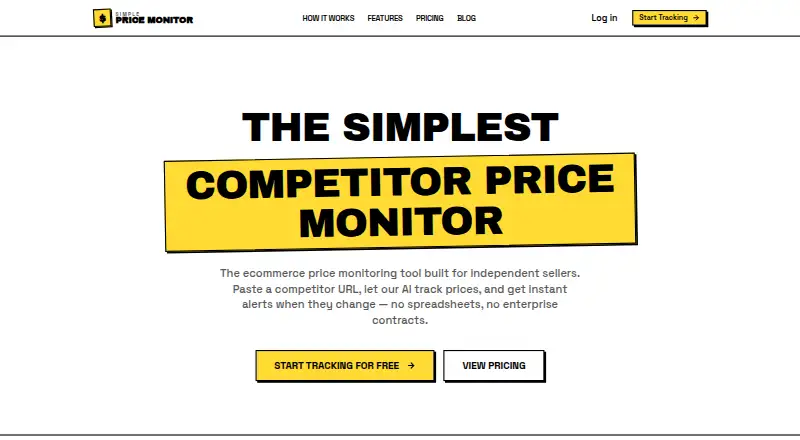
SimplePriceMonitor helps independent sellers track competitor prices across publicly accessible product pages. To add a product, users paste a competitor URL; the service says its AI extracts the price without CSS selectors, catalog imports, or configuration. It supports pages including Amazon, Shopify stores, WooCommerce sites, and brand direct-to-consumer stores. Email or Slack alerts can report price changes, with custom thresholds, and charts show price trends over time. The maker describes its extraction as LLM-based and says headless browser rendering handles JavaScript-heavy pages. The homepage says checks happen up to four times daily, while the Business plan lists hourly checks. The Free plan costs nothing and covers five products, three competitors per product, daily checks, email alerts, seven-day history, and CSV export. Paid plans begin with Starter at $19 a month; Business costs $79 a month and includes 500 products, hourly checks, API access, and one-year history. The product is from Hexora Digital, an AI product studio based in Sri Lanka.
Who it suits
It suits independent sellers and ecommerce businesses that want to monitor competitor listings and receive price-change alerts. Free is limited to five products; larger listed plans provide higher product limits and more frequent checks.
What it does well
- Add products by pasting competitor URLs.
- Monitors several types of public product pages.
- Email or Slack price alerts with custom thresholds.
- Price-history charts show trends.
- Business plan includes API access.
What to know first
- Free plan is limited to five products.
- Free plan checks daily and keeps seven-day history.
- Hourly checks are listed only on Business.
Limits
The free plan covers five products, allows three competitors per product, checks once daily, and keeps seven days of history. Paid plans start at $19 per month; Business costs $79 per month and includes 500 products, hourly checks, three seats, API access, and one-year history.
Plans
| Plan | Billed and limits | Price |
|---|---|---|
| Free | 5 products · 3 competitors / product · Daily (1×) checks · Email alerts · 7-day history · CSV export | Free |
| Starter | $19/month · 25 products · 5 competitors / product · 2× daily checks · Slack alerts · 30-day history | $19 a month |
| Pro | $39/month · 100 products · Unlimited competitors · 4× daily checks · Weekly digest email · Priority scraping queue | $39 a month |
| Business | $79/month · 500 products · Unlimited competitors · Hourly checks · Multi-user (3 seats) · API access · 1-year price history | $79 a month |
As simplepricemonitor.com lists them, read 7 Oct 2026. The maker's own page has the final word.
Getting started
- Open the SimplePriceMonitor website.
- Choose the Free plan or a paid plan.
- Paste a competitor product URL to begin monitoring it.
- Set custom thresholds for price change notifications.
- Use the web service or API where included in the plan.
SimplePriceMonitor is a URL-driven competitor price monitor for independent ecommerce sellers. It fits store owners who need focused tracking across public product pages rather than a full catalog-pricing suite. The main attraction is low-configuration monitoring; the main constraint is that inexpensive plans check only daily or a few times per day.
Overview
Setup is deliberately narrow: paste a competitor product URL and the service extracts the price without CSS selectors, catalog imports, or other configuration. That is a sensible workflow for a small shop choosing a defined set of rival listings, and it avoids maintaining scraping rules. It is less suited to retailers seeking a broad product-information or catalog-management system.
SimplePriceMonitor is made by Hexora Digital, an AI product studio in Sri Lanka. It runs through the web and an API, with plan capacity aimed at small store owners, serious sellers, and growing ecommerce brands. Publicly accessible pages are supported, including Amazon, Shopify, WooCommerce, and brand direct-to-consumer stores.
Key features
The maker says LLM-based extraction combined with headless-browser rendering handles JavaScript-heavy pages. That should make modern storefronts practical targets, while the public-page requirement means private, login-protected listings are outside the stated use case.
Price-change notifications arrive by email or Slack, and custom thresholds let a seller suppress minor movements and focus on commercially meaningful changes. Free includes email alerts; Slack starts with Starter. Charts show price trends over time, turning a single alert into some historical context. The lookback is seven days on Free, 30 days on Starter, and one year on Business.
Refresh speed is the key operational difference between tiers. Free checks once daily, Starter twice daily, and Pro four times daily; the homepage describes checks of up to four times daily, while Business provides hourly checks. A seller reacting to rapid repricing will therefore need Business rather than treating the free monitor as real-time intelligence. Product matching is automated, and Free also offers CSV export.
Pricing
| Plan | Price | Includes |
|---|---|---|
| Free | free | 5 products, 3 competitors per product, daily checks, email alerts, 7-day history, CSV export |
| Starter | $19 a month | 25 products, 5 competitors per product, twice-daily checks, Slack alerts, 30-day history |
| Pro | $39 a month | 100 products, unlimited competitors, four-times-daily checks, weekly digest email, priority scraping queue |
| Business | $79 a month | 500 products, unlimited competitors, hourly checks, three seats, API access, one-year history |
Free is appropriate for a very small watchlist and basic price signals, but five products and seven days of history leave little room for assortment-wide analysis. Starter is the practical entry point for a small store that needs 25 products and Slack, though its five-competitor cap and twice-daily cadence remain meaningful limits. Pro removes the competitor ceiling and raises capacity to 100 products, making it a better fit for a serious seller; its four daily checks are still not hourly. Business is aimed at a growing brand that needs 500 products, team access, API integration, and long-term trend records. Paid plans are billed monthly at the prices shown.
Platforms
SimplePriceMonitor is available on the web and through an API. API access is specifically included with Business, so lower tiers are primarily suited to browser-based workflows.
Who it's for
Choose it if you run an independent store, have a manageable list of public competitor URLs, and value quick setup over elaborate catalog configuration. Starter suits a small operation; Pro suits a larger watchlist with many rivals; Business suits teams and integrations that need hourly data and a year of history. It is not the obvious choice for anyone requiring sub-hourly monitoring, private-page tracking, or broad mobile and desktop app coverage.
Pros and cons
- Pros: URL-only setup avoids selectors and imports; headless rendering is intended for JavaScript-heavy pages; alerts support email, Slack, and thresholds; Pro and Business scale competitor and product capacity.
- Cons: Free is capped at five products, three competitors each, daily checks, and seven days of history; Starter still checks only twice daily; hourly monitoring and API access require the $79 Business plan; the published security page could not be opened.
Alternatives
Competitor Price Monitoring Software is the broader directory for comparing tools in this category.
ShopSavvy is a better fit when mobile, browser, and desktop access matter, with price comparison, history, and drop alerts on its free plan. Choose CompeteTracker for web monitoring with a free three-competitor allowance and annual billing options. Pricefy suits stores wanting up to 50 free SKUs, AI automatch, competitor discovery, and a feed channel. Priceva is worth considering for a larger free allowance of up to 20 products and 6,200 checks per month. Retailgrid targets grid-based workflows, starting with 500 rows on its free tier. SpotRival offers browser alerts and a $9 Starter plan for 25 monitors. VantageDash provides trend analytics with a free 50-product Scout tier. Scout is a paid service with a free one-time competitive pricing snapshot.
Verdict
SimplePriceMonitor is a strong match for independent sellers who want automated URL-based tracking without scraping configuration. Choose it for focused monitoring and straightforward alerting; look elsewhere if you need faster-than-hourly response, richer app coverage, or substantially broader free limits.
Verdict
SimplePriceMonitor focuses on competitor price tracking, with URL-based setup, alerts, and price-history charts. Check frequency, product capacity, and history length vary by plan.
Questions
Is SimplePriceMonitor free?
Yes. Its Free plan costs nothing and covers five products, three competitors per product, daily checks, email alerts, seven-day history, and CSV export.
How much do paid plans cost?
Starter costs $19 per month, Pro costs $39 per month, and Business costs $79 per month.
Which platforms are supported?
The listed platforms are web and API. The service can monitor publicly accessible product pages, including Amazon, Shopify stores, WooCommerce sites, and brand DTC stores.
How does product setup work?
Users paste a competitor product URL, and the service says its AI extracts the price without CSS selectors, catalog imports, or configuration.
Who makes SimplePriceMonitor?
The site identifies it as a product of Hexora Digital, which describes itself as an AI product studio based in Sri Lanka.
Which plan includes API access?
The Business plan includes API access. It costs $79 per month.
Facts from SimplePriceMonitor's own pages
- Alerts
- The service offers price change notifications by email or Slack and lets users set custom thresholds. · simplepricemonitor.com, 7 Oct 2026
- Business plan API
- The Business plan includes API access. · simplepricemonitor.com, 7 Oct 2026
- Extraction
- The site says its LLM-based extraction uses headless browser rendering to handle JavaScript-heavy pages. · simplepricemonitor.com, 7 Oct 2026
- Intended users
- The maker describes the product as built for independent sellers and lists plans for small store owners, serious sellers, and growing ecommerce brands. · simplepricemonitor.com, 7 Oct 2026
- Maker
- The site identifies SimplePriceMonitor as a product of Hexora Digital. · simplepricemonitor.com, 7 Oct 2026
- Maker location
- Hexora Digital describes itself as an AI product studio based in Sri Lanka. · hexoradigital.com, 7 Oct 2026
- Monitoring frequency
- The homepage says prices are checked up to four times daily, while its Business plan lists hourly checks. · simplepricemonitor.com, 7 Oct 2026
- Price history
- The product provides charts to track competitor price trends over time. · simplepricemonitor.com, 7 Oct 2026
- Purpose
- SimplePriceMonitor is an ecommerce competitor price monitoring tool built for independent sellers. · simplepricemonitor.com, 7 Oct 2026
- Security
- The product homepage links to a Privacy page, but that page could not be opened during this research. · simplepricemonitor.com, 7 Oct 2026
- Setup
- Users paste a competitor product URL and the AI extracts its price without CSS selectors, catalog imports, or configuration. · simplepricemonitor.com, 7 Oct 2026
- Supported pages
- The maker says it can monitor publicly accessible product pages, including Amazon, Shopify stores, WooCommerce sites, and brand DTC stores. · simplepricemonitor.com, 7 Oct 2026
Where SimplePriceMonitor stands on Freedom251
- Competitor Price Monitoring Software#10 of 39