Freedom251 › Statistical Analysis Software
SPM
by SPM
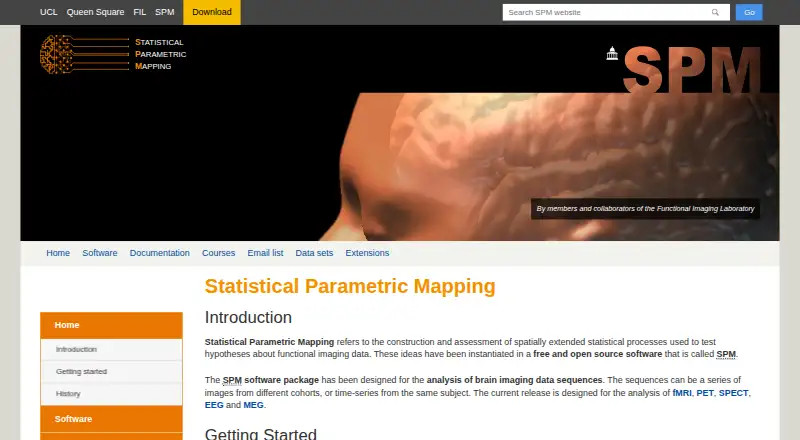
What SPM is
SPM is desktop software for analyzing sequences of brain imaging data, including images from different cohorts and time series from one subject. Its current release is designed for fMRI, PET, SPECT, EEG and MEG analysis. SPM implements methods for constructing and assessing spatially extended statistical processes to test hypotheses about functional imaging data. Listed capabilities include statistical tests, regression models, Bayesian analysis and scripting support. The software imports NIfTI (.nii), Analyze (.hdr/.img), OPM binary, TSV, JSON, FIF and LVM files; DICOM data is supported after conversion to NIfTI. SPM is open-source under the GPL-2.0 license and is written in MATLAB and C. The recommended installation is within MATLAB, with GNU Octave and precompiled Standalone SPM as alternatives. Standalone SPM does not require a MATLAB license and includes MATLAB Runtime, which requires about 2.5 GB. The SPM page lists version 25.01 as the latest release. Learning resources include online tutorials, datasets with analysis instructions, and courses online and in person. Community extensions are available as toolboxes, utilities, batch systems and templates, though the developers caution that some may be incompatible and do not guarantee their usability. SPM is free, with its plan listed as free. Its maker is SPM, based at UCL Queen Square Institute of Neurology in London, UK, and founded in 1991.
Who it suits
SPM suits researchers and analysts working with fMRI, PET, SPECT, EEG or MEG data who need statistical methods, scripting, regression or Bayesian analysis. It can also suit users who want a free, open-source desktop tool and can install it through MATLAB, GNU Octave or Standalone SPM.
What it does well
- Free and open-source under the GPL-2.0 license.
- Designed for fMRI, PET, SPECT, EEG and MEG analysis.
- Supports statistical tests, regression models and Bayesian analysis.
- Imports NIfTI, Analyze, OPM, TSV, JSON, FIF and LVM formats.
- Online tutorials, datasets and courses are available.
What to know first
- The recommended installation is within MATLAB.
- Standalone SPM includes MATLAB Runtime, requiring about 2.5 GB.
- Some community extensions may be incompatible, and usability is not guaranteed.
Limits
SPM is listed as free. Standalone SPM includes MATLAB Runtime, which requires about 2.5 GB; the listed facts do not specify a free-plan quota or feature cutoff.
Plans
| Plan | Billed and limits | Price |
|---|---|---|
| SPM | Free and open-source neuroimaging software | Free |
As fil.ion.ucl.ac.uk lists them, read 10 Oct 2026. The maker's own page has the final word.
Getting started
- Visit the SPM website.
- Choose an installation route: MATLAB, GNU Octave or precompiled Standalone SPM.
- For Standalone SPM, install its included MATLAB Runtime, which requires about 2.5 GB.
- Install SPM on Linux, macOS or Windows.
- Import a supported imaging format, converting DICOM to NIfTI first.
- Use the online tutorials and datasets with analysis instructions to get started.
Verdict
Choose SPM if you need free desktop software for statistical analysis of brain imaging data across its supported modalities and formats. Look elsewhere if the MATLAB-based installation options or the standalone runtime requirement do not suit your setup, or if you need community extensions with guaranteed compatibility.
Questions
How much does SPM cost?
SPM is free, with the plan listed as free. The facts also identify it as open-source software.
Which operating systems support SPM?
SPM is listed for Linux, macOS and Windows, with desktop deployment.
Which brain imaging modalities does SPM support?
The current release is designed for fMRI, PET, SPECT, EEG and MEG analysis.
What data formats can SPM import?
It accepts NIfTI (.nii), Analyze (.hdr/.img), OPM binary, TSV, JSON, FIF and LVM. DICOM is supported after conversion to NIfTI.
Does SPM require MATLAB?
The recommended installation is within MATLAB. Alternatives include GNU Octave and precompiled Standalone SPM, which can run without a MATLAB license and includes MATLAB Runtime.
Who makes SPM, and what license does it use?
SPM is the maker, based at UCL Queen Square Institute of Neurology in London, UK, and founded in 1991. The software is open-source under the GPL-2.0 license.
Facts from SPM's own pages
- Bayesian analysis
- Yes · fil.ion.ucl.ac.uk, 25 Sept 2026
- Current release
- The software page lists SPM 25.01 as the latest version. · fil.ion.ucl.ac.uk, 10 Oct 2026
- Data import formats
- NIfTI (.nii), Analyze (.hdr/.img), DICOM (converted to NIfTI), OPM binary/TSV/JSON, FIF and LVM · fil.ion.ucl.ac.uk, 25 Sept 2026
- Deployment
- desktop · fil.ion.ucl.ac.uk, 25 Sept 2026
- Development
- SPM development takes place on GitHub, where users can access development versions, report issues, request features and propose code changes. · fil.ion.ucl.ac.uk, 10 Oct 2026
- Extensions
- Community-created extensions are listed as toolboxes, utilities, batch systems and templates, and the SPM developers disclaim responsibility for their usability and warn that some may be incompatible. · fil.ion.ucl.ac.uk, 10 Oct 2026
- Founded
- 1991 · fil.ion.ucl.ac.uk, 19 Oct 2026
- Free plan
- Yes · fil.ion.ucl.ac.uk, 25 Sept 2026
- Implementation
- SPM is written in MATLAB and C. · fil.ion.ucl.ac.uk, 10 Oct 2026
- Installation
- The recommended installation is within MATLAB; alternatives include GNU Octave and precompiled Standalone SPM without a MATLAB license. · fil.ion.ucl.ac.uk, 10 Oct 2026
- Learning resources
- SPM provides online tutorials and datasets with instructions for analyzing them, and offers courses online and in person. · fil.ion.ucl.ac.uk, 10 Oct 2026
- License
- SPM is open-source software available under the GPL-2.0 license. · fil.ion.ucl.ac.uk, 10 Oct 2026
- Maker
- The SPM site identifies the Functional Imaging Laboratory at UCL Queen Square Institute of Neurology in London, UK, and says the software is made by its members and collaborators. · fil.ion.ucl.ac.uk, 10 Oct 2026
- Platforms
- SPM works on Windows, macOS and Linux. · fil.ion.ucl.ac.uk, 10 Oct 2026
- Purpose
- SPM analyzes brain imaging data sequences, including images from different cohorts and time series from the same subject. · fil.ion.ucl.ac.uk, 10 Oct 2026
- Regression models
- Yes · fil.ion.ucl.ac.uk, 25 Sept 2026
- Scripting support
- Yes · fil.ion.ucl.ac.uk, 25 Sept 2026
- Standalone runtime
- Standalone SPM includes the MATLAB Runtime, which the documentation says requires about 2.5 GB. · fil.ion.ucl.ac.uk, 10 Oct 2026
- Statistical methods
- SPM implements methods for constructing and assessing spatially extended statistical processes to test hypotheses about functional imaging data. · fil.ion.ucl.ac.uk, 10 Oct 2026
- Statistical tests
- Yes · fil.ion.ucl.ac.uk, 25 Sept 2026
- Support
- The SPM discussion list offers community discussion and help, but a response from an SPM author is not guaranteed because of resource limitations. · fil.ion.ucl.ac.uk, 10 Oct 2026
- Supported modalities
- The current release is designed for fMRI, PET, SPECT, EEG and MEG analysis. · fil.ion.ucl.ac.uk, 10 Oct 2026
Where SPM stands on Freedom251
- Statistical Analysis Software#12 of 106