Freedom251 › Rollback Management

Spinnaker
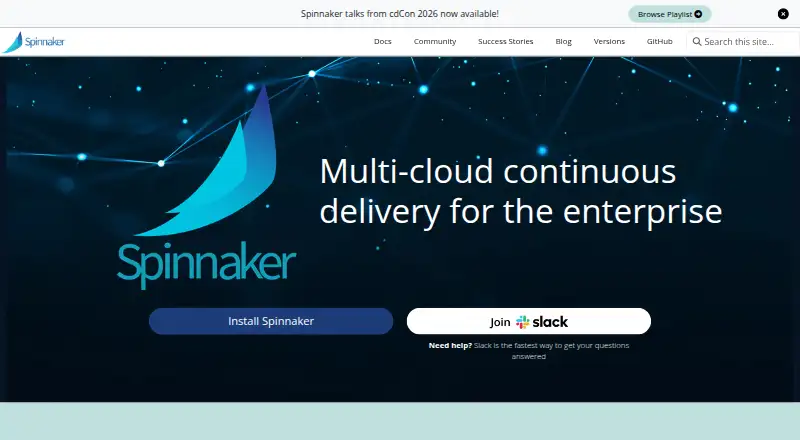
What Spinnaker is
Spinnaker is a free, open-source platform for multi-cloud continuous delivery: releasing software changes through automated pipelines. Pipelines can run integration and system tests, manage server groups, and monitor rollouts. They can start from events including Git, Jenkins, Travis CI, Docker, or CRON. Built-in deployment strategies include blue/green and canary, and teams can define their own.
Documentation lists AWS, Azure, Cloud Foundry, Google Compute Engine, Kubernetes, Oracle Cloud, and App Engine as supported providers. At least one provider must be enabled and have a configured account before applications can be deployed. Integrations include CI services such as Jenkins, Travis, AWS CodeBuild, Concourse, Google CodeBuild, and Artifactory, plus source repositories including GitHub, Bitbucket Server/Stash, and GitLab. Authentication can use OAuth 2.0, SAML, or LDAP; role providers can handle authorization, and SSL can secure UI and API communication. Kubernetes is the recommended installation path, with local Debian packages documented for smaller deployments. The local guide recommends at least 4 cores and 16GB of RAM and notes a single-machine deployment may experience downtime. Spinnaker is self-hosted and requires installation and configuration.
Who it suits
Spinnaker suits teams seeking to standardize software release processes across supported cloud providers. It is for organizations prepared to install, configure, and operate a self-hosted platform.
What it does well
- Open-source and free to use
- Supports blue/green and canary deployments
- Pipelines can monitor rollouts and run tests
- Supports multiple cloud providers
What to know first
- Requires installation and configuration
- Deployments need an enabled provider and configured account
- Local guide recommends 4 cores and 16GB RAM
- Single-machine deployment may have downtime
Limits
The free open-source plan is self-hosted and requires installation and configuration. Local Debian installation guidance recommends at least 4 cores and 16GB of RAM, and a single-machine deployment may have downtime.
Plans
| Plan | Billed and limits | Price |
|---|---|---|
| Spinnaker (open source) | Self-hosted; requires installation and configuration | Free |
As spinnaker.io lists them, read 4 Oct 2026. The maker's own page has the final word.
Getting started
- Open the Spinnaker website.
- Choose an installation route; Kubernetes is recommended, and local Debian packages are documented for smaller deployments.
- Install and configure Spinnaker in your environment.
- Enable at least one supported cloud provider and configure its account.
- Connect the CI and source repository integrations your pipelines need.
- Create pipelines with tests, rollout monitoring, and a deployment strategy.
Verdict
Spinnaker offers configurable pipelines and deployment strategies for multi-cloud release workflows. Its self-hosted setup and provider configuration make it a better fit for teams equipped to manage deployment infrastructure.
Questions
How much does Spinnaker cost?
The Spinnaker open-source plan is free.
Is Spinnaker hosted?
The listed plan is self-hosted and requires installation and configuration.
Which cloud providers are supported?
Documented providers include AWS, Azure, Cloud Foundry, Google Compute Engine, Kubernetes, Oracle Cloud, and App Engine.
Which deployment strategies are available?
Built-in options include blue/green and canary deployments, and users can define custom strategies.
What authentication and authorization options does it support?
Authentication can use OAuth 2.0, SAML, or LDAP. Authorization can use role providers such as Google Groups, GitHub Teams, SAML roles, or LDAP groups.
Facts from Spinnaker's own pages
- Audience
- The site says Spinnaker is for teams looking to standardize release processes and improve quality. · spinnaker.io, 4 Oct 2026
- Automated releases
- Pipelines can run integration and system tests, manage server groups, monitor rollouts, and be triggered by events including Git, Jenkins, Travis CI, Docker, or CRON. · spinnaker.io, 4 Oct 2026
- CI and source integrations
- The FAQ lists Jenkins, Travis, AWS CodeBuild, Concourse, Google CodeBuild, and Artifactory as CI integrations, and GitHub, Bitbucket Server/Stash, and GitLab among source repository integrations. · spinnaker.io, 4 Oct 2026
- Cloud providers
- The documentation lists AWS, Azure, Cloud Foundry, Google Compute Engine, Kubernetes, Oracle Cloud, and App Engine as supported providers. · spinnaker.io, 4 Oct 2026
- Deployment strategies
- Built-in strategies include blue/green and canary deployments, and users can define custom strategies. · spinnaker.io, 4 Oct 2026
- Installation
- The recommended installation path is a Kubernetes cluster; local Debian packages are also documented for smaller deployments. · spinnaker.io, 4 Oct 2026
- Local installation requirements
- The local Debian installation guide recommends at least 4 cores and 16GB of RAM and notes that a single-machine deployment may have downtime. · spinnaker.io, 4 Oct 2026
- Notable provider status
- The provider documentation says OpenStack support was removed after several releases without support. · spinnaker.io, 4 Oct 2026
- Provider setup
- Spinnaker requires at least one enabled cloud provider and an account configured for it to deploy applications. · spinnaker.io, 4 Oct 2026
- Purpose
- Spinnaker is an open-source, multi-cloud continuous delivery platform for releasing software changes. · spinnaker.io, 4 Oct 2026
- Security
- Spinnaker supports authentication through systems such as OAuth 2.0, SAML, or LDAP, and authorization through role providers including Google Groups, GitHub Teams, SAML roles, or LDAP groups. · spinnaker.io, 4 Oct 2026
- Support
- The homepage says Slack is the fastest way to get questions answered. · spinnaker.io, 4 Oct 2026
- Transport security
- Spinnaker supports SSL to secure communication for its UI and API. · spinnaker.io, 4 Oct 2026
Where Spinnaker stands on Freedom251
- Rollback Management#13 of 25
- Deployment Automation Software#18 of 34
- Continuous Delivery Software#20 of 32
- Kubernetes Deployment Tools#18 of 28
- Progressive Delivery Software#19 of 29