Freedom251 › Continuous Delivery Software

Flagger
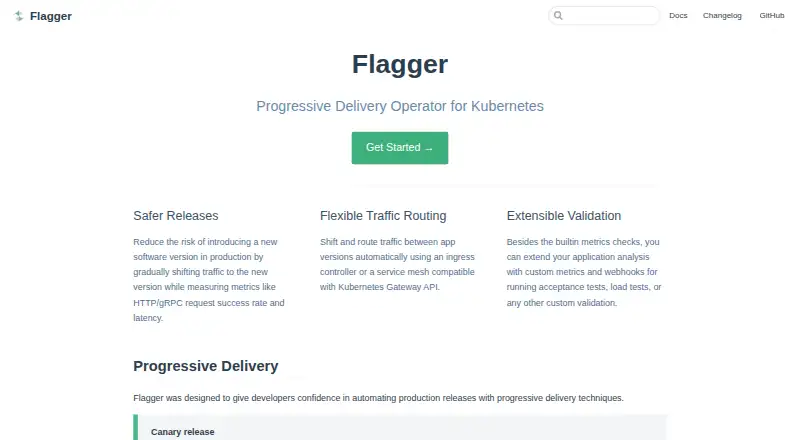
What Flagger is
Flagger is an open source Kubernetes operator for automating progressive delivery of applications running on Kubernetes. It gradually shifts traffic toward a new version while measuring release health, including HTTP or gRPC request success rate and latency. Teams can use it for canary releases, A/B testing, and blue/green deployments, with traffic routing through an ingress controller or a service mesh compatible with the Kubernetes Gateway API. Built-in metric checks cover HTTP request success rate and request duration; custom metrics and webhooks can extend validation for acceptance tests, load tests, or other checks. If SLO analysis detects a performance drop, Flagger automatically rolls back the release. Manual gating allows teams to approve, pause, or resume deployments. It can send deployment and canary result notifications to Slack, Microsoft Teams, Discord, and Rocket. Flagger is configured with Kubernetes custom resources and works with CI/CD solutions made for Kubernetes. It can also be used with Flux to create automated GitOps pipelines for canary deployments. Flagger is self-hosted and licensed under Apache 2.0. The project began at Weaveworks in 2018 and became a CNCF project in 2020.
Who it suits
Flagger suits teams deploying applications on Kubernetes that want to automate staged releases and metric-based rollback. It is also relevant to teams using Kubernetes-compatible CI/CD or Flux-based GitOps pipelines.
What it does well
- Supports canary, A/B testing, and blue/green deployment strategies.
- Built-in checks measure HTTP success rate and request duration.
- Custom metrics and webhooks can extend validation.
- Automatically rolls back releases after detected performance drops.
- Manual controls allow approval, pausing, and resuming.
- Apache 2.0 licensed and self-hosted.
What to know first
- Designed for applications running on Kubernetes.
- Deployment requires self-hosting.
- Traffic routing relies on an ingress controller or compatible service mesh.
Limits
Flagger is for applications running on Kubernetes and is deployed as a self-hosted operator. Its listed plan is free and licensed under Apache 2.0.
Plans
| Plan | Billed and limits | Price |
|---|---|---|
| Flagger | Apache 2.0 licensed · progressive delivery Kubernetes operator | Free |
As flagger.app lists them, read 8 Oct 2026. The maker's own page has the final word.
Getting started
- Visit https://flagger.app/ and consult the project documentation.
- Deploy Flagger as a self-hosted Kubernetes operator.
- Configure it with Kubernetes custom resources.
- Choose a supported deployment strategy and configure traffic routing through an ingress controller or compatible service mesh.
- Connect metrics, validation, and notifications as needed.
Verdict
Choose Flagger if your team deploys on Kubernetes and wants progressive delivery with metric checks, manual gates, and automated rollback. Look elsewhere if you need a delivery tool for applications outside Kubernetes.
Questions
Is Flagger free?
Yes. The listed Flagger plan is free, and the project is Apache 2.0 licensed.
Where does Flagger run?
It is self-hosted as a Kubernetes operator for applications running on Kubernetes.
Which deployment strategies does it support?
Flagger supports canary releases, A/B testing, and blue/green deployments.
Which metrics integrations are listed?
They include Prometheus, Datadog, CloudWatch, New Relic, Graphite, Dynatrace, InfluxDB, and Google Cloud Monitoring.
Can teams control deployments manually?
Yes. Manual gating can approve, pause, or resume deployments.
How does Flagger handle a release performance drop?
If SLO analysis detects a performance drop, Flagger automatically rolls back the release.
Facts from Flagger's own pages
- Built-in metrics
- The built-in checks are HTTP request success rate and request duration. · docs.flagger.app, 8 Oct 2026
- Compatibility
- Flagger is configured with Kubernetes custom resources and is compatible with CI/CD solutions made for Kubernetes. · docs.flagger.app, 8 Oct 2026
- Configuration
- Flagger is configured using Kubernetes custom resources and works with CI/CD solutions made for Kubernetes. · docs.flagger.app, 8 Oct 2026
- Deployment strategies
- It supports canary releases, A/B testing, and blue/green deployments. · docs.flagger.app, 8 Oct 2026
- Founded
- 2018 · flagger.app, 23 Sept 2026
- GitOps
- Flagger can be used in GitOps pipelines with tools such as Flux CD. · docs.flagger.app, 8 Oct 2026
- History
- Flagger was initially developed in 2018 at Weaveworks by Stefan Prodan and became a CNCF project in 2020. · flagger.app, 8 Oct 2026
- License
- Flagger is licensed under Apache 2.0. · flagger.app, 8 Oct 2026
- Manual controls
- The feature matrix lists manual gating to approve, pause, or resume deployments across supported routing integrations. · github.com, 8 Oct 2026
- Metrics
- Release analysis can query Prometheus, InfluxDB, Datadog, New Relic, CloudWatch, Stackdriver, or Graphite. · docs.flagger.app, 8 Oct 2026
- Metrics integrations
- Metric query integrations listed include Prometheus, Datadog, CloudWatch, New Relic, Graphite, Dynatrace, InfluxDB, and Google Cloud Monitoring. · flagger.app, 8 Oct 2026
- Notifications
- It can send deployment and canary result notifications to Slack, Microsoft Teams, Discord, and Rocket. · flagger.app, 8 Oct 2026
- Product
- Flagger is a progressive delivery Kubernetes operator that automates application releases on Kubernetes. · flagger.app, 8 Oct 2026
- Project history
- Flagger was initially developed at Weaveworks in 2018 by Stefan Prodan and became a CNCF project in 2020. · flagger.app, 8 Oct 2026
- Project status
- Flagger is a graduated Cloud Native Computing Foundation project and part of the Flux family of GitOps tools. · docs.flagger.app, 8 Oct 2026
- Purpose
- Flagger automates progressive delivery for applications running on Kubernetes by shifting traffic gradually while measuring metrics and running conformance tests. · docs.flagger.app, 8 Oct 2026
- Rollback
- If SLO analysis detects a performance drop, Flagger automatically rolls back the release. · docs.flagger.app, 8 Oct 2026
- Routing
- Traffic routing uses an ingress controller or a service mesh compatible with the Kubernetes Gateway API. · flagger.app, 8 Oct 2026
- Support
- The project directs users to its documentation, the CNCF community Slack #flagger channel, Flux talks, and GitHub issues for help. · flagger.app, 8 Oct 2026
- Traffic shifting
- It gradually shifts traffic to a new version while measuring metrics such as HTTP or gRPC request success rate and latency. · flagger.app, 8 Oct 2026
- Validation
- Built-in metric checks can be extended with custom metrics and webhooks for acceptance tests, load tests, or other validation. · flagger.app, 8 Oct 2026
Where Flagger stands on Freedom251
- Continuous Delivery Software#15 of 32
- Rollback Management#12 of 25
- Progressive Delivery Software#14 of 29
- Kubernetes Deployment Tools#15 of 28