Solo 2
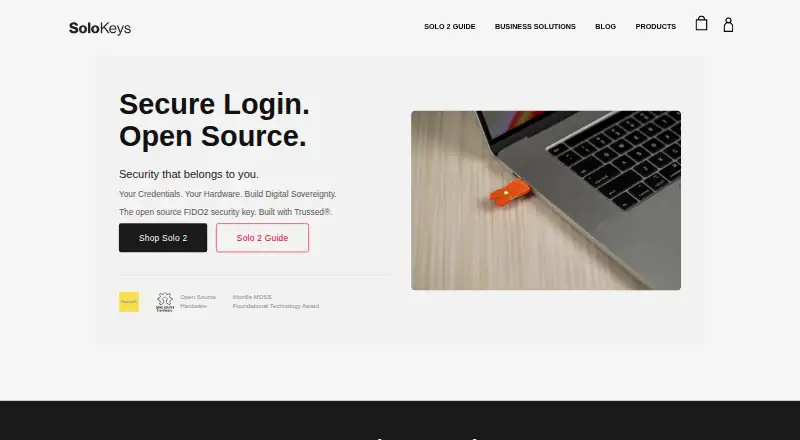
What Solo 2 is
Solo 2 is a physical security key for protecting online accounts from phishing, account takeover, and unauthorized access. It supports FIDO2, WebAuthn, and U2F, and basic use needs no software installation or drivers. A capacitive sensor confirms authentication when touched. The key stores credentials and passkeys on the device rather than in cloud services, with capacity for approximately 100 passkeys. It works with security-key-enabled services such as Google, Microsoft, Facebook, Salesforce, GitHub, Dropbox, and Twitter/X. The maker lists Chrome, Edge, Safari, Brave, and Firefox as supported browsers. Solo 2 is open source across its software, hardware, and documentation. Standard models ship with locked firmware and SoloKeys attestation certificates; the Hacker model does not include attestation. The solo2-cli tool manages passkeys, firmware updates, PINs, PIV, and OpenPGP settings. A forgotten PIN cannot be recovered without resetting the key, which erases stored passkeys. Prices start at $34 as a one-time purchase.
Who it suits
Solo 2 suits everyday users, security professionals, and enterprise teams seeking physical-key authentication. The Hacker model is aimed at developers, security researchers, and makers.
What it does well
- Supports FIDO2, WebAuthn, and U2F.
- Basic use requires no software or drivers.
- Stores approximately 100 passkeys on the key.
- Works with services including Google and GitHub.
- Open-source software, hardware, and documentation.
What to know first
- Forgotten PIN reset erases stored passkeys.
- Hacker model does not include attestation.
- NFC is limited to NFC models.
Limits
Forgetting the PIN means resetting the key, which erases stored passkeys; the guide recommends registering a backup key. The 34.00 USD Solo 2C Security Key is USB-C without NFC, while NFC is listed on Solo 2+ models from $46 as a one-time purchase.
Plans
| Plan | Billed and limits | Price |
|---|---|---|
| Solo 2C Security Key | One-time purchase · USB-C · no NFC | $34, paid once |
| Solo 2 USB-A Hacker | One-time purchase · USB-A · unlocked for custom firmware · no NFC | $35, paid once |
| Solo 2 USB-A Security Key | One-time purchase · USB-A · no NFC | $35, paid once |
| Solo 2C+ NFC Security Key | One-time purchase · USB-C · NFC | $46, paid once |
| Solo 2A+ NFC Security Key | One-time purchase · USB-A · NFC | $46, paid once |
As solokeys.com lists them, read 5 Oct 2026. The maker's own page has the final word.
Getting started
- Visit the SoloKeys website.
- Choose a Solo 2 model and connection type: USB-C or USB-A, with NFC available on Solo 2+ models.
- Purchase the selected key as a one-time purchase.
- Connect the key and use its touch sensor when authentication requires confirmation.
- Use solo2-cli for passkey, firmware, PIN, PIV, or OpenPGP management.
Solo 2 is a physical security key for people who want phishing-resistant sign-in and passkeys kept under their control. It fits individuals, security professionals, and teams that use services supporting hardware authentication, while the Hacker model targets developers and makers. Its open design and wide standards support are compelling, but recovery requires disciplined backup-key and PIN management.
Overview
Solo 2 supports FIDO2, WebAuthn, and U2F, covering the authentication standards used by many modern account providers. Basic operation needs no driver or companion software, so it can add a hardware factor without another desktop installation. A capacitive sensor with three contact points requires a touch to confirm authentication, adding a deliberate physical check rather than silently approving a sign-in.
The key works with security-key-enabled services such as Google, Microsoft, Facebook, Salesforce, GitHub, Dropbox, and Twitter/X. It stores credentials and passkeys on the physical key, with capacity for approximately 100 passkeys and no cloud copy. That is a good fit for users who prefer local custody of credentials, but it makes loss recovery a responsibility: resetting after a forgotten PIN deletes the stored passkeys, so registering a backup key is a sensible requirement rather than an optional extra.
Key features
- Broad authentication support: FIDO2, WebAuthn, and U2F let one key cover current passkey flows and older security-key deployments.
- Local passkey storage: About 100 passkeys can remain on the device instead of a cloud service. Users gain control and lose cloud-based recovery.
- Open-source licensing: Software is dual licensed under Apache 2.0 and MIT, hardware under CERN-OHL-S, and documentation under CC-BY-SA 4.0. This is particularly relevant to security-conscious teams and developers who value inspectable, reusable components.
- Touch confirmation: The capacitive three-contact sensor makes authentication an intentional physical action, useful when preventing unattended approvals matters.
- Management utility: The solo2-cli tool handles passkeys, firmware updates, PINs, PIV, and OpenPGP settings. A graphical Solo 2 interface is still described as coming soon, so command-line management is the practical option for advanced administration.
- Attestation choices: Standard Solo 2 devices ship with locked firmware and SoloKeys attestation certificates. The Hacker model omits attestation and is unlocked for custom firmware, making it better suited to experimentation than policy-driven enterprise enrollment.
Pricing
Solo 2 is sold as a one-time hardware purchase, with no free plan or trial. The entry option is Solo 2C Security Key at $34, paid once; it uses USB-C and has no NFC, making it the lowest-cost choice for USB-C computers and phones that do not need contactless sign-in.
The Solo 2 USB-A Security Key costs $35, paid once and has USB-A without NFC. The Solo 2 USB-A Hacker is also $35, paid once, with USB-A, no NFC, and firmware unlocked for custom work; choose it for development or research, not when attestation is required.
For contactless use, Solo 2C+ NFC Security Key and Solo 2A+ NFC Security Key each cost $46, paid once, with USB-C or USB-A respectively and NFC support. The premium is justified for compatible mobile workflows; the cheaper models give up NFC rather than authentication standards.
Platforms
Solo 2 is offered across Android, iOS, Linux, macOS, the web, and Windows. The maker also lists Windows, macOS, Linux, Android, ChromeOS, and xBSD as supported operating systems, plus Chrome, Edge, Safari, Brave, and Firefox browsers. NFC authentication on compatible Android and iOS devices is supported by Solo 2+ models, not the standard no-NFC versions.
Who it's for
Everyday users protecting email, social, development, and business accounts get a simple hardware factor with broad service coverage. Enterprise teams can use the standard, attested model when locked firmware and a conventional security-key posture matter. Developers, security researchers, and makers have a more specialized option in the Hacker model because custom firmware is possible, although its lack of attestation rules it out for some controlled deployments.
Pros and cons
Pros
- Standards coverage: FIDO2, WebAuthn, and U2F support reduces the need to maintain separate keys for different account systems.
- Local control: Passkeys stay on the key and are not backed up to cloud services.
- Open hardware and software: Published licenses suit organizations that need an inspectable platform.
- Multiple connectors: USB-A, USB-C, and NFC configurations cover desktops and compatible mobile devices.
Cons
- PIN-reset risk: Forgetting the PIN and resetting the device erases all stored passkeys, so a second registered key is important.
- No graphical manager yet: Advanced key, firmware, and credential administration relies on solo2-cli while the GUI is forthcoming.
- NFC costs more: Contactless models cost 46.00 USD, above the 34.00–35.00 USD wired options.
- Hacker model lacks attestation: Its unlocked firmware is unsuitable where device attestation is part of an access policy.
Alternatives
Security Keys is the broader category to browse when you want to compare other hardware authenticators.
Choose Yubico Authenticator instead if you want free, open-source companion software for Android, iOS, Linux, macOS, and Windows; it requires a YubiKey to store credentials and generate codes.
Deepnet SafeKey is an alternative hardware-key family with Android, iOS, macOS, web, and Windows coverage and quote-based pricing.
SafeNet MobilePASS+ is another paid option for Android, iOS, macOS, and Windows.
Pick Swissbit iShield Key 2 when you need USB-A or USB-C plus NFC and prefer purchasing through a sales partner.
TrustKey T110 is a paid alternative focused on web and Windows support.
FEITIAN ePass FIDO-NFC Security Key costs $35, paid once and combines USB-A or USB-C, NFC, FIDO U2F/FIDO2, and HOTP/TOTP.
Token2 T2F2-NFC-Slim is a paid USB-A alternative with volume pricing and a product-page price of £18.80 in Great Britain.
Choose YubiKey 5 Series instead if you want a paid key family with USB-A, USB-C, and NFC models, including 58.00 USD options.
Verdict
Solo 2 is a strong choice for users and teams seeking an open-source, touch-confirmed key that supports major authentication standards and keeps passkeys local. Its main reason to choose it is the combination of broad compatibility and transparent hardware/software licensing at a one-time price from 34.00 USD. Look elsewhere if you need cloud-style credential recovery, a ready graphical management console, or attestation on an unlocked development key.
Verdict
Solo 2 combines several authentication standards with on-device passkey storage and broad service support. Register a backup key, since resetting after a forgotten PIN erases stored passkeys.
Questions
How much does Solo 2 cost?
The Solo 2C Security Key is $34 as a one-time purchase. Other listed models range from 35.00 USD to $46 as a one-time purchase.
Is there a free plan or trial?
No. Solo 2 is listed as paid, with no free plan and no free trial.
Which authentication standards does it support?
It supports FIDO2, WebAuthn, and U2F.
Does Solo 2 support NFC?
The listed Solo 2 USB-A and USB-C models without a plus sign have no NFC. Solo 2+ models support NFC on compatible Android and iOS devices.
Is Solo 2 open source?
Yes. Software is dual licensed under Apache 2.0 and MIT, hardware under CERN-OHL-S, and documentation under CC-BY-SA 4.0.
What happens if I forget the PIN?
Resetting the key erases stored passkeys. The guide recommends registering a backup key.
Facts from Solo 2's own pages
- Attestation
- Standard Solo 2 devices ship with locked firmware and SoloKeys attestation certificates; the Hacker model does not include attestation. · solokeys.com, 5 Oct 2026
- Authentication
- It supports FIDO2, WebAuthn, and U2F; basic use requires no software installation or drivers. · solokeys.com, 5 Oct 2026
- Browser support
- The maker lists Chrome, Edge, Safari, Brave, and Firefox as supported browsers. · solokeys.com, 5 Oct 2026
- Headquarters
- Newark, Delaware, United States · solokeys.com, 28 Sept 2026
- Integrations
- It works with security-key-enabled services including Google, Microsoft, Facebook, Salesforce, GitHub, Dropbox, and Twitter/X. · solokeys.com, 5 Oct 2026
- Intended users
- Solo 2 is presented for everyday users, security professionals, and enterprise teams; Solo 2 Hacker is aimed at developers, security researchers, and makers. · solokeys.com, 5 Oct 2026
- Key management
- The solo2-cli tool can manage passkeys, firmware updates, PINs, PIV, and OpenPGP settings; the Solo 2 GUI is listed as coming soon. · solokeys.com, 5 Oct 2026
- Limits
- If a user forgets the PIN, resetting the key erases stored passkeys; the guide recommends registering a backup key. · solokeys.com, 5 Oct 2026
- Open source
- The maker says Solo 2 is fully open source: software is dual licensed under Apache 2.0 and MIT, hardware under CERN-OHL-S, and documentation under CC-BY-SA 4.0. · solokeys.com, 5 Oct 2026
- Operating systems
- The maker lists Windows, macOS, Linux, Android, ChromeOS, and xBSD; Solo 2+ supports NFC authentication on compatible Android and iOS devices. · solokeys.com, 5 Oct 2026
- Passkey storage
- Solo 2 stores credentials and passkeys on the physical key, does not back them up to cloud services, and can store approximately 100 passkeys. · solokeys.com, 5 Oct 2026
- Product
- Solo 2 is an open source FIDO2 security key designed to protect online accounts from phishing, account takeover, and unauthorized access. · solokeys.com, 5 Oct 2026
- Support
- For help with a purchased device, SoloKeys directs customers to its support email or contact form. · solokeys.com, 5 Oct 2026
- Touch confirmation
- A capacitive sensor with three contact points confirms authentication when touched. · solokeys.com, 5 Oct 2026
Where Solo 2 stands on Freedom251
- Security Keys#4 of 20