Freedom251 › Database Schema Comparison Tools

Skeema
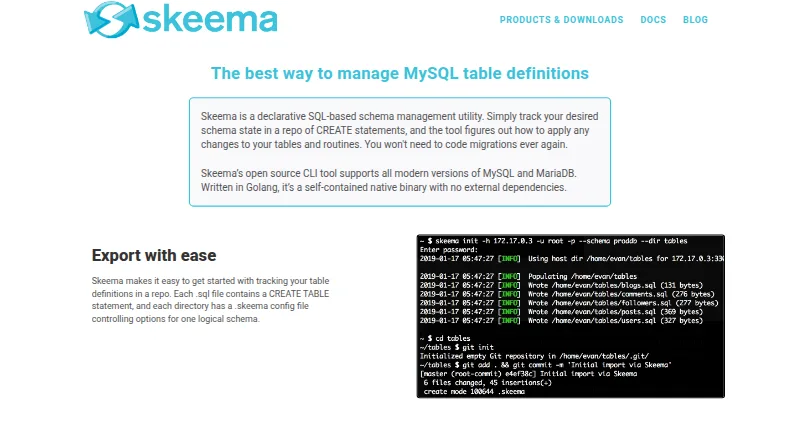
What Skeema is
Skeema is a declarative SQL schema management utility for applying repository changes to MySQL and MariaDB tables and routines. It generates SQL DDL from schema files and provides diff, lint, push, and pull commands. Configurable linter rules flag unsafe changes, and Skeema checks generated ALTER TABLE statements in a workspace before proceeding. Online schema changes can use native database alterations or tools such as pt-online-schema-change and gh-ost, with execution configured by environment and table size. Schema directories can map to multiple database servers or schemas, and Skeema can detect drift across shards. The site lists MySQL 5.5–9.7, MariaDB 10.1–12.3, and Percona Server support; AWS Aurora MySQL 5.7–8.4 is listed for Premium. Skeema Cloud Linter can automatically produce diff and lint output for related GitHub commits. All editions can use SSL/TLS; Premium adds client certificates, CA verification options, and SSH tunnels. Community costs nothing. Plus is $124/month or $1238/year, while Max is $499/month or $4988/year. Community lists Linux and macOS; Plus and Max list Linux, macOS, and Windows.
Who it suits
Skeema suits developers and teams managing MySQL or MariaDB schema changes through SQL files and repository workflows. Its sharding and support options may also suit teams managing multiple database environments.
What it does well
- Diff, lint, push, and pull commands
- Detects unsafe changes and checks generated ALTER statements
- Supports online alteration tools including gh-ost
- Can detect schema drift across shards
- Community plan costs nothing
What to know first
- Does not manage users, grants, roles, or global variables
- MariaDB sequences are not yet supported
- Community lists Linux and macOS only
- Rollback support: no
Limits
Community includes tables, stored procedures and functions, and 18 linter checks; it lists Linux and macOS. Plus is limited to 10 shards per directory, while Max lists unlimited sharding. Community and Plus receive public technical support; private email technical support is included with Max.
Plans
| Plan | Billed and limits | Price |
|---|---|---|
| Community | Tables · stored procedures and functions · 18 linter checks · Linux and macOS · Apache 2.0 | Free |
| Plus | $124/month or $1238/year · Tables, routines, views, triggers, events, seed data · Linux, macOS, Windows · sharding up to 10 shards per directory · public support | $1,238 a year |
| Plus | $124/month or $1238/year · Tables, routines, views, triggers, events, seed data · Linux, macOS, Windows · sharding up to 10 shards per directory · public support | $124 a month |
| Max | $499/month or $4988/year · Tables, routines, views, triggers, events, seed data · Linux, macOS, Windows · unlimited sharding · private email technical support | $4,988 a year |
| Max | $499/month or $4988/year · Tables, routines, views, triggers, events, seed data · Linux, macOS, Windows · unlimited sharding · private email technical support | $499 a month |
| Skeema Cloud Linter | $649 USD per year · Optional SaaS add-on · covers an entire GitHub organization · automatic diff and lint for Skeema commits in GitHub repositories | $649 a year |
As skeema.io lists them, read 29 Sept 2026. The maker's own page has the final word.
Getting started
- Visit the Skeema website.
- Choose Community, Plus, or Max based on the listed plan features.
- Use Linux or macOS for Community, or Linux, macOS, or Windows for Plus and Max.
- Prepare schema files with CREATE statements in a repository.
- Use Skeema's diff, lint, push, and pull commands for the schema workflow.
Skeema is a schema-management utility for teams maintaining MySQL or MariaDB databases through SQL files in a repository. It is best suited to developers who want reviewable deployments and shard-aware drift checks. Its safeguards and flexible online-change options are compelling, but it does not roll changes back or manage several important database-level settings.
Overview
Skeema generates database DDL from schema files and provides commands to compare, lint, apply, and retrieve changes. Keeping the desired schema in a repository gives teams a repeatable path for reviewing changes before they reach a database, with CI/CD automation and a self-hosted option to fit that workflow.
Configurable lint rules detect unsafe changes, and Skeema verifies generated ALTER TABLE statements in a workspace before proceeding. Online alterations can use native database capabilities or tools such as pt-online-schema-change and gh-ost, with execution configured by environment and table size. Those controls help teams adapt deployments to their databases; the lack of rollback support means recovery planning still needs to happen elsewhere.
Key features
Schema review and deployment
Diff and lint commands make proposed changes easier to inspect before pushing them, while workspace verification checks the generated ALTER statements. This is useful for teams that want guardrails in a code-review and deployment process rather than a one-step migration command. Skeema works with MySQL 5.5–9.7, MariaDB 10.1–12.3, and Percona Server; AWS Aurora MySQL 5.7–8.4 is supported on Premium.
Online changes and sharding
Configurable use of native alterations or external online-schema-change tools gives teams options for different environments and table sizes. Skeema can map a schema directory to multiple servers or schemas and detect drift across shards. Plus caps sharding at 10 shards per directory, while Max removes that cap, so larger estates have a concrete reason to consider the higher tier.
GitHub and security
Skeema Cloud Linter can automatically produce diff and lint output for Skeema-related commits in GitHub repositories and supports pull-request workflows through cloud-based CI. All editions support SSL/TLS connections; Premium adds client certificates, CA verification options, and SSH tunnels. These are meaningful distinctions for teams with stricter connection requirements, while public technical support through GitHub issues is available to CLI users and private email support is reserved for Max.
Scope limits
Skeema does not manage database users, privilege grants, roles, or global variables, and MariaDB sequences are not yet supported. Teams that need those objects managed alongside tables and routines will need another approach. It supports schema diffs and drift detection, but no rollback support.
Pricing
Community is free (free) and open source under Apache 2.0. It covers tables, stored procedures, and functions, includes 18 linter checks, and runs on Linux and macOS. This is a sensible starting point for a free workflow, but it gives up views, triggers, events, seed data, Windows support, and paid-tier sharding allowances.
Plus costs $124 a month, billed $124/month or $1238/year. It adds routines, views, triggers, events, seed data, Windows support, public support, and sharding up to 10 shards per directory. It fits smaller teams that need those objects or Windows; its shard ceiling can rule it out for larger deployments.
Max costs $499 a month, billed $499/month or $4988/year. It includes the same schema-object coverage and platform support as Plus, with unlimited sharding and private email technical support. Larger organizations with many shards or a need for private support are the clearest fit; teams without those needs may find Plus sufficient.
Skeema Cloud Linter is an optional SaaS add-on at $649 a year, billed $649 USD per year. It covers an entire GitHub organization and automates diff and lint output for Skeema commits. It is aimed at organizations that want that cloud-based pull-request workflow rather than only the CLI.
Platforms
Community runs on Linux and macOS; Plus and Max also support Windows. That makes the free edition narrower for teams standardized on Windows, while paid editions cover all three listed desktop/server platforms.
Who it's for
Skeema suits developers and database teams managing MySQL- or MariaDB-family schemas as repository-backed SQL, especially where deployment safety checks or shard drift detection matter. Community is appropriate for a limited tables-and-routines workflow on Linux or macOS; Plus fits startups and smaller teams needing broader object coverage, Windows, or up to 10 shards per directory. Max is positioned for larger organizations needing unlimited sharding and private email support. It is a poorer fit when rollback or database users, grants, roles, global variables, or MariaDB sequences must be managed as part of the same tool.
Pros and cons
- Pros: Configurable linting and workspace verification provide checks before ALTER statements proceed, and online-change options can be tailored to environment and table size.
- Pros: Shard mapping and drift detection address multi-server schema management, with Plus supporting up to 10 shards per directory and Max offering unlimited sharding.
- Pros: Paid editions cover views, triggers, events, and seed data, while Community provides an Apache 2.0 option for tables and routines.
- Cons: There is no rollback support, so teams must plan for recovery outside Skeema.
- Cons: Users, grants, roles, global variables, and MariaDB sequences fall outside its scope.
- Cons: Community excludes Windows and several schema-object types available in paid editions.
Alternatives
For a broader comparison, see Database Migration Tools and Database Schema Comparison Tools.
Atlas is worth considering if its open-core model, Apache 2.0 core, and free plan with a free trial better match your needs. FluentMigrator is a free Apache-2.0 framework distributed through NuGet, with provider packages selected separately. Bytebase Enterprise is an alternative with a free trial and self-hosted, web, and API platforms. Alembic is a free, MIT-licensed self-hosted alternative. SchemaHero is a free alternative available across Linux, macOS, self-hosted, web, and Windows platforms. Liquibase is another freemium option, with a Starter plan for up to five applications and one database type that requires a professional services package for onboarding and implementation. sqldef and dbmate are free alternatives, with sqldef also listing self-hosted and web platforms.
Verdict
Choose Skeema if your team manages MySQL or MariaDB schemas as repository-backed SQL and values pre-deployment checks, configurable online changes, and shard-aware drift detection. Community is a useful free entry point when its object and platform limits suffice; Plus and Max make sense as broader needs grow. Look elsewhere if rollback or management of users, privileges, roles, global variables, or MariaDB sequences is essential.
Verdict
Skeema focuses on schema changes and drift management for MySQL and MariaDB environments. Check the plan’s database coverage and the stated limits before choosing an edition.
Questions
Is Skeema free?
Yes. Community is listed as free and is described as free open-source software. Paid plans start at $124 a month.
What does Skeema cost?
Plus is $124 a month, billed at $124/month or $1238/year. Max is $499 a month, billed at $499/month or $4988/year.
Which databases does Skeema support?
The site lists MySQL 5.5–9.7, MariaDB 10.1–12.3, and Percona Server. AWS Aurora MySQL 5.7–8.4 is listed on Premium.
Which operating systems are supported?
Community lists Linux and macOS. Plus and Max list Linux, macOS, and Windows.
Does Skeema integrate with GitHub?
Skeema Cloud Linter can automatically provide diff and lint output for Skeema-related commits in GitHub repositories and supports pull-request workflows through cloud-based CI.
What does Skeema not manage?
It does not manage database users, privilege grants, roles, or global variables. MariaDB sequences are not yet supported.
Facts from Skeema's own pages
- Database compatibility
- The site lists support for MySQL 5.5–9.7, MariaDB 10.1–12.3, Percona Server, and—on Premium—AWS Aurora MySQL 5.7–8.4. · skeema.io, 29 Sept 2026
- Founded
- 2016 · skeema.io, 28 Sept 2026
- GitHub integration
- Skeema Cloud Linter provides automatic diff and lint output for Skeema-related commits in GitHub repositories and supports a pull-request workflow through cloud-based CI. · skeema.io, 29 Sept 2026
- Headquarters
- Northern New Jersey, United States · skeema.io, 28 Sept 2026
- Intended users
- Skeema Community is described as free open-source software, while Premium Plus is positioned for startups and smaller teams and Max for larger organizations. · skeema.io, 29 Sept 2026
- Maker history
- The Skeema CLI was initially released in 2016, and its creator Evan Elias independently created the tool to bring declarative schema management to MySQL and MariaDB. · skeema.io, 29 Sept 2026
- Notable limits
- Skeema does not manage database users, privilege grants, roles, or global variables, and MariaDB sequences are not yet supported. · skeema.io, 29 Sept 2026
- Online schema changes
- Skeema supports database-native online alterations and external tools such as pt-online-schema-change and gh-ost, with configurable execution based on environment and table size. · skeema.io, 29 Sept 2026
- Purpose
- Skeema is a declarative SQL-based schema management utility that applies changes expressed as CREATE statements in a repository to MySQL and MariaDB tables and routines. · skeema.io, 29 Sept 2026
- Safety
- Skeema uses configurable linter rules, detects unsafe changes, and verifies generated ALTER TABLE statements in a workspace before proceeding. · skeema.io, 29 Sept 2026
- Schema workflow
- Skeema generates SQL DDL from schema files and provides diff, lint, push, and pull commands. · skeema.io, 29 Sept 2026
- Security
- All editions can use SSL/TLS connections; Premium adds client certificates, CA verification options, and SSH tunnels. · skeema.io, 29 Sept 2026
- Sharding
- Skeema can map a schema directory to multiple database servers or schemas and can detect schema drift across shards. · skeema.io, 29 Sept 2026
- Support
- Public technical support is available to all CLI users through GitHub issues, while private technical support is included with Max. · skeema.io, 29 Sept 2026
Where Skeema stands on Freedom251
- Database Schema Comparison Tools#10 of 25
- Database Migration Tools#19 of 32