Freedom251 › VoIP Monitoring Software
sip-exporter
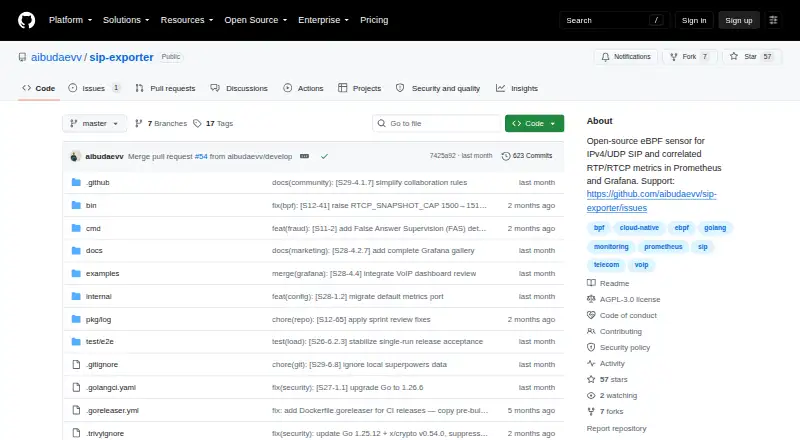
What sip-exporter is
sip-exporter is an open-source Linux eBPF sensor that turns observed SIP signaling and related RTP traffic into Prometheus metrics. Its `/metrics` endpoint includes SIP traffic and session measures, RFC 6076 performance measures, RTP and RTCP statistics, fraud signals, and diagnostics. RTP analysis covers jitter, packet loss, packet-delay variation, and E-model MOS; RTCP sender and receiver statistics include loss, jitter, and round-trip time correlated by SSRC. Documented fraud indicators include registration scans, INVITE bursts, account takeover after a registration country change, and False Answer Supervision. The repository includes a Grafana dashboard with 11 sections and examples of Prometheus alert rules. Metrics are documented for Prometheus, VictoriaMetrics, Grafana Cloud, and other compatible scrapers. The single-container deployment requires privileged access and host networking. The sensor must run where it can see both SIP signaling and the correlated RTP media on the same call path. Capture is limited to IPv4/UDP; IPv6, fragmented UDP, and SIP over TCP or TLS are unsupported. The project says it does not store packets or audio, though RTP snapshots sent to userspace may include a small payload prefix.
Who it suits
It suits Linux operators who need SIP and RTP/RTCP monitoring in a Prometheus-compatible environment and can place the sensor on the relevant call path. It is aimed at teams able to deploy a privileged container with host networking.
What it does well
- Reports SIP, RTP, and RTCP measures.
- Includes jitter, packet loss, and MOS analysis.
- Provides a Grafana dashboard and alert-rule examples.
- Free for commercial use with AGPL-3.0 conditions.
What to know first
- Does not capture SIP over TCP or TLS.
- IPv6 and fragmented UDP are unsupported.
- Requires privileged access and host networking.
- Needs visibility into signaling and media on the same path.
Limits
The plan is free, with free use subject to AGPL-3.0 terms, including conditions for commercial use. Capture is limited to IPv4/UDP SIP and RTP/RTCP; IPv6, fragmented UDP, SIP over TCP/TLS, and mirrored traffic for trustworthy QoE or direction are unsupported.
Plans
| Plan | Billed and limits | Price |
|---|---|---|
| AGPL-3.0 open-source | Free for personal and educational use; free for commercial use with conditions under AGPL-3.0 | Free |
As github.com lists them, read 5 Oct 2026. The maker's own page has the final word.
Getting started
- Open the project website on GitHub.
- Deploy the provided single container on Linux with privileged access and host networking.
- Run the sensor on a host that sees both SIP signaling and the related RTP/RTCP path.
- Connect a Prometheus-compatible scraper to the `/metrics` endpoint.
- Use the included Grafana dashboard and adapt the documented alert-rule examples.
Overview
sip-exporter is free, open-source software for monitoring SIP calls from a Linux host, with metrics designed for Prometheus-compatible tools. It suits operators who can place a sensor on the call path and run it with elevated container privileges. Its detailed call-quality and fraud signals are compelling, but only for traffic that fits its narrow capture model.
This is a specialist sensor rather than a broad VoIP monitoring service: it can correlate signaling and media, but only when both are visible to the same host.
Key features
The exporter exposes SIP traffic, active sessions, performance and voice-quality measures, plus RTP, RTCP, fraud and diagnostic metrics at /metrics. For RTP streams it can report jitter, packet loss, packet-delay variation and E-model MOS. RTCP sender and receiver statistics add loss, jitter and round-trip time, correlated by SSRC. Together, these measures give operators a useful view of call quality and media behavior when the sensor sees the associated SIP and media traffic.
Its documented fraud signals include registration scans, bursts of INVITE requests, account takeover following a registration-country change, and False Answer Supervision. The included Grafana dashboard has 11 sections, and the project provides Prometheus alert-rule examples, with Alertmanager examples for Slack, PagerDuty and email. Metrics are documented as compatible with Prometheus, VictoriaMetrics, Grafana Cloud and other Prometheus-compatible scrapers.
Privacy-conscious teams may value that the project says it does not store packets or audio. RTP processing parses the fixed header rather than inspecting audio, although RTP snapshots copied to userspace may contain a small prefix of payload. Anonymous usage telemetry is enabled by default; operators can disable it by setting SIP_EXPORTER_TELEMETRY to false.
Pricing
AGPL-3.0 open-source — free. The project is free for personal and educational use, and permits commercial use subject to AGPL-3.0 conditions. There is no free trial because the software is free. The license matters for organizations deploying modified versions over a network: those versions must offer users the corresponding source under the license terms.
Platforms
sip-exporter runs on Linux and is self-hosted. A single-container deployment is provided, but the container must run privileged and use host networking to access eBPF and the network interface. That setup is a practical constraint for environments with strict container permissions or centralized monitoring architectures.
Capture is limited to IPv4 SIP over UDP and correlated RTP/RTCP. SIP over TCP or TLS, IPv6, and fragmented UDP are unsupported. Mirrored traffic is also unsupported for trustworthy quality-of-experience and direction metrics. For full metrics, the sensor must sit on a host that sees both SIP signaling and the RTP media for the same call.
Who it's for
This is a good fit for Linux-based voice operators who already use Prometheus-compatible monitoring and can place a privileged sensor on the actual call path. The combination of SIP performance, correlated RTP quality, RTCP statistics and fraud indicators is particularly relevant to teams investigating call degradation or suspicious registration and calling patterns.
It is a poor fit where traffic uses IPv6 or SIP over TCP/TLS, where media and signaling take different paths, or where privileged host networking is not acceptable. The project directs users to GitHub Issues for support, bug reports and feature requests, and to its security policy for private vulnerability reports.
Pros and cons
- Useful call-quality coverage: MOS, jitter, packet loss, packet-delay variation and RTCP round-trip time help characterize media when it can be correlated with SIP.
- Actionable security signals: the documented registration and calling-pattern signals give voice operators more than basic traffic counts.
- Ready monitoring components: a multi-section Grafana dashboard and alert examples can support adoption in an existing Prometheus-compatible stack.
- Strict capture requirements: IPv4/UDP-only capture excludes common protocol and network configurations, and both signaling and media must be visible at the same host.
- Elevated deployment privileges: privileged mode and host networking may conflict with security policies or container-platform restrictions.
- License obligations: commercial use is permitted with AGPL-3.0 conditions, including source-offer requirements for modified network-accessible versions.
Alternatives
VoIP Monitoring Software is a broader category to explore when comparing monitoring approaches.
Consider Obkio if you want a cross-platform monitoring option with a free plan and a 14-day trial that includes premium features, up to 10 agents and no credit card requirement. Dotcom-Monitor is another free-plan option, with monitoring for up to 25 targets, a five-minute minimum frequency and two locations.
HOMER is a free, open-source alternative for teams seeking a self-hosted VoIP monitoring tool with commercial support available by quote. If your requirements instead call for a controller and one or more node devices that can control over 100 nodes, consider MultiDSLA.
Bicom Systems SIP Monitoring (sipMON), CallMeter, and Nectar Diagnostics are other paid alternatives. ServicePilot VoIP Monitoring offers a free plan and trial alongside per-object pricing for supported VoIP systems.
Verdict
Choose sip-exporter if you need call-quality and fraud metrics from IPv4/UDP SIP traffic and can run a privileged Linux sensor where it sees both signaling and media. Its strongest case is the depth of correlated SIP, RTP and RTCP data at no software cost. Look elsewhere if your traffic uses unsupported protocols, your call path cannot provide the required visibility, or your deployment cannot accept its privileges and AGPL obligations.
Verdict
sip-exporter provides detailed SIP and correlated media metrics for compatible IPv4/UDP traffic. Its capture limits and privileged deployment requirements are important considerations before using it.
Questions
How much does sip-exporter cost?
The AGPL-3.0 open-source plan is free. It is free for personal and educational use, and free for commercial use with conditions under AGPL-3.0.
What traffic can it capture?
It captures IPv4/UDP SIP and correlated RTP/RTCP. SIP over TCP or TLS, IPv6, and fragmented UDP are unsupported.
Which metrics does it provide?
It exposes SIP traffic and session, RFC 6076, voice-quality, RTP, RTCP, fraud, and diagnostic metrics. RTP quality measures include jitter, packet loss, packet-delay variation, and E-model MOS.
Does it include a dashboard or alert examples?
The repository includes a Grafana dashboard with 11 sections and documented Prometheus alert-rule examples. Alertmanager examples cover Slack, PagerDuty, and email.
Where can its metrics be sent?
The metrics are documented as compatible with Prometheus, VictoriaMetrics, Grafana Cloud, and other Prometheus-compatible scrapers.
Does sip-exporter store packets or audio?
The project says it does not store packets or audio and processes the fixed RTP header. RTP snapshots copied to userspace may include a small payload prefix.
Facts from sip-exporter's own pages
- Capture
- It captures IPv4/UDP SIP and correlated RTP/RTCP; SIP over TCP or TLS is not captured. · github.com, 5 Oct 2026
- Capture method
- An eBPF socket filter selects IPv4 SIP packets over UDP for userspace processing; SIP over TCP or TLS is not captured. · github.com, 5 Oct 2026
- Dashboard and alerts
- The repository includes a Grafana dashboard and documented Prometheus alert-rule examples, with Alertmanager examples for Slack, PagerDuty, and email. · github.com, 5 Oct 2026
- Data handling
- The project says it does not store packets or audio; its RTP processing parses the fixed RTP header and does not inspect or persist audio. · github.com, 5 Oct 2026
- Deployment
- The project provides a single-container deployment and says the container must run privileged with host networking to access eBPF and the network interface. · github.com, 5 Oct 2026
- Fraud signals
- Documented fraud signals include registration scans, INVITE bursts, account takeover after a registration country change, and False Answer Supervision. · github.com, 5 Oct 2026
- Grafana dashboard
- The repository includes a Grafana dashboard with 11 sections and documented Prometheus alert-rule examples. · github.com, 5 Oct 2026
- Integrations
- The Prometheus-format metrics are documented as compatible with Prometheus, VictoriaMetrics, Grafana Cloud, and other Prometheus-compatible scrapers. · github.com, 5 Oct 2026
- License
- The project is licensed under AGPL-3.0 and says modified network-accessible versions must offer users the corresponding source under the license terms. · github.com, 5 Oct 2026
- Limits
- The sensor requires a host that sees IPv4/UDP SIP signaling and the correlated RTP/RTCP path; IPv6, fragmented UDP, SIP over TCP/TLS, and mirrored traffic for trustworthy QoE/direction are unsupported. · github.com, 5 Oct 2026
- Metrics
- It exposes SIP traffic, active-session, RFC 6076 performance, RFC 6035 voice-quality, RTP, RTCP, fraud, and diagnostic metrics at `/metrics`. · github.com, 5 Oct 2026
- Network placement
- For full metrics, the sensor must run on a host that sees both SIP signaling and RTP media on the same call path. · github.com, 5 Oct 2026
- Privacy
- The README says the exporter does not store packets or audio and parses only the fixed 12-byte RTP header, while RTP snapshots copied to userspace may include a small payload prefix. · github.com, 5 Oct 2026
- Purpose
- sip-exporter is an open-source eBPF sensor that turns SIP signaling and correlated RTP traffic observed on a Linux host into Prometheus metrics and Grafana dashboards. · github.com, 5 Oct 2026
- RTCP support
- It reports RTCP receiver and sender statistics, including loss, jitter, and round-trip time, correlated by SSRC. · github.com, 5 Oct 2026
- RTP quality
- RTP analysis includes jitter, packet loss, packet-delay variation, and E-model MOS for streams correlated with SIP dialogs. · github.com, 5 Oct 2026
- SIP and RTP metrics
- The exporter reports SIP traffic and session metrics, RFC 6076 performance metrics, and RTP quality metrics including packet loss, jitter, and MOS. · github.com, 5 Oct 2026
- Support
- The project directs users to GitHub Issues for support, bug reports, and feature requests, and to its security policy for private vulnerability reports. · github.com, 5 Oct 2026
- Supported traffic
- Capture support is IPv4/UDP SIP and RTP/RTCP; SIP over TCP/TLS, IPv6 traffic, and fragmented UDP are listed as unsupported. · github.com, 5 Oct 2026
- Telemetry
- Anonymous usage telemetry is enabled by default and can be opted out of by setting SIP_EXPORTER_TELEMETRY to false. · github.com, 5 Oct 2026
Where sip-exporter stands on Freedom251
- VoIP Monitoring Software#5 of 20