Freedom251 › Physics Simulation Software
simDRIFT
by simDRIFT
What simDRIFT is
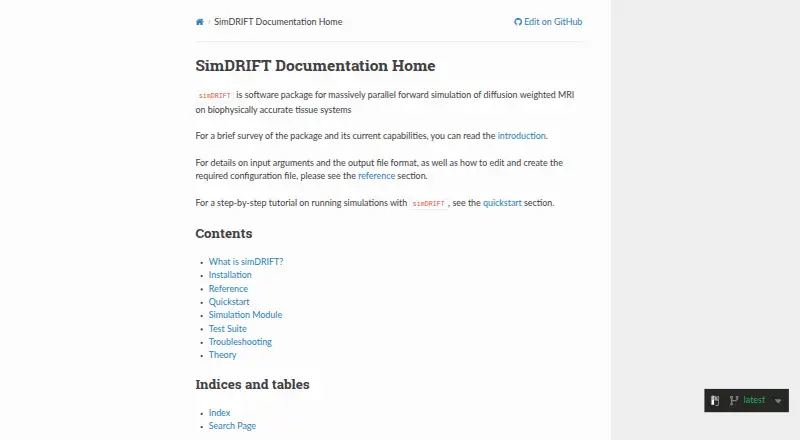
simDRIFT is open-source desktop software for massively parallel Monte Carlo forward simulations of diffusion-weighted MRI experiments in biophysical tissue systems. It is intended for diffusion MRI researchers and can support signal-processing model development, validation, and teaching. The Python package uses Numba’s CUDA API to simulate spin trajectories on GPU threads, with mesh-free tissue modeling. Fiber bundles can be configured as cylinders or sticks with user-defined radii, intrinsic diffusivities, orientations, and densities; cells are represented as isotropic spheres or balls. Built-in DBSI, ABCD, and NODDI diffusion schemes are available, and users can supply b-value and gradient-direction files. Outputs may include spin trajectories, NIfTI signal files, an execution log, and a copy of the input configuration. It runs on Linux and Windows, requires Python 3.8 or later and a CUDA device with compute capability 3 or higher, and documents a GPU-enabled Google Colab workflow. The project is under active development and licensed BSD-3-Clause.
Who it suits
It suits diffusion MRI researchers developing or validating signal-processing models, as well as instructors teaching signal processing or diffusion imaging. Users need Python 3.8 or later and a suitable CUDA device.
What it does well
- Mesh-free Monte Carlo tissue simulations
- Configurable fibers and isotropic cell models
- Built-in DBSI, ABCD, and NODDI schemes
- Exports trajectories, NIfTI signals, and logs
- Linux and Windows desktop support
What to know first
- Requires a CUDA device with compute capability 3+
- Cell random-walk model assumes zero exchange
- Higher cell fractions can increase runtime substantially
- Documentation recommends no more than four fiber bundles
Verdict
simDRIFT provides configurable GPU simulations for diffusion-weighted MRI modeling and teaching. Its hardware requirements and stated modeling limits should be checked before configuring larger experiments.
Facts from simDRIFT's own pages
- Authoring tools
- Yes · simdrift.readthedocs.io, 24 Sept 2026
- Availability
- The project README describes simDRIFT as open-source software. · github.com, 11 Oct 2026
- Cell limits
- The reference recommends keeping total cell volume fraction at or below 0.40 because higher densities make sphere packing difficult and increase runtime. · simdrift.readthedocs.io, 11 Oct 2026
- Colab
- The quickstart provides GPU-enabled Google Colab installation steps for running an example simulation. · simdrift.readthedocs.io, 11 Oct 2026
- Colab workflow
- The quickstart describes a Google Colab GPU workflow for installing simDRIFT and running a basic simulation. · simdrift.readthedocs.io, 11 Oct 2026
- Configurable fibers
- Fiber bundles support user-defined radii, intrinsic diffusivities, orientations, and densities; the reference recommends no more than three or four bundles. · simdrift.readthedocs.io, 11 Oct 2026
- Data export
- Yes · simdrift.readthedocs.io, 24 Sept 2026
- Delivery mode
- desktop · simdrift.readthedocs.io, 24 Sept 2026
- Diffusion schemes
- The reference lists built-in DBSI, ABCD, and NODDI diffusion schemes, and allows user-supplied b-value and gradient-direction files. · simdrift.readthedocs.io, 11 Oct 2026
- Founded
- 2023 · simdrift.readthedocs.io, 19 Oct 2026
- Free plan
- Yes · simdrift.readthedocs.io, 24 Sept 2026
- GPU requirement
- simDRIFT requires a CUDA device with compute capability 3 or higher and is compatible with Python 3.8 or later. · simdrift.readthedocs.io, 11 Oct 2026
- Implementation
- The GitHub project says simDRIFT is written in Python and uses Numba's CUDA API to simulate spin trajectories in parallel on GPU threads. · github.com, 11 Oct 2026
- Installation
- The guide recommends a dedicated conda environment and installs the package from its GitHub source repository using pip. · simdrift.readthedocs.io, 11 Oct 2026
- Intended users
- The documentation identifies diffusion MRI researchers as the intended users and says the software may also be useful for signal-processing or diffusion-imaging instructors. · simdrift.readthedocs.io, 11 Oct 2026
- License
- The GitHub repository identifies the project license as BSD-3-Clause. · github.com, 11 Oct 2026
- Mesh-free simulation
- The package describes its Monte Carlo simulations as mesh-free, avoiding the need to create meshes for tissue geometries. · simdrift.readthedocs.io, 11 Oct 2026
- Modeling limitation
- The simulation documentation says its cell random-walk implementation assumes zero exchange between compartments and is physically accurate only when diffusion time is less than the stated exchange time. · simdrift.readthedocs.io, 11 Oct 2026
- Model limits
- The reference recommends no more than three or four fiber bundles and says cell fractions above 0.40 can substantially increase runtime. · simdrift.readthedocs.io, 11 Oct 2026
- Outputs
- Simulation results can include spin trajectories, NIfTI signal files, an execution log, and a copy of the input configuration. · simdrift.readthedocs.io, 11 Oct 2026
- Project status
- The documentation says the project is under active development. · simdrift.readthedocs.io, 11 Oct 2026
- Purpose
- simDRIFT runs massively parallel Monte Carlo forward simulations of diffusion-weighted MRI experiments in biophysical tissue systems. · simdrift.readthedocs.io, 11 Oct 2026
- Requirements
- The installation guide specifies Python 3.8 or later and a CUDA device with compute capability 3 or higher. · simdrift.readthedocs.io, 11 Oct 2026
- Scale guidance
- The reference recommends 256,000 walkers for quick small simulations and 1,000,000 for larger simulations. · simdrift.readthedocs.io, 11 Oct 2026
Where simDRIFT stands on Freedom251
- Physics Simulation Software#57 of 89