Freedom251 › Physics Simulation Software
oxDNA
What oxDNA is
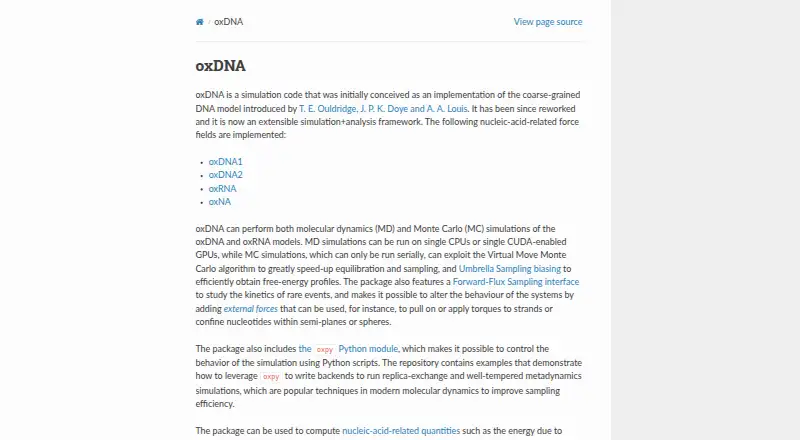
oxDNA is a free, open-source framework for simulating and analyzing nucleic acids with coarse-grained models. Its documented force fields are oxDNA1, oxDNA2, oxRNA, and oxNA. The software performs molecular dynamics and Monte Carlo simulations; molecular dynamics can use one CPU or one CUDA-enabled GPU, while Monte Carlo runs serially. Sampling includes Virtual Move Monte Carlo, Umbrella Sampling, and a Forward-Flux Sampling interface. The oxpy Python module controls simulations with scripts, including examples for replica exchange and well-tempered metadynamics. oxDNA_analysis_tools provides trajectory utilities for alignment, mean structures, subsetting, distances, and interduplex angles. Linux, macOS, and self-hosted use are listed. Installation requires obtaining the source or archive and compiling with CMake and make. Compilation needs CMake and a C++14-compliant g++; CUDA additionally needs CMake 3.5 or newer and CUDA toolkit 10 or newer. Python 3.11 or newer is specified for oxpy and analysis tools.
Who it suits
oxDNA suits researchers and developers modeling DNA or RNA who can compile scientific software and work with Python. It supports Linux, macOS, and self-hosted workflows.
What it does well
- Supports four documented nucleic-acid force fields
- Provides molecular dynamics and Monte Carlo methods
- Includes Python simulation bindings
- Offers trajectory analysis utilities
- Free GPL-3.0 open source
What to know first
- Simulations run on single CPU cores or GPUs
- Monte Carlo simulations run serially
- Compilation requires CMake and C++14 g++
- Python tools specify Python 3.11 or newer
Plans
| Plan | Billed and limits | Price |
|---|---|---|
| oxDNA | GPL-3.0; standalone software compiled from source | Free |
As lorenzo-rovigatti.github.io lists them, read 4 Oct 2026. The maker's own page has the final word.
Verdict
oxDNA combines coarse-grained DNA and RNA simulation with scriptable control and trajectory analysis. It is suited to technical users who can compile the GPL-licensed software and accept its single-device simulation limit.
Facts from oxDNA's own pages
- Analysis
- oxDNA_analysis_tools provides trajectory analysis tools including alignment, mean structures, subsetting, distances, and interduplex angles. · lorenzo-rovigatti.github.io, 4 Oct 2026
- Compute support
- MD simulations can run on a single CPU or a single CUDA-enabled GPU, while MC simulations run serially. · lorenzo-rovigatti.github.io, 4 Oct 2026
- Force fields
- The documented nucleic acid force fields are oxDNA1, oxDNA2, oxRNA, and oxNA. · lorenzo-rovigatti.github.io, 4 Oct 2026
- Installation
- Users clone the repository or extract an archive, then compile the software with CMake and make. · lorenzo-rovigatti.github.io, 4 Oct 2026
- License
- The repository includes the GNU General Public License, version 3. · github.com, 4 Oct 2026
- Parallelism limit
- The repository FAQ says oxDNA simulations run on single CPU cores or single GPUs; Python bindings can be used to implement parallel algorithms on top. · github.com, 4 Oct 2026
- Purpose
- oxDNA is an extensible simulation and analysis framework based on coarse-grained nucleic acid models. · lorenzo-rovigatti.github.io, 4 Oct 2026
- Python bindings
- The oxpy Python module lets users control simulations with Python scripts, with examples for replica exchange and well-tempered metadynamics. · lorenzo-rovigatti.github.io, 4 Oct 2026
- Python requirement
- The installation documentation says oxpy and OxDNA Analysis Tools require Python 3.11 or newer, with instructions for using oxpy with older versions. · lorenzo-rovigatti.github.io, 4 Oct 2026
- Requirements
- Compilation requires CMake and a C++14-compliant g++; CUDA support requires CMake 3.5 or newer and CUDA toolkit 10 or newer. · lorenzo-rovigatti.github.io, 4 Oct 2026
- Sampling
- The package supports Virtual Move Monte Carlo, Umbrella Sampling, and a Forward-Flux Sampling interface. · lorenzo-rovigatti.github.io, 4 Oct 2026
- Security and support
- The opened project pages provide no security or compliance claims and identify no formal support service. · github.com, 4 Oct 2026
- Simulation methods
- It performs molecular dynamics and Monte Carlo simulations of oxDNA and oxRNA models. · lorenzo-rovigatti.github.io, 4 Oct 2026
Where oxDNA stands on Freedom251
- Physics Simulation Software#53 of 89