Freedom251 › Build Cache Software
Silo
What Silo is
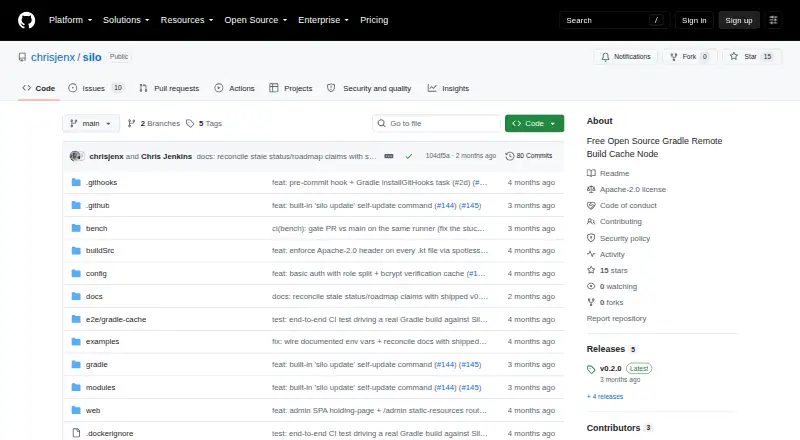
Silo is an open-source, self-hosted HTTP server for remote Gradle build caching. It implements the Gradle cache protocol’s GET, PUT and HEAD methods, allowing Gradle clients to retrieve, upload and check cached artifacts. The project is designed as a replacement for the end-of-life Gradle Remote Build Cache Node. Silo runs on Linux, requires JVM 21 or later, and is delivered either as a fat JAR or as a multi-architecture Docker image for linux/amd64 and linux/arm64. Filesystem storage is available now, while S3 and GCS are listed as roadmap work. Cache administration includes least-recently-used eviction, time-to-live rules, byte and entry limits, and reserved free-space thresholds. Authentication supports HTTP Basic and OIDC/Bearer with read-only or read-write role mapping. Operators get Prometheus metrics, JSON-structured logs, health and readiness endpoints, a live statistics stream and a single-page dashboard at /admin. The project states that it has no phone-home telemetry or accounts, supports atomic writes with crash recovery, and publishes cosign-signed releases with checksums and CycloneDX SBOMs. Silo is free under Apache-2.0 and describes its current status as alpha and pre-1.0.
Who it suits
Silo suits teams running Gradle builds that want to host their own remote cache on Linux. It is aimed at operators comfortable with JVM 21, Docker or JAR deployment, authentication configuration and filesystem administration.
What it does well
- Free Apache-2.0 self-hosted Gradle cache
- Supports GET, PUT and HEAD cache methods
- HTTP Basic and OIDC/Bearer authentication
- LRU, TTL, byte and entry cache controls
- Prometheus metrics and health endpoints
- Linux amd64 and arm64 Docker images
What to know first
- Project is currently alpha and pre-1.0
- S3 and GCS storage remain roadmap items
- Requires JVM 21 or later
- Only the latest v0.x release receives security fixes
Limits
The free plan is self-hosted and currently provides filesystem storage. S3, GCS, compression and replication are described as open work, and the project is pre-1.0 with security fixes limited to the latest v0.x release.
Plans
| Plan | Billed and limits | Price |
|---|---|---|
| Silo | Self-hosted Gradle build cache · Apache-2.0 · filesystem storage | Free |
As github.com lists them, read 8 Oct 2026. The maker's own page has the final word.
Getting started
- Open the Silo GitHub website
- Choose the fat JAR or Linux Docker image for your architecture
- Provide a JVM 21-or-later environment when using the JAR
- Configure filesystem storage and cache policies
- Set HTTP Basic or OIDC/Bearer roles
- Connect Gradle clients to the Silo HTTP cache
Verdict
Pick Silo if you need a free, self-hosted Gradle remote cache with configurable access, eviction and monitoring. Look elsewhere if you require available S3 or GCS backends, compression or replication, or prefer a product beyond alpha status.
Questions
How much does Silo cost?
Silo is listed as free under its free self-hosted plan.
Which build system does Silo support?
Silo supports Gradle through the Gradle HTTP build cache protocol.
Which platforms can run Silo?
It runs on Linux and is distributed as a fat JAR or Docker images for linux/amd64 and linux/arm64. The JAR requires JVM 21 or later.
Is Silo open source?
Yes. Silo is open source under the Apache-2.0 license.
What storage backend is available?
Filesystem storage is implemented. S3 and GCS are roadmap items.
Facts from Silo's own pages
- Admin dashboard
- Silo includes a single-page admin dashboard at /admin, and its live demo runs with simulated data without installation or a backend. · github.com, 8 Oct 2026
- Authentication
- Silo supports HTTP Basic and OIDC/Bearer authentication with read-only and read-write role mapping. · github.com, 8 Oct 2026
- Cache management
- It supports LRU eviction, TTL, byte and entry caps, and reserved free-space thresholds. · github.com, 8 Oct 2026
- Current status
- The project describes itself as alpha and says S3/GCS backends, compression, and replication remain open work. · github.com, 8 Oct 2026
- Deployment
- Silo is distributed as a fat JAR and a multi-architecture Docker image for linux/amd64 and linux/arm64. · github.com, 8 Oct 2026
- Implementation
- Silo is written in Kotlin using Ktor and requires JVM 21 or later. · github.com, 8 Oct 2026
- Monitoring
- Silo provides Prometheus metrics, JSON-structured logs, health and readiness endpoints, and a live stats stream. · chrisjenx.github.io, 8 Oct 2026
- Protocol
- It supports the Gradle HTTP build cache protocol methods GET, PUT, and HEAD. · github.com, 8 Oct 2026
- Purpose
- Silo is a self-hosted HTTP server that speaks the Gradle build cache protocol and replaces the end-of-life Gradle Remote Build Cache Node. · github.com, 8 Oct 2026
- Release integrity
- The security policy says release artifacts are cosign-signed, the fat JAR has a SHA-256 checksum, and every release includes a CycloneDX SBOM. · github.com, 8 Oct 2026
- Security
- The project says it has no phone-home telemetry or accounts and supports atomic writes with crash recovery. · github.com, 8 Oct 2026
- Security support
- Silo is pre-1.0, and only the latest v0.x release receives security fixes; the policy promises acknowledgement within 3 business days and initial assessment within 7 business days. · github.com, 8 Oct 2026
- Storage
- Filesystem storage is implemented, while S3 and GCS are listed as roadmap items. · github.com, 8 Oct 2026
Where Silo stands on Freedom251
- Build Cache Software#15 of 23