Freedom251 › Spatial Databases
SedonaDB
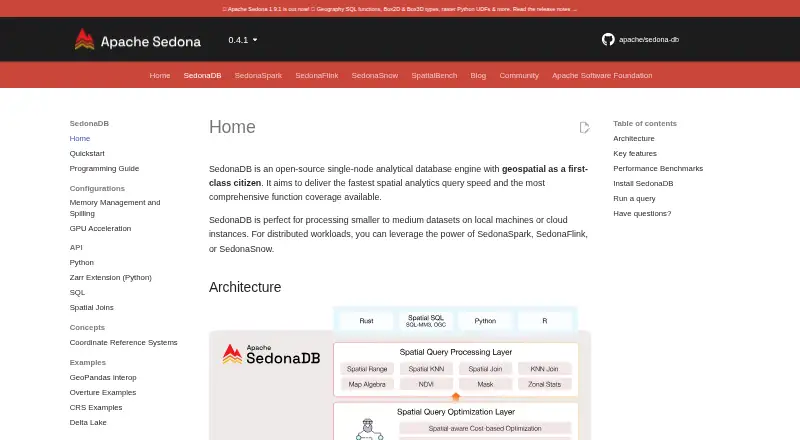
What SedonaDB is
SedonaDB is a free, open-source, single-node analytical database engine built around geospatial data. It is intended for smaller and medium datasets on a local machine or cloud instance; the project points to SedonaSpark, SedonaFlink, or SedonaSnow for distributed workloads. Its architecture uses columnar in-memory datasets, spatial indexing, coordinate reference system tracking, and Arrow format. Python and SQL interfaces are available, and the quickstart documents an R package and SQL query function. Query types include spatial range, KNN, spatial joins, and KNN joins. SedonaDB interoperates with PyArrow-compatible libraries such as GeoPandas, DuckDB, and Polars. Its named formats include GeoParquet, Shapefile, and GeoJSON, with vector support also covering WKT, WKB, and formats supported by GeoPandas. Documentation demonstrates reading from AWS S3 and using Iceberg tables through PyIceberg and Arrow. The project is an Apache Sedona subproject governed by the Apache Software Foundation and licensed under Apache-2.0.
Who it suits
SedonaDB suits developers and analysts working with geospatial data in a single-node setup, especially on local machines or cloud instances. It is aimed at smaller and medium datasets rather than distributed workloads.
What it does well
- Provides Python and SQL interfaces.
- Supports spatial range, KNN, and join queries.
- Works with GeoPandas, DuckDB, and Polars.
- Supports memory-limited execution with automatic spill-to-disk.
- Free and open source under Apache-2.0.
What to know first
- The default execution mode has no memory limit and does not spill to disk.
- GPU-accelerated spatial joins require CUDA 12 or later and a qualifying NVIDIA GPU.
- The single-node engine is not aimed at distributed workloads.
Plans
| Plan | Billed and limits | Price |
|---|---|---|
| Apache SedonaDB | Open-source single-node engine · no paid tiers stated | Free |
As sedona.apache.org lists them, read 2 Oct 2026. The maker's own page has the final word.
Getting started
- Open the SedonaDB website
- Deploy the engine on Linux or another self-hosted environment
- Choose Python, SQL, or the documented R package interface
- Connect data from supported formats, AWS S3, or Iceberg tables
- Use spatial queries, joins, indexing, and coordinate transforms
- Integrate results with PyArrow-compatible libraries
Verdict
SedonaDB offers geospatial querying and interoperability for single-node analytical work. Check the execution defaults and GPU requirements against your workload before choosing it.
Questions
What does SedonaDB cost?
The Apache SedonaDB plan is free. It is open source, with no paid tiers stated.
Where can SedonaDB run?
SedonaDB is listed for Linux and self-hosted deployment.
Which interfaces are available?
SedonaDB offers Python and SQL interfaces, and its quickstart documents an R package and SQL query function.
What file formats can it use?
Named formats include GeoParquet, Shapefile, GeoJSON, WKT, WKB, and formats supported by GeoPandas.
Does it support distributed workloads?
SedonaDB is single-node; the project points to SedonaSpark, SedonaFlink, or SedonaSnow for distributed workloads.
What license governs the project?
SedonaDB is an Apache Sedona subproject governed by the Apache Software Foundation and licensed under Apache-2.0.
Facts from SedonaDB's own pages
- Architecture
- Its architecture uses columnar in-memory datasets, spatial indexing, CRS tracking, and Arrow format. · sedona.apache.org, 2 Oct 2026
- File formats
- The feature list names GeoParquet, Shapefile, and GeoJSON; the repository README says vector support includes GeoParquet, WKT, WKB, and formats supported by GeoPandas. · sedona.apache.org, 2 Oct 2026
- Founded
- 2025 · sedona.apache.org, 28 Sept 2026
- Governance and license
- The repository describes SedonaDB as a subproject of Apache Sedona governed by the Apache Software Foundation and identifies its license as Apache-2.0. · github.com, 2 Oct 2026
- GPU support
- GPU-accelerated spatial joins require a SedonaDB build with GPU support, NVIDIA CUDA 12 or later, and an NVIDIA GPU with compute capability 7.5 or higher. · sedona.apache.org, 2 Oct 2026
- Integrations
- The project describes interoperability with PyArrow-compatible libraries including GeoPandas, DuckDB, and Polars. · sedona.apache.org, 2 Oct 2026
- Intended workloads
- The project describes SedonaDB as suited to smaller and medium datasets on local machines or cloud instances, and points to SedonaSpark, SedonaFlink, or SedonaSnow for distributed workloads. · sedona.apache.org, 2 Oct 2026
- Interfaces
- SedonaDB offers Python and SQL interfaces, and its quickstart also documents an R package and SQL query function. · sedona.apache.org, 2 Oct 2026
- Memory limits
- Memory-limited execution with automatic spill-to-disk is supported, but the documented default enforces no memory limit and does not spill to disk. · sedona.apache.org, 2 Oct 2026
- Raster support
- The repository README says raster support is coming soon; release notes for 0.4.1 list GDAL-backed raster functions and raster-vector spatial joins. · github.com, 2 Oct 2026
- Security
- The repository page links to a Security policy, but the opened page does not state specific security certifications or compliance claims. · github.com, 2 Oct 2026
- Spatial queries
- Documented query types include spatial range, KNN, spatial join, and KNN join queries. · sedona.apache.org, 2 Oct 2026
- Storage integration
- The documentation demonstrates reading data from AWS S3 and working with Iceberg tables through PyIceberg and Arrow. · sedona.apache.org, 2 Oct 2026
- Support
- The project directs users to GitHub Discussions and its Discord community to ask developers questions. · sedona.apache.org, 2 Oct 2026
- What it does
- SedonaDB is an open-source single-node analytical database engine with geospatial data as a first-class citizen. · sedona.apache.org, 2 Oct 2026
Where SedonaDB stands on Freedom251
- Spatial Databases#27 of 40