Freedom251 › Minecraft Schematic Tools
schematic4j
What schematic4j is
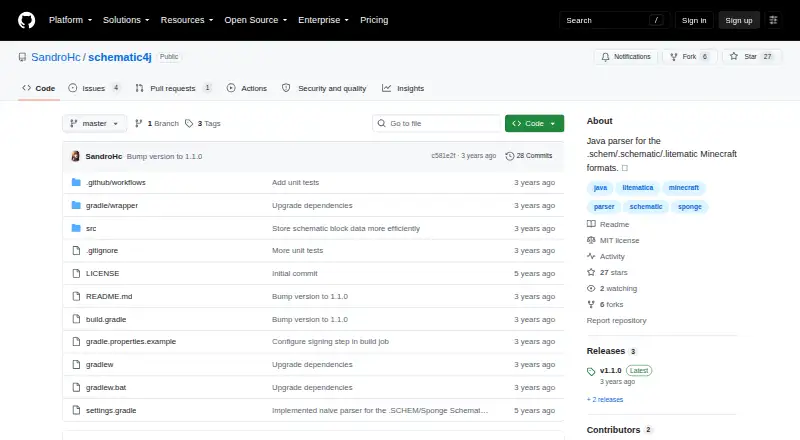
schematic4j is a free Java library for reading Minecraft schematic files in Sponge Schematic (.schem), Litematica (.litematic), and Schematica (.schematic) formats. It supports Sponge Schematic versions 1, 2, and 3. A Java application can load a file with `SchematicLoader.load()` and access its name, width, height, length, and the block at a chosen coordinate. The usage example also shows collecting blocks, block entities, and entities. Version 1.1.0 added Litematica and Schematica support and reduced memory use for Sponge schematics. Its release notes also describe updated block and biome iterators that return positions alongside blocks, and deprecate `SchematicUtil` in favor of `SchematicLoader`. The project provides Gradle and Maven dependency instructions for version 1.1.0 through Maven Central, with JitPack linked for development builds. It uses the MIT License, which permits use and distribution under its conditions; the license provides the software without warranty.
Who it suits
It suits Java developers who need to load Minecraft schematic files and inspect their contents in a Gradle or Maven project.
What it does well
- Reads .schem, .schematic, and .litematic files.
- Supports Sponge Schematic versions 1, 2, and 3.
- Exposes dimensions, blocks, block entities, and entities.
- Version 1.1.0 is available through Maven Central.
What to know first
- The MIT license provides the software without warranty.
- It is a Java library added as a project dependency.
Plans
| Plan | Billed and limits | Price |
|---|---|---|
| Schematic4j | Java library · supports .schem, .schematic, and .litematic formats | Free |
As github.com lists them, read 11 Oct 2026. The maker's own page has the final word.
Getting started
- Open the project website on GitHub.
- Add net.sandrohc:schematic4j:1.1.0 from Maven Central to a Gradle or Maven project.
- Use `SchematicLoader.load()` to load a schematic file.
- Access the schematic name, dimensions, blocks, block entities, or entities.
Verdict
schematic4j provides Java projects with access to three Minecraft schematic formats and their contents. It is free, with installation instructions for Gradle and Maven.
Questions
Is schematic4j free?
Yes. Its listed price is free, and it has a free plan.
Which schematic formats does it support?
It supports Sponge Schematic (.schem), Litematica (.litematic), and Schematica (.schematic). Sponge Schematic support includes versions 1, 2, and 3.
How do I add it to a project?
The README provides Gradle and Maven dependency instructions for version 1.1.0 through Maven Central. JitPack is linked for development builds.
What data can a Java project access?
The usage example shows access to a schematic's name, dimensions, blocks, block entities, and entities.
What license does it use?
schematic4j uses the MIT License, which permits use, copying, modification, distribution, sublicensing, and sale subject to its conditions. The software is provided without warranty.
Facts from schematic4j's own pages
- Development builds
- The README directs users to JitPack for development builds. · github.com, 11 Oct 2026
- Distribution
- The release notes say version 1.0.1 became available in Maven Central, so the JitPack repository was no longer required for that version. · github.com, 4 Oct 2026
- Exposed data
- The usage example shows access to schematic name, dimensions, blocks, block entities, and entities. · github.com, 4 Oct 2026
- Installation
- The README provides Gradle and Maven dependency instructions for version 1.1.0, available through Maven Central. · github.com, 4 Oct 2026
- Install with Gradle
- The README gives the Maven Central dependency net.sandrohc:schematic4j:1.1.0 for Gradle. · github.com, 11 Oct 2026
- Install with Maven
- The README gives the net.sandrohc:schematic4j:1.1.0 dependency coordinates for Maven. · github.com, 11 Oct 2026
- Intended users
- The README describes a Java library used by adding it as a dependency to a Gradle or Maven project. · github.com, 11 Oct 2026
- Issue tracking
- The project build metadata identifies GitHub as its issue management system. · github.com, 11 Oct 2026
- License
- The project is distributed under the MIT License, which grants use, copying, modification, distribution, sublicensing, and sale subject to its stated conditions. · github.com, 11 Oct 2026
- Loading files
- The README shows loading a schematic from a file with SchematicLoader.load(). · github.com, 4 Oct 2026
- Purpose
- Schematic4j is a Java parser for Minecraft .schem, .schematic, and .litematic formats. · github.com, 4 Oct 2026
- Read collections
- The usage example shows collecting blocks, block entities, and entities from a schematic. · github.com, 11 Oct 2026
- Read schematic data
- The usage example shows access to a schematic’s name, width, height, length, and block at a specified coordinate. · github.com, 11 Oct 2026
- Release changes
- Version 1.1.0 notes say block and biome iterators return positions with blocks, and SchematicUtil is deprecated in favor of SchematicLoader. · github.com, 4 Oct 2026
- Release features
- Version 1.1.0 release notes list Litematica and Schematica support and reduced memory use for Sponge schematics. · github.com, 4 Oct 2026
- Supported format
- It supports Sponge Schematic files with the .schem extension, including versions 1, 2, and 3. · github.com, 11 Oct 2026
- Supported formats
- The README lists Sponge Schematic (.schem), Litematica (.litematic), and Schematica (.schematic). · github.com, 4 Oct 2026
- Warranty
- The MIT license states that the software is provided as is, without warranty. · github.com, 4 Oct 2026
- What it does
- Schematic4j is a Java parser for Minecraft .schem, .schematic, and .litematic formats. · github.com, 11 Oct 2026
Where schematic4j stands on Freedom251
- Minecraft Schematic Tools#24 of 42