Freedom251 › Decision Management Software
Rulebricks
What Rulebricks is
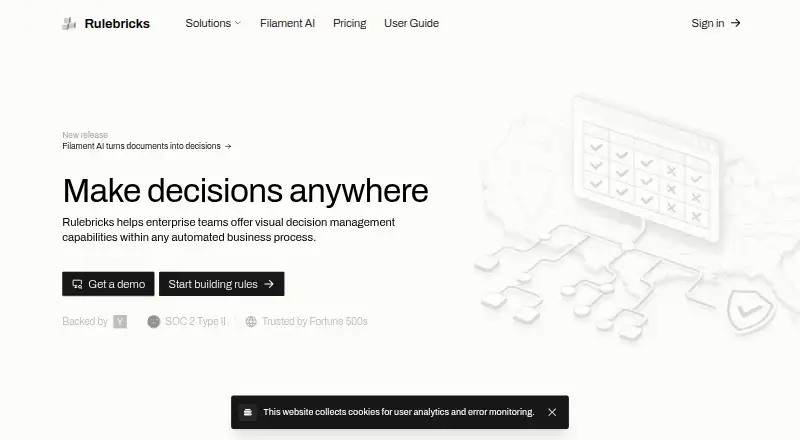
Rulebricks is a visual decision management platform for teams that automate business processes. Domain experts and process owners can model decisions through a no-code interface and publish API endpoints, while developers can use the API to solve and manage rules, flows, contexts, logs, values, and users. Excel models can be imported to generate rules, and multiple rules can be orchestrated in workflows. A test management interface and API help check rules before deployment; what-if backtests help assess changes to rule conditions. Decision tables can power embeddable calculators, with branding and embedding options. Listed integrations include Salesforce, Excel, Zapier, and PostgreSQL, and the maker says it can connect wherever an API can be called. Developer tools include a JavaScript component for embedding the UI. Deployment options include major cloud providers, on-premises environments, and air-gapped setups, with isolated tenants, single sign-on, and fine-grained access controls. The free Design plan allows up to 10 rules and flows, 1,000 monthly executions, and five team members. Paid pricing is listed from $200/mo (annual).
Who it suits
Rulebricks suits domain experts and process owners who need to update business decisions without writing code, as well as teams deploying rule-based workflows through APIs. Its deployment options also address organizations needing on-premises or air-gapped environments.
What it does well
- No-code interface for modeling business decisions.
- What-if backtests assess rule-condition changes.
- Imports Excel models to generate rules.
- Testing UI and API check rules before deployment.
- Supports on-premises and air-gapped deployment.
What to know first
- Free Design plan limits rules and flows to 10.
- Free Design plan allows 1,000 monthly executions.
- All plans are billed annually.
Limits
The free Design plan allows up to 10 rules and flows, 1,000 monthly rule executions, and five team members with RBAC. Paid plans start at $200/mo (annual).
Plans
| Plan | Billed and limits | Price |
|---|---|---|
| Design | All plans are billed annually · Up to 10 rules and flows · Up to 1,000 monthly rule executions · Up to 5 team members with RBAC · Rule versioning and changelog · Daily email support | Free |
| Professional | All plans are billed annually · Unlimited unique rules · Up to 10,000 monthly rule executions · Up to 5 team members with RBAC · Rule logging and analytics · Free onboarding session · Live chat support | $200 a month |
| Business | All plans are billed annually · Unlimited rules and flows · Up to 1M monthly rule executions · Up to 10 team members with RBAC · Built-in multi-tenant capabilities · Dedicated Slack channel · Four-hour response SLA and engineering support | $850 a month |
| Embedded | All plans are billed annually · Unlimited rules, flows, users and executions · Zero-cost proof of concept and migration support · Direct UI embedding support · Private or hybrid deployment · On-site training and support · One-hour SLA and on-call line | On request |
As rulebricks.com lists them, read 15 Oct 2026. The maker's own page has the final word.
Getting started
- Go to https://rulebricks.com/.
- Start with the free Design plan or choose a paid plan.
- Use the no-code interface to model decisions and rules.
- Import an Excel model if you want to generate rules from spreadsheet data.
- Test rules in the management interface or API before deployment.
- Publish rules as API endpoints and connect them to your applications.
Rulebricks is a visual decision-management platform for teams automating business processes with rules. It suits process owners who need to shape decisions alongside developers responsible for integration and deployment. Its breadth is compelling, but the free plan’s execution and seat caps may constrain a growing team.
Overview
Teams can author decisions visually without code and publish them as API endpoints. Decision tables and what-if backtests support both structuring business logic and assessing the impact of proposed changes. That makes Rulebricks a stronger fit for recurring operational decisions than for a one-off rule set that does not need testing or managed deployment.
Rulebricks also orchestrates multiple rules and provides a test-management interface and API for checking them before deployment. Its API can solve and manage rules, flows, contexts, decision logs, values, and users, giving developers programmatic access beyond simply calling a decision endpoint.
Key features
Native Excel model import can help teams bring spreadsheet logic into a rule system rather than maintain it separately. Integrations include Salesforce, Excel, Zapier, and PostgreSQL; the platform can also connect to systems that accept API calls. This range makes it useful where decisions must sit among existing business tools, although integration still depends on the receiving systems and API work involved.
Embeddable calculators built from decision tables, application-wide branding, and embedding options provide a way to surface decisions in other applications. A JavaScript component supports embedding the UI, while programmatic tools cover inviting users, managing tenants, constructing rules, and uploading tests. These capabilities offer developers several integration paths without making authoring exclusively a coding task.
For larger or more controlled deployments, Rulebricks supports multiple isolated tenants, single sign-on, fine-grained access control, major cloud providers, on-premises deployment, and air-gapped environments. Its trust center identifies SOC 2 Type 1 and Type 2 as compliant. Those controls broaden its potential fit, but the more extensive deployment and support needs point toward higher-tier plans.
Pricing
Rulebricks is freemium, with paid plans starting at $200/mo (annual). All plans are billed annually, so the paid entry price carries a yearly commitment. The paid starting price is not a quote for every plan: Business, Professional, and Embedded have custom pricing.
- Design: free. It allows up to 10 rules and flows, 1,000 monthly rule executions, and five team members with RBAC. Daily email support is included. This is a practical evaluation tier or a fit for a small, low-volume use case, but both execution and member caps can become restrictive.
- Professional: custom pricing. It includes unlimited unique rules, up to 10,000 monthly rule executions, five team members with RBAC, and live chat support. Compared with Design, it removes the rule-count cap and upgrades support, but the execution allowance remains relatively modest and the same seat limit applies.
- Business: custom pricing. It raises the allowance to up to 1M monthly rule executions and 10 team members with RBAC, with unlimited rules and flows. A dedicated Slack channel, four-hour response SLA, and engineering support suit teams with heavier usage and a need for responsive assistance.
- Embedded: custom pricing. It offers unlimited rules, flows, users, and executions, plus zero-cost proof-of-concept and migration support, private or hybrid deployment options, and a one-hour SLA with an on-call line. This is the clearest fit for deployments with substantial volume or dedicated operational requirements, rather than a low-cost starting point.
Platforms
Rulebricks is available on web and through APIs, with self-hosted deployment also supported. Hybrid deployment is an option, and the enterprise deployment choices include cloud, on-premises, and air-gapped environments. This flexibility is useful for teams with deployment constraints, though self-hosting or isolation may require more operational involvement than a web-based setup.
Who it's for
Rulebricks is best suited to organizations where domain experts or process owners need to change business decisions without writing code, while developers handle APIs, embedding, or deployment. Teams that need to test decisions, coordinate multiple rules, or move spreadsheet logic into managed workflows have a particularly strong case. A solo user or small team with few rules and little execution volume may find the platform’s broader tooling unnecessary.
Pros and cons
- Pro: Visual authoring, Excel import, backtesting, and pre-deployment testing span the path from decision design to review.
- Pro: API management, integrations, UI embedding, and multiple deployment options support varied ways of putting rules into business processes.
- Pro: The Business and Embedded support commitments include defined response times, with engineering support or an on-call line at the higher tiers.
- Con: Design caps teams at 10 rules and flows, 1,000 monthly executions, and five members, limiting its headroom for broader use.
- Con: Professional retains a 10,000-execution limit and five-member cap; teams needing more capacity move to a custom-priced tier.
- Con: Paid plans are billed annually, and custom pricing for the paid tiers makes the cost of scaling beyond Design less predictable.
Alternatives
For a broader comparison, see Business Rules Management Software.
- GoRules BRMS is worth considering for teams wanting a freemium option across desktop, web, API, and self-hosted platforms; its Pro plan is $167 a month, billed $2,000 billed annually, with five users and defined project and deployment limits.
- AI Rule Engine may suit a team that can work within a smaller free allowance: its free plan provides 200 ruleset runs per month, two author seats, and a 7-day log retention period.
- DecisionRules is another freemium option, with a free plan for 10 business rules and flows, one user, one project, and 1,000 solver API calls; its free trial may also suit someone evaluating before committing.
- Nected offers a self-hosted free tier with unlimited rules and workflows and 1k daily invocations, making it an option for teams prioritizing that deployment model.
- Drools is a free, Java-based rules option for teams comfortable with a self-hosted, API-oriented platform rather than Rulebricks’ visual product.
- Decisions is an alternative for readers comparing low-code design studio software.
- FlexRule Open is an alternative for readers willing to request a quote.
- InRule Decisioning is an alternative for readers considering subscription licensing based on configurable components.
Verdict
Choose Rulebricks if process owners and developers need a shared system for authoring, testing, orchestrating, and publishing business decisions, especially when deployment flexibility or integrations matter. Its strongest advantage is covering much of that lifecycle in one platform. Look elsewhere if a small execution allowance, limited seats, annual billing, or custom-priced scaling does not fit your needs.
Verdict
Rulebricks combines visual rule authoring, testing, workflow orchestration, and API publishing. The free Design plan has explicit limits, while paid plans are billed annually.
Questions
Does Rulebricks have a free plan?
Yes. The Design plan is free and includes up to 10 rules and flows, 1,000 monthly executions, and five team members with RBAC.
How much does Rulebricks cost?
The listed starting price is $200/mo (annual). Business, Professional, and Embedded plan prices are not given here.
Which platforms does Rulebricks support?
The listed platforms are API, self-hosted, and web.
What does Rulebricks integrate with?
Native integrations listed include Salesforce, Excel, Zapier, and PostgreSQL. The maker says it can connect wherever an API can be called.
Can Rulebricks be deployed on premises?
Yes. The maker lists on-premises deployment, as well as major cloud providers and air-gapped environments.
What support comes with the plans?
Design lists daily email support, Professional lists live chat, Business lists a dedicated Slack channel and a four-hour response SLA, and Embedded lists a one-hour SLA with an on-call line.
Facts from Rulebricks's own pages
- API access
- The API reference documents endpoints for solving and managing rules, flows, contexts, decision logs, values, and users programmatically. · rulebricks.com, 7 Oct 2026
- Bulk API limit
- The bulk-solve endpoint accepts at most 1,000 JSON payloads per request. · rulebricks.com, 15 Oct 2026
- Collaboration and AI
- The platform advertises real-time collaboration and AI features for modeling complex multi-variable decisions. · rulebricks.com, 15 Oct 2026
- Company background
- The company says it built Rulebricks after years of work in RPA and experience with the limits of logic in automation platforms. · rulebricks.com, 7 Oct 2026
- Company origin
- Rulebricks says it was created after its team spent years building robotic-process-automation software and encountered limits in built-in automation logic. · rulebricks.com, 15 Oct 2026
- Crunchbase funding
- Crunchbase categorizes the company as private, pre-seed and records one pre-seed round backed by Y Combinator, with the amount obscured. · crunchbase.com, 15 Oct 2026
- Crunchbase legal entity
- Crunchbase identifies the legal name as Prefix Software, Inc. and the founder as Siddharth Garimella. · crunchbase.com, 15 Oct 2026
- Decision analysis
- The platform supports what-if backtests to help users assess the business impact of changing rule conditions. · rulebricks.com, 7 Oct 2026
- Decision tables
- Its core authoring model uses spreadsheet-like decision tables where conditions map to returned result data. · rulebricks.com, 15 Oct 2026
- Developer tools
- The developer toolkit includes a JavaScript component for embedding the UI and programmatic tools to invite users, manage tenants, construct rules, and upload tests. · rulebricks.com, 7 Oct 2026
- Documentation depth
- The user guide covers rule modeling, testing, publishing, releases, flows, contexts, analysis, forms, team management, private deployment, embedding and security. · rulebricks.com, 15 Oct 2026
- Enterprise controls
- The platform advertises isolated tenants, single sign-on, fine-grained access control and autoscaling deployment options. · rulebricks.com, 15 Oct 2026
- Enterprise deployment
- The maker lists support for multiple isolated tenants, single sign-on, fine-grained access control, major cloud providers, on-premises deployment, and air-gapped environments. · rulebricks.com, 7 Oct 2026
- Execution scale
- The maker claims microsecond-tier execution and batch or real-time processing at gigabyte-per-second speeds. · rulebricks.com, 15 Oct 2026
- Forms
- An embeddable form builder turns decision tables into calculators, quizzes or other branded forms. · rulebricks.com, 15 Oct 2026
- Forms and embedding
- Rulebricks supports embeddable calculators built from decision tables, along with application-wide branding and embedding options. · rulebricks.com, 7 Oct 2026
- GitHub public repositories
- The company GitHub organization publishes documentation, examples, Python, Node, C#, Java and CLI repositories, plus Helm charts for private deployments. · github.com, 15 Oct 2026
- GitHub repository licenses
- GitHub displays MIT licensing for the public docs, C# SDK and Spark repositories. · github.com, 15 Oct 2026
- Headquarters
- San Francisco, California, United States · rulebricks.com, 28 Sept 2026
- Impact analysis
- Users can run what-if backtests to estimate the effect of changing rule conditions. · rulebricks.com, 15 Oct 2026
- Integrations
- The maker lists native integrations with Salesforce, Excel, Zapier, and PostgreSQL, and says Rulebricks can connect anywhere an API can be called. · rulebricks.com, 7 Oct 2026
- Intended users
- Rulebricks says it helps domain experts and process owners update key business decisions without writing code. · rulebricks.com, 7 Oct 2026
- Lifecycle notifications
- Decision lifecycle hooks provide real-time notifications across multiple channels when decisions change. · rulebricks.com, 15 Oct 2026
- Limit: advanced orchestration
- Nected's review claims there is no GitHub sync, scheduler, event streaming or native multi-table workflow chaining for more elaborate event-driven architectures. · nected.ai, 15 Oct 2026
Where Rulebricks stands on Freedom251
- Decision Management Software#4 of 16
- Business Rules Management Software#7 of 18