Freedom251 › Life Sciences Software
RSpace
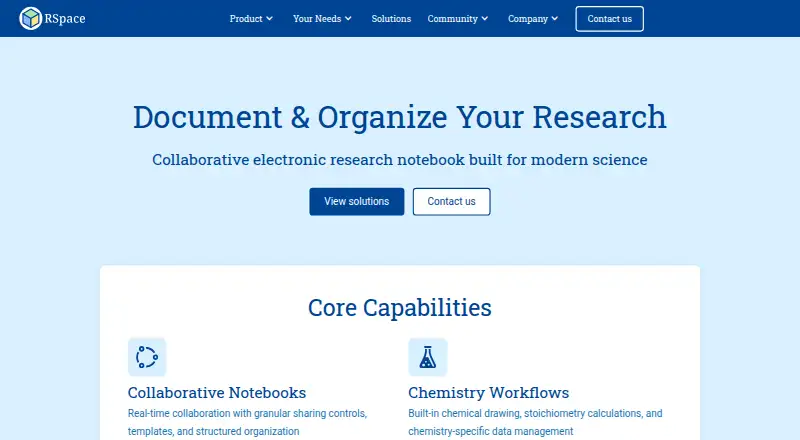
What RSpace is
RSpace is an open-source electronic research notebook and research data management platform for research workflows. Teams can collaborate in real time using granular sharing controls, comments, and annotations. Its chemistry tools support drawing and automatic stoichiometry calculations, while RSpace Inventory manages samples alongside notebook records. Forms offer structured fields and ontology integration for FAIR research metadata. Users can search full text and metadata, and export records in formats including PDF, Word, HTML, XML, JSON, and RO-Crate. A RESTful API supports custom integrations and workflows; the product page lists more than 20 integrations, though named connectors on its integrations page are marked “Soon!”. RSpace states that data is encrypted at rest and over a network and supports 21 CFR Part 11 compliance and GLP; Research Space identifies as ISO 27001 and SOC 2 certified. The browser-based app requires no end-user installation. Options include self-installation, managed instances, and Enterprise on-premises or private AWS deployment. A free open-source plan is available; paid plans start at $6,000 USD per year.
Who it suits
RSpace suits research teams and institutions that need shared electronic notebooks, inventory tracking, structured metadata, or configurable deployment. The company also describes serving research data managers, librarians, stewards, research computing specialists, and policymakers.
What it does well
- Real-time collaboration includes granular sharing, comments, and annotations.
- Chemical drawing and automatic stoichiometry support reaction planning.
- Inventory management accompanies ELN documentation.
- Exports include PDF, Word, HTML, XML, JSON, and RO-Crate.
- Enterprise offers on-premises or private AWS deployment.
What to know first
- Self-installation requires your own engineers.
- Global IDs, signatures, and full audit history cannot migrate between servers.
- Named connectors on the integrations page are marked “Soon!”.
- Enterprise plans cost $34,000 USD per year.
Limits
The RSpace Open Source plan is self-installed with your own engineers. Its migration cannot transfer Global IDs, digital signatures, or full audit history. Team plans are listed as minimal annual subscriptions; Enterprise plans add SSO and premium support.
Plans
| Plan | Billed and limits | Price |
|---|---|---|
| RSpace Open Source | Self-install with your own engineers · migration cannot transfer Global IDs, digital signatures, or full audit history | Free |
| Team (Commercial) | Minimal annual subscription · Managed RSpace instance · open-source features · Microsoft 365 interoperability · private AWS instance · backups · uptime SLA · basic training/support | $12,000 a year |
| Enterprise (Commercial) | Minimal annual subscription · On-premises or private AWS · SAML2/LDAP SSO · live training · migration · integration assistance · premium support · advanced analytics · co-branding · HIPAA available at extra charge | $34,000 a year |
| Enterprise (Academia) | Minimal annual subscription · On-premises or private AWS · SAML2/LDAP SSO · live training · migration · integration assistance · premium support · advanced analytics · co-branding · HIPAA available at extra charge | $34,000 a year |
| Team (Academia) | Minimal annual subscription · Managed RSpace instance · open-source features · Microsoft 365 interoperability · private AWS instance · backups · uptime SLA · basic training/support | $6,000 a year |
| Infrastructure | Custom open-source deployment into a Research Cloud or Research Commons · tailored services and support | On request |
As researchspace.com lists them, read 8 Oct 2026. The maker's own page has the final word.
Getting started
- Open the RSpace website in a modern browser.
- Choose the RSpace Open Source plan for self-installation with your own engineers, or select a Team or Enterprise plan.
- For a Team plan, use the managed instance with basic training and support.
- For Enterprise, choose on-premises or private AWS deployment.
- Contact the support team or use the knowledge base for help.
Overview
RSpace is an open-source electronic research notebook and research data management platform for research workflows. It best suits research teams that need structured records, inventory and chemistry tools, and control over deployment. Its breadth is compelling, but the annual subscription costs and migration limits deserve close attention.
Key features
RSpace brings notebook records together with sample and inventory management, so teams can connect documentation to the materials they track. Chemistry drawing and automatic stoichiometry calculations add practical support for reaction planning; teams without chemistry workflows may get less from that breadth.
Real-time collaboration, granular sharing controls, comments, and annotations support shared work without treating every record as equally accessible. Structured forms with ontology integration help organize FAIR research metadata, while full-text and metadata search can make those records easier to retrieve.
Exports include PDF, Word, HTML, XML, and RO-Crate; the platform also states JSON as an export format. A RESTful API supports custom integrations and workflows. The product page describes more than 20 integrations, but the integrations page marks named connectors “Soon!”, so teams depending on a particular connector should confirm its status before committing.
RSpace states that data is encrypted at rest and over a network, and supports 21 CFR Part 11 compliance and GLP. Research Space identifies itself as ISO 27001 and SOC 2 certified. Audit trails and electronic signatures are supported. These capabilities make RSpace relevant to regulated work, though buyers should assess their own compliance requirements.
Pricing
RSpace Open Source costs nothing. It is self-installed with the customer’s own engineers, making it the no-subscription route for organizations able to manage deployment themselves. It carries an important constraint: Global IDs, digital signatures, and full audit history cannot be migrated between servers.
Team (Academia) costs $6,000 a year, and Team (Commercial) costs $12,000 a year. Both are minimal annual subscriptions for a managed instance with basic training and support, hosted on a private AWS instance. These plans reduce internal hosting work, but the stated price gap makes the commercial tier substantially more expensive.
Enterprise (Academia) and Enterprise (Commercial) each cost $34,000 a year. Both include on-premises or private AWS deployment, SSO, premium support, and volume discounts for large deployments. This tier is aimed at organizations that need deployment choice and stronger support; it is a significant commitment compared with Team.
The contact page offers a support team and knowledge base, while Enterprise adds live chat and premium email support. The plans do not state seat or storage quotas. Evaluate the migration restriction especially carefully before changing servers or choosing a deployment path.
Platforms
RSpace runs as a web application in a modern browser, with no end-user software installation required. It also offers API access and self-hosted deployment. Enterprise customers can choose on-premises hosting or a private AWS instance in a location of their choice. This flexibility suits institutions with deployment requirements, though self-installation puts engineering responsibility on the customer.
Who it's for
RSpace is a strong fit for research groups and institutions that want notebook documentation connected to inventory, chemistry planning, structured metadata, and custom workflows. Its deployment options and stated compliance support also suit organizations with specific infrastructure or governance needs. A small team seeking a simple, low-cost hosted notebook may find the annual Team subscriptions hard to justify.
Pros and cons
- Broad research workflow coverage: Notebook, inventory, chemistry tools, metadata forms, exports, and API access sit in one platform.
- Deployment choice: Self-hosting, managed private AWS, and Enterprise on-premises options serve different infrastructure needs.
- Migration risk: Global IDs, digital signatures, and full audit history cannot be transferred between servers.
- High subscription threshold: Managed plans start at $6,000 a year, and Enterprise costs $34,000 a year.
- Connector uncertainty: Named integrations marked “Soon!” may not serve teams that require a specific connection immediately.
Alternatives
LabArchives is worth considering for teams seeking a freemium option; its free plan includes two owned notebooks, 1GB per user, a 25MB file limit, and SnapGene and GraphPad Prism integrations.
LabCollector ELN may suit a small group looking to start without subscription cost: its free Startup Pack covers three users and 1,000 data records, with ELN optional.
eLabFTW is an alternative for teams comfortable administering their own server; its self-hosted software is free under AGPLv3.
SciNote offers a free plan for one user with a dedicated workspace and no guaranteed support, making it an option for an individual starting out.
Benchling Notebook may fit academic researchers seeking a free Notebook and Molecular Biology plan.
Indigo ELN is a free, self-hosted alternative under GNU General Public License v3.
LabID is another free and open-source option for self-hosting on your own infrastructure.
Phoenix ELN is available at no cost to end users and targets Windows.
Compare more options in Electronic Lab Notebook Software.
Verdict
Choose RSpace if your research workflows benefit from a combined notebook, inventory, chemistry, metadata, and API toolkit, and your organization can support its subscription or self-hosting model. Its deployment flexibility and research-specific breadth are the main reasons to choose it. Look elsewhere if annual managed-plan pricing is beyond reach or if preserving identifiers, signatures, and full audit history across server migrations is essential.
Verdict
RSpace combines notebook documentation with inventory, chemistry tools, metadata forms, and a RESTful API. Buyers should weigh deployment and support needs against plan pricing and the stated limits on migration.
Questions
Is RSpace free?
The RSpace Open Source plan is free. Managed Team plans are $6,000 a year for Academia and $12,000 a year for Commercial.
Is RSpace open source?
Yes. RSpace is described as an open-source electronic research notebook and has a self-installable RSpace Open Source plan.
What platforms does RSpace support?
The listed platforms are API, self-hosted, and web. The web application runs in a modern browser without end-user software installation.
Can RSpace connect to other systems?
It provides a RESTful API for custom integrations and workflows. Its product page lists more than 20 integrations, while named connectors on the integrations page are marked “Soon!”.
What are the Enterprise deployment options?
Enterprise customers can choose on-premises deployment or a private AWS instance in a location of their choice.
What cannot be migrated between RSpace servers?
Global IDs, digital signatures, and full audit history cannot be migrated from one server to another.
Facts from RSpace's own pages
- Accreditations
- The site identifies Research Space as ISO 27001 and SOC 2 certified. · researchspace.com, 8 Oct 2026
- API
- RSpace exposes REST APIs for programmatic search, retrieval, document creation, file upload, sharing and data export. · community.researchspace.com, 15 Oct 2026
- API documentation depth
- The documentation hub lists seven developer articles covering API and SDK configuration, examples and community projects. · documentation.researchspace.com, 15 Oct 2026
- Audit and signatures
- The product includes audit trails, version history, signing and witnessing features. · researchspace.com, 15 Oct 2026
- Chemistry
- RSpace includes chemical drawing and automatic stoichiometry calculations for reaction planning. · researchspace.com, 8 Oct 2026
- Chemistry workflows
- RSpace provides chemical drawing, stoichiometry calculations and chemistry-specific data management. · researchspace.com, 15 Oct 2026
- Collaboration
- The ELN supports real-time collaboration, granular sharing controls, comments, and annotations. · researchspace.com, 8 Oct 2026
- Collaborative notebooks
- The ELN supports real-time collaboration, granular sharing controls, templates and structured organization. · researchspace.com, 15 Oct 2026
- Company headquarters
- LinkedIn lists headquarters in Edinburgh, Scotland. · linkedin.com, 15 Oct 2026
- Company history
- Research Space says its originating company was spun out of the University of Edinburgh in 2003 by neuro-informatics researchers. · researchspace.com, 15 Oct 2026
- Company size
- LinkedIn lists ResearchSpace as a privately held software company with 11–50 employees. · linkedin.com, 15 Oct 2026
- Compliance
- Official feature material states GDPR, 21 CFR Part 11 and GLP compliance, plus suitability for NIH Data Sharing Policy requirements. · researchspace.com, 15 Oct 2026
- Deployment
- Enterprise customers can choose on-premises deployment or a private AWS instance in a location of their choice. · researchspace.com, 8 Oct 2026
- Deployment choices
- Customers can use a managed AWS instance, private cloud or on-premises deployment, with data located in their country or the EU for EU states. · researchspace.com, 15 Oct 2026
- Documentation and support
- The help center lists 109 researcher articles, 49 system-administrator articles, 34 inventory articles and seven developer articles; paid customers receive email and in-app support. · documentation.researchspace.com, 15 Oct 2026
- Exports
- Documents and files can be exported as HTML, XML, PDF, DOC and RO-Crate, with repository export options such as Figshare and Dataverse. · researchspace.com, 15 Oct 2026
- Founded
- 2003 · researchspace.com, 28 Sept 2026
- Integration availability
- The integrations page marks many listed connectors, including S3, Box, ChemDraw, Dataverse, Dropbox and Figshare, as coming soon. · researchspace.com, 15 Oct 2026
- Integrations
- The site advertises more than 20 integrations spanning storage, repositories, data-management-plan tools, chemistry, biology, instruments and collaboration software. · researchspace.com, 15 Oct 2026
- Intended users
- The company describes its work as serving researchers, research data managers, librarians, stewards, research computing specialists, and policymakers. · researchspace.com, 8 Oct 2026
- Inventory
- Its integrated inventory system manages samples alongside experimental documentation. · researchspace.com, 15 Oct 2026
- Limit: perceived value and adoption
- Another Reddit user described RSpace as expensive for what it does and said colleagues rarely used its collaborative note-taking feature. · reddit.com, 15 Oct 2026
- Limit: performance and file organization
- A Reddit reviewer reported that RSpace felt slow and that attached files were dumped into one large gallery, making retrieval difficult. · reddit.com, 15 Oct 2026
- Metadata
- Forms support structured fields and ontology integration for FAIR research metadata. · researchspace.com, 8 Oct 2026
Where RSpace stands on Freedom251
- Life Sciences Software#2 of 28
- Electronic Lab Notebook Software#2 of 23