Freedom251 › Life Sciences Software
OpenClinica
What OpenClinica is
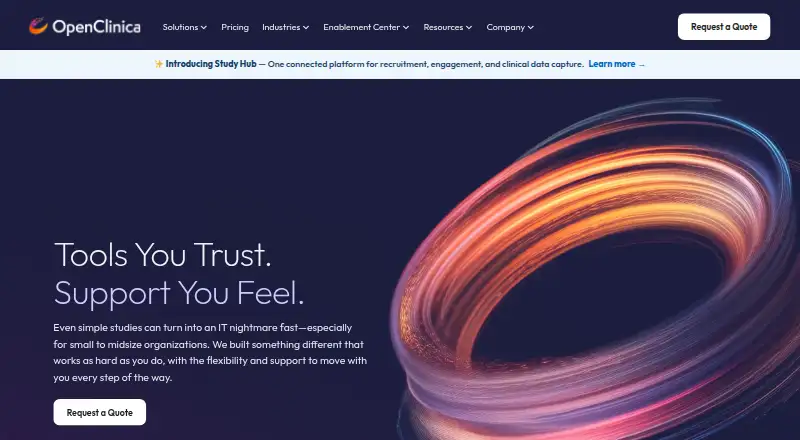
OpenClinica is an eClinical platform combining electronic data capture, eConsent, eCOA, randomization, EHR-to-EDC, analytics, and patient recruitment. Its EDC tools include drag-and-drop study building, templated CRFs, and real-time validation. EHR-to-EDC can connect systems such as Epic and Cerner through FHIR or HL7, bringing clinical source information into study forms; described data includes vitals, labs, medications, and medical history, with coordinator review and audit trails. The company says its platform complies with ICH GCP E6 (R2), 21 CFR Part 11, HIPAA, and GDPR, and is SOC 2 Type II and ISO 27001 certified. Launch costs $750 a month and is EDC-only, capped at 150 participants and three sites, with email notifications only and no API or SMS; it has a 30-day trial. Core costs $3,000 a month per study on a 12-month contract. Advanced costs $3,750 a month per study on the same contract term and adds one module to Core. A free, open-source Community Edition is available under GNU LGPL.
Who it suits
OpenClinica is aimed at small to midsize sponsors, CROs, and academic research teams. Its range of study tools and deployment options may suit organizations seeking a hosted or self-managed eClinical system.
What it does well
- Includes electronic data capture and eConsent
- EHR-to-EDC supports FHIR or HL7 connections
- Community Edition is free and open source
- Every client receives onboarding and a Customer Success Manager
What to know first
- Launch is limited to 150 participants and three sites
- Launch excludes API and SMS
- Core and Advanced require 12-month contracts
Limits
Launch is limited to 150 participants and three sites, includes EDC only, and allows email notifications only; it has no API or SMS. The 30-day free trial applies to Launch.
Plans
| Plan | Billed and limits | Price |
|---|---|---|
| Core | Per month per study, based on 12-month contract · EDC, reporting and analytics · advanced analytics · API access · workflows and SMS · dedicated isolated EDC · 24/5 helpdesk | $3,000 a month |
| Advanced | Per month per study, based on 12-month contract · Core plus one module · 3+ concurrent studies · unlimited data · MFA and SSO · full audit trails · 10 professional-services hours | $3,750 a month |
| Launch | Billed monthly · No annual contract · EDC only · 30-day free trial · 150 participants · 3 sites · standard data limits · no API/SMS · single study | $750 a month |
| Enterprise & Academic | Annual per-study pricing; academic budget-aligned pricing for nonprofits and academic organizations · 20+ studies · no data limits · all modules unlocked program-wide · enterprise analytics · MFA, SSO and roles | On request |
As openclinica.com lists them, read 14 Oct 2026. The maker's own page has the final word.
Getting started
- Visit the OpenClinica website.
- Choose between the free Community Edition and a paid plan.
- Use the 30-day trial offered with Launch if evaluating that plan.
- Select cloud-hosted or self-hosted and managed deployment for Enterprise.
- Arrange onboarding and a study build with the included expert-managed build on Core, Advanced, or Enterprise & Academic.
Overview
OpenClinica is an eClinical platform that brings clinical study data capture, consent, outcome collection, randomization, analytics and recruitment into one product. It is aimed at small and midsize sponsors, CROs and academic research teams. Its breadth is a strong reason to consider it, but the right plan depends on how many participants, sites and concurrent studies you need to support.
Key features
EDC combines drag-and-drop study building, templated CRFs and real-time validation. Those tools support study setup and data checks without requiring teams to assemble separate products for each task. EHR-to-EDC can bring source data from Epic and Cerner into study forms through FHIR or HL7, including vitals, labs, medications and medical history. Coordinator review and audit trails keep a human check in that flow, which is useful when reducing manual transfer work matters.
The wider platform includes eConsent, eCOA, randomization, reporting and analytics, and patient recruitment. OpenClinica states compliance with ICH GCP E6 (R2), 21 CFR Part 11, HIPAA and GDPR, plus SOC 2 Type II and ISO 27001 certifications. Every client gets a Customer Success Manager, onboarding, on-demand LMS training and 24/5 application support. Core, Advanced, and Enterprise & Academic include a free expert-managed study build, a practical advantage for teams that want help getting a study configured.
Pricing
Launch costs $750 a month, billed monthly with no annual contract. It is EDC-only and capped at 150 participants and three sites; notifications are email-only, with no API or SMS. The 30-day free trial makes it possible to assess the entry plan before committing, but its caps and missing integrations make it a narrow fit for small studies that can work within those boundaries.
Core costs $3,000 a month per study, based on a 12 month contract. It adds Reporting & Analytics, API access, a 24/5 helpdesk and dedicated CSM. This is the more suitable step for teams that need programmatic access or reporting beyond EDC, though the per-study price and year-long term raise the commitment substantially over Launch.
Advanced costs $3,750 a month per study, also based on a 12 month contract. It includes the Core bundle plus one module—eCOA, eConsent, or Randomization—and is built for three or more concurrent studies. Teams needing only one study or one module may find the higher monthly cost difficult to justify.
Enterprise & Academic uses annual per-study pricing with custom pricing. It supports 20 or more studies, has no data limits, unlocks all modules program-wide and offers custom support packages. Academic pricing is aligned to nonprofit and academic budgets. This is the plan for broad, multi-study programs; its custom terms require a pricing discussion rather than a direct comparison with the fixed-price plans.
The free Community Edition is open source under the GNU LGPL license. It offers a no-cost route for teams able to use an open-source edition, while the paid plans add stated support and managed study-build provisions. Enterprise can be cloud-hosted or self-hosted and managed.
Platforms
OpenClinica supports web, Windows, Linux, API and self-hosted environments. Enterprise deployment can be cloud-hosted or self-hosted and managed, giving organizations a choice in how they operate the system.
Who it's for
OpenClinica is a strong fit for clinical research teams that want EDC alongside consent, outcome collection, randomization or EHR data transfer, particularly small and midsize sponsors, CROs and academic groups. Launch suits a small, bounded study; Core is more appropriate when API access and analytics matter; Advanced fits teams running at least three concurrent studies that need an additional module. Organizations with 20 or more studies or no data-limit tolerance should consider Enterprise & Academic. It is less suitable when a study exceeds Launch’s caps but the team cannot take on a 12-month per-study contract.
Pros and cons
Pros
- Broad clinical workflow coverage: EDC, eConsent, eCOA, randomization, EHR-to-EDC, analytics and recruitment are part of the platform, reducing the need to piece together those functions.
- Structured EHR transfer: FHIR or HL7 connections and coordinator review with audit trails support a more controlled path from source records to study forms.
- Support and launch assistance: Clients receive onboarding, a dedicated Customer Success Manager, training and 24/5 application support; several paid plans also include an expert-managed study build.
- Deployment choice: Enterprise can be hosted in the cloud or self-hosted and managed, while a free open-source Community Edition is also available.
Cons
- Launch is deliberately limited: Its 150-participant and three-site caps, EDC-only scope, and lack of API and SMS can rule it out as a study grows or needs broader workflows.
- Higher plans require a longer commitment: Core and Advanced are priced per study per month on 12-month contracts, making them a bigger commitment than monthly Launch.
- Advanced adds only one module: Teams that need multiple add-ons may need to look beyond its one-module inclusion.
- Enterprise requires custom pricing: The broadest plan's cost must be established for each program rather than checked against a fixed monthly price.
Alternatives
For research administration rather than clinical study execution, compare Research Administration Software. Kuali Curriculum Management is another paid option, with API and web platforms and pricing through a personalized demo.
OneRamp ERA Suite is a paid alternative for readers comparing research administration products, with Android, iOS and web support. Pure Award Management is a paid API- and web-based alternative. Cayuse Award Management is paid, supports API and web, and requires a pricing inquiry.
Clinion CTMS is a paid, web-based alternative for readers considering a CTMS. CommunityForce is a paid web-based awards management platform with pricing through a demo or expert conversation. eProtocol is a paid alternative available on web and self-hosted platforms.
Verdict
Choose OpenClinica if your clinical research program needs EDC plus connected study workflows, EHR data transfer and a defined support structure. Its strongest case is breadth backed by stated compliance credentials and multiple deployment options. Look elsewhere if Launch’s participant and site limits are too small and a 12-month per-study commitment or custom Enterprise pricing does not fit your budget or operating model.
Verdict
OpenClinica covers multiple clinical study workflows, with a free Community Edition and paid plans with stated limits. Compare Launch’s participant and site caps with your study needs before choosing a plan.
Questions
Is OpenClinica free?
A free, open-source Community Edition is available under the GNU LGPL. The paid Launch plan is $750 a month.
What does Launch cost?
Launch costs $750 a month, billed monthly with no annual contract. It includes a 30-day free trial.
What do the Core and Advanced plans cost?
Core costs $3,000 a month per study on a 12-month contract. Advanced costs $3,750 a month per study on a 12-month contract.
Which platforms does OpenClinica support?
Listed platforms are API, Linux, self-hosted, web, and Windows.
Is OpenClinica open source?
Its Community Edition is open source and distributed under the GNU LGPL license.
What support is included?
The maker says every client gets a Customer Success Manager, onboarding, on-demand LMS training, and 24/5 application support.
Facts from OpenClinica's own pages
- API
- The service exposes REST web services for data exchange and bulk imports, event scheduling and participant creation. · servicedesk.openclinica.com, 14 Oct 2026
- API limitation
- Launch subscriptions do not include API access; Core and higher plans do. · servicedesk.launch.openclinica.com, 14 Oct 2026
- API tooling
- An authenticated Swagger interface lets administrators inspect and execute API endpoints; documented operations include JSON, XML or PDF retrieval, XML import, participant and site creation. · servicedesk.openclinica.com, 14 Oct 2026
- Browser support
- Supported desktop browsers are current Chrome, Edge, Firefox and Safari; Chrome is supported on Android and Safari on iOS/iPadOS, while IE11 and Edge Legacy are unsupported. · openclinica.helpscoutdocs.com, 14 Oct 2026
- Community download
- The latest listed Community Edition release is OpenClinica 3.17.3 dated 12 November 2025; a separate web-services package is available for SOAP use. · docs.openclinica.com, 14 Oct 2026
- Community edition
- OpenClinica offers a free, open-source Community Edition distributed under the GNU LGPL license. · docs.openclinica.com, 7 Oct 2026
- Company founders
- OpenClinica identifies Cal Collins and Ben Baumann as co-founders. · openclinica.com, 14 Oct 2026
- Company founding
- LinkedIn lists OpenClinica as founded in 2004. · linkedin.com, 14 Oct 2026
- Company headquarters and size
- LinkedIn lists OpenClinica as privately held, headquartered in Waltham, Massachusetts, with 51–200 employees. · linkedin.com, 14 Oct 2026
- Company history
- The company says it has spent 20 years building eClinical software and that its EDC began for academic institutions. · openclinica.com, 7 Oct 2026
- Compliance
- The company states its platform is ICH GCP E6 (R2), 21 CFR Part 11, HIPAA, and GDPR compliant, and SOC 2 Type II and ISO 27001 certified. · openclinica.com, 7 Oct 2026
- Deployment
- OpenClinica documentation says its Enterprise offering is available as a cloud-hosted solution or a self-hosted and managed system. · docs.openclinica.com, 7 Oct 2026
- Documentation
- OpenClinica publishes user, technical/API and Participate guides plus a searchable support knowledge base. · openclinica.com, 14 Oct 2026
- eCOA
- The eCOA module lets participants complete mobile-friendly assessments with media, visual scales and automated reminders without installing an app. · openclinica.com, 14 Oct 2026
- eConsent
- Its consent module supports multimedia consent, comprehension checks, notifications and electronic signatures for remote, in-person or hybrid studies. · openclinica.com, 14 Oct 2026
- EDC features
- Its EDC offering includes drag-and-drop study building, templated CRFs, and real-time validation. · openclinica.com, 7 Oct 2026
- EDC study builder
- The platform provides drag-and-drop study design, templated case-report forms and real-time validation. · openclinica.com, 14 Oct 2026
- EHR integration
- The EHR-to-EDC module uses FHIR and HL7 to move data from systems such as Epic and Cerner into study forms with review and audit trails. · openclinica.com, 14 Oct 2026
- FedRAMP status
- The company says five services are in its FedRAMP certification work boundary and that its FedRAMP identifier is still pending. · openclinica.com, 14 Oct 2026
- Free study build
- OpenClinica says its Core, Advanced, and Enterprise & Academic plans include a free expert-managed study build. · openclinica.com, 7 Oct 2026
- Headquarters
- Needham, Massachusetts, USA · openclinica.com, 28 Sept 2026
- Integrations
- The product advertises standards-based EHR connectivity, Apple Health collection and links to common clinical-research systems such as CTMS, labs, payments and IxRS through integrations or APIs. · openclinica.com, 14 Oct 2026
- Intended users
- The company says it focuses on small to midsize sponsors, CROs, and academic research teams. · openclinica.com, 7 Oct 2026
- Launch plan limit
- Launch is EDC-only and limited to 150 participants and three sites, with email notifications only and no API or SMS. · openclinica.com, 7 Oct 2026
Where OpenClinica stands on Freedom251
- Life Sciences Software#1 of 28
- Research Administration Software#1 of 20
- Electronic Data Capture Software#1 of 19