Freedom251 › Social Media Analytics Software
RPSync
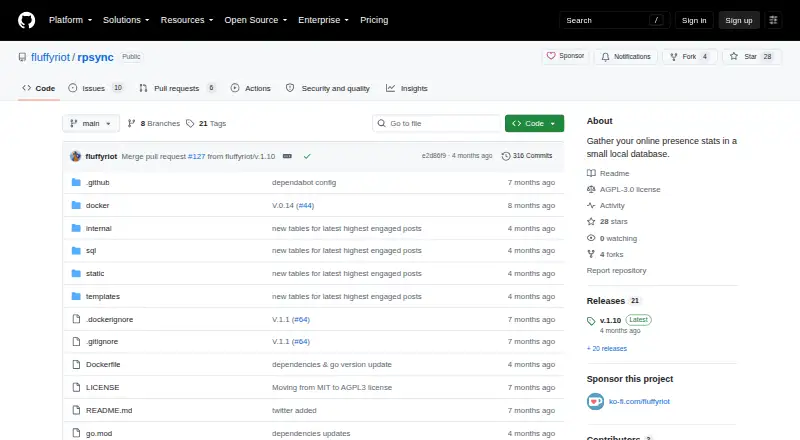
What RPSync is
RPSync is a free, self-hosted command center for gathering and visualizing statistics about an online presence. Its dashboard brings together posts and statistics from supported social services and creator platforms, including Instagram, Threads, TikTok, Twitter, YouTube, Bluesky, Mastodon, Reddit, Twitch, Telegram, and Discord. For websites, it fetches visitor and page-view statistics from Google Analytics, along with visitor and impression statistics from Google Search Console. Data can be exported to NocoDB or CSV. The project says data stays on the user’s machine and offers password requirements, TOTP two-factor authentication, and passkeys; passkeys require a public-domain deployment. Installation requires Docker and Docker Compose, with WSL2 required for Windows users. TikTok sync involves exporting cookies from a local setup before importing them into a cloud deployment. Twitter sync uses browser session cookies that may need renewal after several months. The project warns that some features, including web scraping, may conflict with platforms’ terms, leaving compliance responsibility to users. RPSync is listed as free and open source, under the AGPL-3.0 license, and provided without warranty.
Who it suits
RPSync suits people who want to collect and export online presence statistics in a self-hosted setup. Users need to be comfortable installing Docker and Docker Compose and managing the additional steps for some integrations.
What it does well
- Combines supported social and creator sources in one dashboard
- Fetches website statistics from Google Analytics and Search Console
- Exports data to NocoDB or CSV
- Supports TOTP two-factor authentication and passkeys
- Listed as free and open source
What to know first
- Installation requires Docker and Docker Compose
- Windows users are told to install WSL2 first
- TikTok cloud sync requires cookie export from a local setup
- Some features may violate platform terms
Limits
The free plan is listed as free, with no subscriptions or hidden fees. TikTok sync requires cookie export from a local setup before cookies can be imported into a cloud deployment; Twitter sync relies on browser session cookies that may need renewal after several months.
Plans
| Plan | Billed and limits | Price |
|---|---|---|
| Free & Open Source | No subscriptions · no hidden fees | Free |
As github.com lists them, read 4 Oct 2026. The maker's own page has the final word.
Getting started
- Open the RPSync GitHub project page.
- Install Docker and Docker Compose; on Windows, install WSL2 first.
- Follow the project's installation instructions to run RPSync.
- Set password requirements, TOTP two-factor authentication, or passkeys as needed; passkeys require a public-domain deployment.
- Connect supported social, creator, or website sources.
- Export data to NocoDB or CSV as needed.
RPSync is a self-hosted command center for bringing social, website, and creator-platform statistics into one local dashboard. It suits privacy-conscious individuals, creators, and small teams willing to run Docker rather than hand data to a hosted analytics vendor. Its breadth and zero price are compelling, but setup, cookie maintenance, and platform-compliance obligations make it a deliberate choice rather than a turnkey one.
Overview
RPSync collects posts and performance statistics from a broad set of services, then presents them in a unified dashboard. Social sources include Instagram, Threads, TikTok, Twitter, YouTube, Bluesky, Mastodon, Reddit, Twitch, Telegram, Discord, and several creator platforms. It also connects Google Analytics for visitor and page-view data and Google Search Console for visitor and impression statistics.
The project is designed around local ownership: it describes the installation as 100% local and private, with data remaining on your machine. Exports go to NocoDB or CSV, and the published report export format is CSV. That combination is useful when you want a portable archive or need to move reporting data into another system instead of being locked into a vendor dashboard.
Key features
Unified reporting
A single view across social accounts, websites, and creator services reduces the need to reconcile separate native dashboards. The value is greatest for users managing several channels; it is less significant if you track only one network and already find its built-in analytics sufficient.
Exports and ownership
NocoDB and CSV exports make the collected information usable outside RPSync. Local storage also gives privacy-focused operators direct control, but that control includes responsibility for backups, availability, and maintenance on the machine running the service.
Authentication
Password requirements, TOTP two-factor authentication, and passkeys provide meaningful account protection. Passkeys require a public-domain deployment, so they are not an option for every strictly local setup.
Cookie-based connections
TikTok synchronization requires exporting cookies from a local setup before importing them into a cloud deployment. Twitter synchronization relies on browser session cookies exported with the Cookie-Editor extension, and those cookies may need renewal after several months. These steps can interrupt unattended reporting and add operational work that hosted alternatives usually handle for you.
Some features, including web scraping, may conflict with platform terms of service. RPSync places compliance responsibility on the user, so organizations should review each service's rules before enabling a connector.
Pricing
| Plan | Price | What you get |
|---|---|---|
| Free & Open Source | free | No subscriptions and no hidden fees; self-hosted access to the project and its supported integrations. |
There are no paid tiers, seat charges, subscription renewals, or stated usage quotas in this plan. The trade-off is infrastructure work: you provide the machine, Docker environment, storage, updates, and troubleshooting. The AGPL-3.0 license supports modification and sharing under its terms, while the project is supplied as is without warranty.
Platforms
RPSync runs on Linux, through a self-hosted deployment, and in a web interface. Installation requires Docker and Docker Compose; Windows users are instructed to install WSL2 first. The releases page lists v.0.17, including one-click Bash installation, experimental cloud deployment, and login-security updates.
Who it's for
Choose RPSync if you want one owned data store spanning many social networks and Google reporting tools, need CSV or NocoDB exports, and can administer a Docker-based service. It is particularly suitable for technically comfortable creators, privacy-minded publishers, and small organizations that prefer local control over a managed subscription.
Look elsewhere if you need a polished hosted setup with no cookie handling, guaranteed platform compatibility, vendor-backed uptime, or formal warranty. Windows users without WSL2 and teams unwilling to monitor credentials will face avoidable friction.
Pros and cons
- Pros: Broad coverage across major social, creator, analytics, and search platforms; local storage keeps collected data on your machine; CSV and NocoDB exports support independent reporting; password rules, TOTP, and passkeys strengthen access control; free and open-source with no subscription fees.
- Cons: Docker and Docker Compose are required, with WSL2 added for Windows; TikTok and Twitter connections depend on exported browser cookies, and Twitter cookies may expire; passkeys need a public domain; scraping-related compliance is your responsibility; no warranty is provided.
Alternatives
Iconosquare is the better fit for a hosted mobile-and-web service with a free tier, trial, and defined limits such as one user, 10 posts per month per profile, and one month of analytics history; choose it when you prefer managed access over self-hosting.
Fanpage Karma suits users wanting hosted Android, API, and web access, with a free plan covering one user, one brand, five owned and five competitor profiles, 50 posts per month, and 30 days of dashboard history.
Hopper HQ Hashtag Generator is preferable when hashtag discovery and scheduled social work matter more than owning a cross-platform statistics hub; its free generator needs no sign-up or login.
Social Blade is a simpler choice for public channel tracking, with a free tier offering five favorites per platform, top-100 lists, and up to 14 days of tabular data.
Exolyt is the focused option for TikTok analysis, with a free plan for one tracked account, one hashtag, and one influencer campaign.
Pixalera fits lightweight social publishing needs, offering a free web plan with one channel, three scheduled posts per month, 25 AutoDM messages, 10 AI credits, and 50 MB of storage.
Social Status is a hosted reporting alternative whose free plan includes one plan quota, one month of data history, and report exports.
ViralDashboard is another hosted option for social profiles, scheduling, and analytics.
For a wider comparison, browse Social Media Analytics Software.
Verdict
RPSync is a strong recommendation for technically capable users who want broad, local ownership of social and website metrics without subscription costs. Its central advantage is the combination of integration breadth, exports, and privacy. Look elsewhere if you want hands-off hosting, stable cookie-free connections, or a provider to assume compliance and support responsibilities.
Verdict
RPSync centralizes supported social and website statistics and provides export and authentication options in a self-hosted project. Setup requirements, cookie handling, and the project’s warning about platform terms are important considerations.
Questions
How much does RPSync cost?
The Free & Open Source plan is listed as free, with no subscriptions or hidden fees.
Is RPSync open source?
Yes. The repository identifies an AGPL-3.0 license.
Which platforms does RPSync support?
It is listed for Linux, self-hosted, and web use.
What data sources can it connect to?
Supported sources include Instagram, Threads, TikTok, Twitter, YouTube, Bluesky, Mastodon, Reddit, Twitch, Telegram, Discord, and several creator platforms. It also fetches website statistics from Google Analytics and Google Search Console.
What does installation require?
The documented installation requires Docker and Docker Compose. Windows users are instructed to install WSL2 first.
Where does RPSync keep data?
The project describes RPSync as local and private, with data staying on the user's machine.
Facts from RPSync's own pages
- Authentication security
- It supports password requirements, TOTP two-factor authentication, and passkeys; passkeys require a public-domain deployment. · github.com, 4 Oct 2026
- Dashboard
- It provides a unified dashboard to visualize posts and statistics. · github.com, 4 Oct 2026
- Data exports
- It can export data to NocoDB or CSV. · github.com, 4 Oct 2026
- License and warranty
- The repository identifies an AGPL-3.0 license and says the software is provided as is without warranty. · github.com, 4 Oct 2026
- Local data
- The project describes itself as 100% local and private, with data staying on the user's machine. · github.com, 4 Oct 2026
- Platform limits
- TikTok sync requires a local setup to export cookies before those cookies can be imported into a cloud deployment. · github.com, 4 Oct 2026
- Purpose
- RPSync is a local command center for collecting, visualizing, and owning online presence statistics. · github.com, 4 Oct 2026
- Release
- The releases page lists v.0.17 with one-click bash installation, experimental cloud deployment, and login security updates among its changes. · github.com, 4 Oct 2026
- Setup requirements
- The documented installation requires Docker and Docker Compose, and Windows users are told to install WSL2 first. · github.com, 4 Oct 2026
- Social integrations
- Supported sources include Instagram, Threads, TikTok, Twitter, YouTube, Bluesky, Mastodon, Reddit, Twitch, Telegram, Discord, and several creator platforms. · github.com, 4 Oct 2026
- Support
- The project invites bug reports and feature requests through GitHub issues and contributions through pull requests. · github.com, 4 Oct 2026
- Terms caveat
- The project says some features, including web scraping, may violate some platforms' terms of service and puts compliance responsibility on the user. · github.com, 4 Oct 2026
- Twitter limit
- Twitter sync uses browser session cookies exported with the Cookie-Editor extension, and the cookies may need renewal after several months. · github.com, 4 Oct 2026
- Website integrations
- It fetches visitor and page view statistics from Google Analytics and visitor and impression statistics from Google Search Console. · github.com, 4 Oct 2026
Where RPSync stands on Freedom251
- Social Media Analytics Software#10 of 35