Freedom251 › In-Memory Databases

RonDB
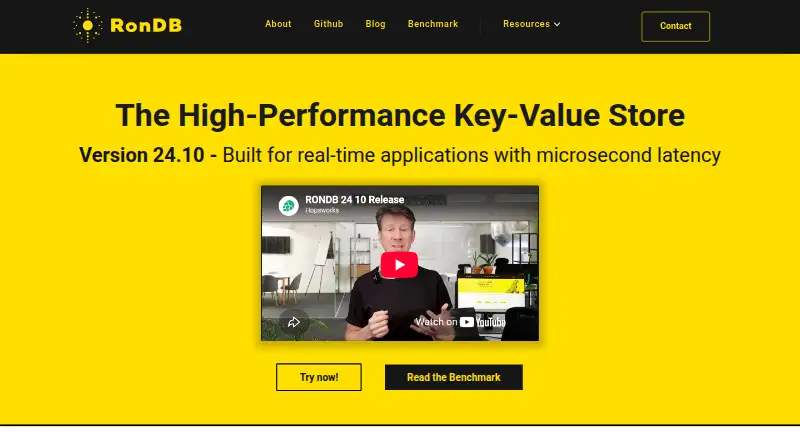
What RonDB is
RonDB is a free, open-source distributed storage engine for real-time applications and a fork of MySQL NDB Cluster. Its shared-nothing design supports up to 1 PiB of storage, with online horizontal and vertical scaling for storage and MySQL-server compute. Applications can connect through the MySQL Server API for SQL-compatible access and parallel queries. ACID transactions are provided through MySQL-server support; in-memory data is persisted using REDO logs and checkpoints. RonDB describes its goals as low latency, high availability, high throughput, and scalable storage. It also supports AI application storage integrated with Spark and Kafka, while Rondis implements a Redis server using RonDB storage and the Redis wire protocol. Deployment options include local testing, Docker, cloud deployments using your own AWS, Azure, or GCP credentials, and on-premises deployment by inquiry. Replication includes synchronous active-active across availability zones and asynchronous cross-region replication with conflict resolution. The free Hopsworks serverless plan has quotas on Feature Groups and memory usage. RonDB uses read-committed isolation and does not support range locks.
Who it suits
RonDB suits teams building real-time applications that need distributed storage, SQL access, or AI application storage. It is available for Linux, API, and self-hosted use.
What it does well
- Supports up to 1 PiB of storage
- Online horizontal and vertical scaling
- SQL-compatible access through the MySQL Server API
- Synchronous and asynchronous replication options
- Free serverless plan
What to know first
- Uses read-committed isolation
- Does not support range locks
- Free serverless plan has Feature Group and memory quotas
Limits
The free Serverless RonDB via Hopsworks plan has quotas on Feature Groups (tables) and memory usage. RonDB uses read-committed isolation and does not support range locks.
Plans
| Plan | Billed and limits | Price |
|---|---|---|
| Serverless RonDB via Hopsworks | quotas on Feature Groups (tables) · quotas on memory usage | Free |
As rondb.com lists them, read 1 Oct 2026. The maker's own page has the final word.
Getting started
- Visit the RonDB website.
- Choose local testing or run RonDB in Docker.
- For managed cloud use, deploy with your own AWS, Azure, or GCP credentials.
- For on-premises deployment, make an inquiry.
- For the Hopsworks serverless plan, use RonDB through Hopsworks.
Verdict
RonDB combines distributed storage, SQL access, and multiple deployment and replication options for real-time workloads. Its isolation and range-lock limits, along with the free plan’s quotas, are important constraints to weigh.
Questions
Is RonDB free and open source?
Yes. RonDB is open source, and the Serverless RonDB via Hopsworks plan costs nothing, subject to Feature Group and memory quotas.
Where can RonDB run?
It can be tested locally, run in Docker, managed in AWS, Azure, or GCP using your own cloud credentials, or deployed on-premises by inquiry.
Does RonDB support SQL?
Yes. Applications can use the MySQL Server API for SQL-compatible access and parallel queries.
What transaction behavior does RonDB support?
RonDB is ACID compliant through MySQL-server support. It uses read-committed isolation and does not support range locks.
What replication options are available?
RonDB supports synchronous active-active replication across availability zones with 1 to 3 replicas, and asynchronous cross-region replication across clusters with conflict resolution.
Who makes RonDB?
The RonDB team at Hopsworks AB brings it to users. Hopsworks AB provides dedicated support for high-performance online feature-store requirements.
Facts from RonDB's own pages
- AI integrations
- RonDB supports AI application storage integrated with Spark and Kafka. · rondb.com, 1 Oct 2026
- Deployment options
- RonDB can be tested locally, run in Docker, managed in AWS, Azure or GCP using own cloud credentials, or deployed on-premises by inquiry. · docs.rondb.com, 1 Oct 2026
- Encryption at rest
- RonDB supports encryption of on-disk data including local checkpoints, tablespaces, REDO logs and UNDO logs, but not backups. · docs.rondb.com, 1 Oct 2026
- Maker support
- RonDB is brought to you by the RonDB team at Hopsworks AB, which provides dedicated support for high-performance online feature-store requirements. · docs.rondb.com, 1 Oct 2026
- Performance model
- RonDB targets low latency, high availability, high throughput and scalable storage, which it calls LATS. · docs.rondb.com, 1 Oct 2026
- Primary use case
- RonDB is used as the online feature-store database for low-latency, high-availability machine-learning applications in Hopsworks. · docs.rondb.com, 1 Oct 2026
- Redis compatibility
- Rondis implements a Redis server using RonDB storage and the Redis wire protocol. · docs.rondb.com, 1 Oct 2026
- Replication
- RonDB supports synchronous cross-availability-zone active-active replication with 1 to 3 replicas and asynchronous cross-region replication across clusters with conflict resolution. · docs.rondb.com, 1 Oct 2026
- REST security
- The RonDB REST API supports Hopsworks API-key authentication and recommends TLS when API keys are used. · docs.rondb.com, 1 Oct 2026
- Scaling
- RonDB supports online horizontal and vertical scaling for storage and MySQL-server compute. · docs.rondb.com, 1 Oct 2026
- SQL access
- Applications can access RonDB through the MySQL Server API with SQL compatibility and parallel query support. · rondb.com, 1 Oct 2026
- Storage scale
- RonDB supports up to 1 PiB of storage. · docs.rondb.com, 1 Oct 2026
- Transactional limit
- RonDB uses read-committed isolation and does not support range locks. · docs.rondb.com, 1 Oct 2026
- Transactions
- RonDB is ACID compliant through MySQL-server support, with in-memory data persisted using REDO logs and checkpoints. · docs.rondb.com, 1 Oct 2026
- What it does
- RonDB is a distributed, shared-nothing storage engine and an open-source fork of MySQL NDB Cluster for real-time applications. · docs.rondb.com, 1 Oct 2026
Where RonDB stands on Freedom251
- In-Memory Databases#10 of 25
- Key-Value Databases#16 of 31