Freedom251 › PDF Creation Software
ReportLab
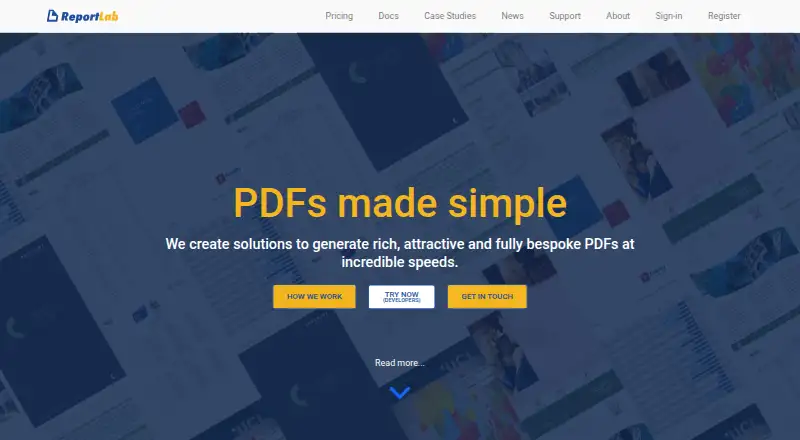
What ReportLab is
ReportLab is a Python toolkit for generating PDF documents and graphics, with options for building files from RML/XML, Python objects, CSV, images, and existing PDFs. Its chart and diagram tools can reflect changing data for print or web output. The open-source library is free for commercial use; ReportLab PLUS adds template-based PDF production through an XML markup language and commercial support. For hosted workflows, DocEngine accepts multiple inputs and offers validation tools, user access controls, and audit trails. Deployments can run in-house or on ReportLab servers, and documents can be delivered through print, on-demand web creation, or email. ReportLab also lists data merging, bulk PDF generation, API access, and fillable form creation. The open-source toolkit is community-supported, while PLUS annual customers receive support and upgrades. PLUS licensing depends on monthly output volume and is intended for server-side use. Listed platforms are API, Linux, macOS, self-hosted, web, and Windows.
Who it suits
ReportLab suits businesses and developers that need to generate PDFs from varied data and content sources. Its listed sectors include financial services, digital print, universities, travel, and sport.
What it does well
- Open-source core is free for commercial use.
- Inputs include XML, CSV, images, and existing PDFs.
- Supports data merging and bulk PDF generation.
- DocEngine includes validation and access controls.
- Listed for Linux, macOS, Windows, web, and self-hosting.
What to know first
- Open-source support is community-based.
- PLUS licensing is intended for server-side use.
- Standard licensing bars embedding for resale.
- PLUS charges vary by monthly output-page volume.
Limits
The open-source plan is the core PDF generation library. The listed PLUS plan at £1,728 a year covers up to 30,000 PDF output pages per month for non-financial use; financial-services pricing for that volume is £3,456 a year. PLUS evaluation output carries a nag line on every page until a licence is installed.
Plans
| Plan | Billed and limits | Price |
|---|---|---|
| ReportLab open-source | Core PDF generation library; free for commercial use | Free |
| ReportLab PLUS — 100k–300k pages/month (Financial) | Annual licence; page allowance is per month · 100k–300k PDF output pages/month · server-side use | £13,824 |
| ReportLab PLUS — 300k–1 Million pages/month (Non-Financial) | Annual licence; page allowance is per month · 300k–1 Million PDF output pages/month · server-side use · financial-services pricing is double | £13,824 |
| ReportLab PLUS — up to 30,000 pages/month (Non-Financial) | Annual licence; page allowance is per month · Up to 30,000 PDF output pages/month · server-side use · financial-services pricing is double | £1,728 |
| ReportLab PLUS — 300k–1 Million pages/month (Financial) | Annual licence; page allowance is per month · 300k–1 Million PDF output pages/month · server-side use | £27,648 |
| ReportLab PLUS — 30k–100k pages/month (Non-Financial) | Annual licence; page allowance is per month · 30k–100k PDF output pages/month · server-side use · financial-services pricing is double | £3,456 |
| ReportLab PLUS — up to 30,000 pages/month (Financial) | Annual licence; page allowance is per month · Up to 30,000 PDF output pages/month · server-side use | £3,456 |
| ReportLab PLUS — 30k–100k pages/month (Financial) | Annual licence; page allowance is per month · 30k–100k PDF output pages/month · server-side use | £6,912 |
The first 8 of 10 plans, as reportlab.com lists them, read 30 Sept 2026. The maker's own page has the final word. Every plan
Getting started
- Visit the ReportLab website.
- Choose the open-source toolkit or review ReportLab PLUS and DocEngine.
- Use the toolkit's Python library or API with a supported input source.
- For a PLUS evaluation, download the fully functional evaluation version; it adds a nag line to each generated page until a licence is installed.
- Deploy in-house or run the solution on ReportLab servers.
ReportLab is a Python library and commercial document-generation platform for creating PDFs and graphics. It is best suited to teams building repeatable, data-driven document workflows into software—not people looking for a desktop PDF editor. Its free core is commercially usable; commercial templates, support and hosting add options for larger workflows.
Overview
The open-source toolkit generates PDFs from Python objects and variables, RML/XML, CSV, images and existing PDFs. Data merging, bulk generation and fillable forms make it a foundation for automated production rather than a tool for editing finished documents.
ReportLab says its charts and diagrams can retain fidelity across print and web, and update when their data changes. Documents can be delivered through print, on-demand web creation or email. Demonstrations include JSON-to-PDF and XLS-to-PDF workflows, an AWS Elastic Beanstalk deployment, and a Flask application combined with ReportLab PLUS. These examples suit developers integrating PDF generation into existing systems.
Teams can deploy in-house or use ReportLab's servers with a modular json2pdf approach. Hosted DocEngine accepts multiple inputs and includes validation tools, user access controls and audit trails. ReportLab says it does not itself hold security certifications; its data centres are ISO-27001 compliant, and it describes penetration testing on specific hosted projects. In version 5.0, remote image sources are untrusted by default and must be explicitly whitelisted before fetching.
Key features
- Flexible generation: Multiple input formats, data merging and bulk PDF generation suit recurring output from business data. That flexibility puts implementation work on the team using the library.
- Templates and graphics: ReportLab PLUS adds a commercial XML markup language for template-based PDFs, while the toolkit supports charts and diagrams for print and web.
- Deployment choices: In-house operation gives teams control of their workflow; DocEngine offers a hosted route with validation, access controls and audit trails.
- Commercial evaluation: The fully functional PLUS evaluation adds a nag line to every generated page until a licence is installed, which makes it practical for evaluation but unsuitable for clean production output.
Pricing
The open-source library costs nothing and is free for commercial use. It is the sensible starting point for teams able to work with community support and build their own workflow. ReportLab offers a free trial, but the PLUS evaluation's page-level nag line is a meaningful constraint.
PLUS licences are annual, priced by monthly PDF output volume, and intended for server-side use. The standard licence does not permit embedding the software for resale. Financial-services pricing is double the non-financial rate at the same page allowance.
- Up to 30,000 pages/month: £1,728 a year for non-financial use; £3,456 a year for financial services.
- 30k–100k pages/month: £3,456 a year for non-financial use; £6,912 a year for financial services.
- 100k–300k pages/month: £6,912 a year for non-financial use; £13,824 a year for financial services.
- 300k–1 Million pages/month: £13,824 a year for non-financial use; £27,648 a year for financial services.
- 1 Million+ pages/month: custom pricing; the annual licence page allowance is per month.
PLUS annual licence customers receive same-working-day responses during UK working hours, version upgrades, best-efforts bug fixes and a non-bug support-hours allowance. The free toolkit is community-supported, with no promise that ReportLab staff will answer requests directly. Buyers should match the page allowance to actual monthly output and account for the higher financial-services rate before committing.
Platforms
ReportLab supports API, Linux, macOS, self-hosted, web and Windows environments. That range accommodates both embedded developer workflows and hosted deployment, but the product is a generation toolkit rather than a cross-platform desktop editing app.
Who it's for
ReportLab names financial services, digital print, universities, travel and sport among the sectors its document-generation tools serve, alongside business and marketing needs. It fits developers and organizations that need repeatable PDFs, data-driven graphics or high-volume document workflows, and can manage the implementation and licensing choices. It is a weaker fit for individuals who want to edit PDFs by hand or teams that require guaranteed direct support while using the free library.
Pros and cons
- Pro: The free core permits commercial use, giving developers a way to build PDF workflows without an upfront licence charge.
- Pro: Multiple input formats, bulk generation, data merging and fillable forms cover a broad range of automated document jobs.
- Pro: In-house and hosted deployment options let teams choose between operating their own workflow and using DocEngine's controls and validation tools.
- Con: Open-source support is community-based, and ReportLab staff do not promise direct replies.
- Con: PLUS requires an annual licence tied to page volume, with financial-services rates doubled and resale embedding prohibited under the standard licence.
- Con: The evaluation's nag line on every page prevents clean output until a licence is installed.
Alternatives
For a broader set of options, browse PDF Creation Software.
- PDF24 Compare PDF is the better pick for users who want a free tool with no limits, registration or time restrictions across desktop, mobile and web platforms.
- Carbone is another freemium option for document generation across API, self-hosted and web environments; its Cloud Free plan is listed as free.
- WeasyPrint is worth considering for teams seeking free and open-source software across API, Linux, macOS, self-hosted and Windows platforms.
- Anvil PDF Generation API may suit users seeking a web or API option with a free starter plan; API-key access requires adding a credit card or upgrading.
- APITemplate.io offers a free plan capped at 50 PDFs or images per month and three templates, for users whose needs fit those limits.
- CraftMyPDF offers a free plan with 50 PDFs or images per month, three templates and integrations including REST API, Zapier, Make.com and Bubble.io.
- DocRaptor has a free plan capped at five documents per month, which may fit a small-volume workflow.
- DocuGenerate offers 20 free documents per month, two templates, API and integrations, and one concurrent document on its free plan.
Verdict
Choose ReportLab if you need a developer-oriented PDF-generation foundation that can handle varied inputs and scale into commercial or hosted workflows. The commercially usable free core is its clearest advantage; the strongest reasons to look elsewhere are the implementation burden, community-only support on the free library, and PLUS's annual, volume-based licence with restrictions on resale embedding.
Verdict
ReportLab offers both a free PDF-generation library and commercial or hosted options for larger document workflows. Check the PLUS page allowance, licence terms, and support needs against your intended use.
Questions
Is ReportLab free?
The open-source toolkit is free for commercial use. ReportLab also offers paid PLUS licences based on output-page volume.
How much does ReportLab PLUS cost?
The listed non-financial plan for up to 30,000 pages per month costs £1,728 a year. The equivalent financial-services plan costs £3,456 a year.
Is there a free trial?
Yes. The fully functional PLUS evaluation download adds a nag line to every generated page until a licence is installed.
What platforms does ReportLab support?
Listed platforms are API, Linux, macOS, self-hosted, web, and Windows.
Is ReportLab open source?
The ReportLab Toolkit is open source and free for commercial use. ReportLab PLUS is a commercial product.
What support comes with ReportLab?
The open-source toolkit is community-supported, without a promise of direct replies from ReportLab staff. Annual PLUS licence customers receive same-working-day responses during UK working hours, version upgrades, best-efforts bug fixes, and a non-bug support-hours allowance.
Facts from ReportLab's own pages
- Audience
- ReportLab says its document-generation tools serve business and marketing needs and lists financial, digital print, university, travel, and sport sectors. · reportlab.com, 30 Sept 2026
- Commercial evaluation
- A fully functional ReportLab PLUS evaluation download adds a nag line to every generated page until a licence is installed. · reportlab.com, 30 Sept 2026
- Commercial limits
- ReportLab PLUS licence charges are based on output page volume, licences are intended for server-side use, and embedding the software for resale is not permitted under the standard licence. · reportlab.com, 30 Sept 2026
- Commercial product
- ReportLab PLUS provides a commercial XML markup language for producing PDFs from templates and includes commercial support. · docs.reportlab.com, 30 Sept 2026
- Commercial support
- ReportLab PLUS annual licence customers receive same-working-day responses during UK working hours, version upgrades, best-efforts bug fixes, and a non-bug support-hours allowance. · reportlab.com, 30 Sept 2026
- Deployment
- The company says solutions can be deployed in-house or run on its servers using a modular json2pdf approach. · reportlab.com, 30 Sept 2026
- Examples and integrations
- Maker demos show JSON-to-PDF, an AWS Elastic Beanstalk deployment, XLS-to-PDF, and a Flask and ReportLab PLUS combination. · docs.reportlab.com, 30 Sept 2026
- Founded
- 2000 · reportlab.com, 28 Sept 2026
- Headquarters
- London, United Kingdom · reportlab.com, 28 Sept 2026
- Hosted offering
- DocEngine is a hosted business solution that accepts multiple inputs and provides validation tools, user access controls, and audit trails. · reportlab.com, 30 Sept 2026
- Hosted security
- ReportLab says it does not itself hold security certifications and that its data centres are ISO-27001 compliant; it describes prior penetration testing for specific hosted projects. · reportlab.com, 30 Sept 2026
- Image-fetch security
- In version 5.0, remote image sources are untrusted by default and must be explicitly whitelisted before image fetching. · docs.reportlab.com, 30 Sept 2026
- Input and output
- ReportLab describes acquiring data and content from any source and delivering documents through print, web on-demand creation, or email. · reportlab.com, 30 Sept 2026
- Open-source support
- The open-source toolkit is community-supported, and ReportLab staff do not promise to answer support requests directly. · reportlab.com, 30 Sept 2026
- PDF and graphics
- ReportLab supports high fidelity charts and diagrams that can update as data changes for print and web. · reportlab.com, 30 Sept 2026
- Purpose
- The ReportLab Toolkit is a Python library for creating PDF documents and graphics. · docs.reportlab.com, 30 Sept 2026
Where ReportLab stands on Freedom251
- PDF Creation Software#14 of 46