Freedom251 › Data Visualization Software

Redash
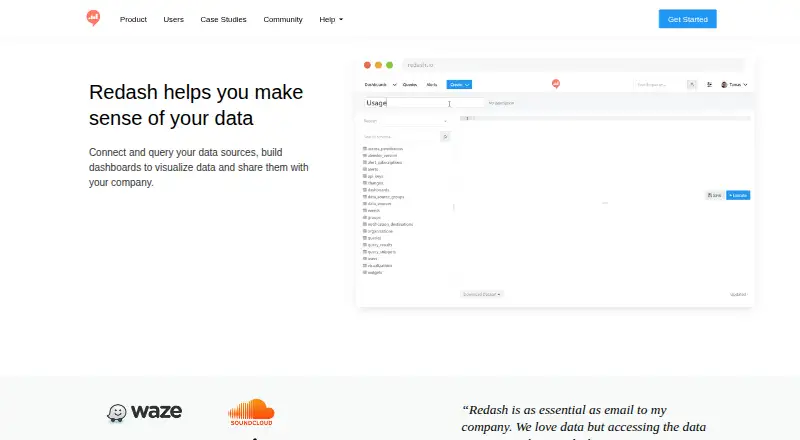
What Redash is
Redash is an open-source, self-hosted web platform for querying data, creating visualizations, and sharing results within an organization. Its query editor offers schema browsing, autocomplete, keyboard shortcuts, and reusable snippets. Users can create charts, cohort views, pivot tables, boxplots, maps, counters, sankey diagrams, sunbursts, and word clouds. Dashboards can combine data from multiple sources and be shared by URL or embedded as widgets. Scheduled result updates and alerts for data events are supported. Listed data sources include Amazon Athena, BigQuery, PostgreSQL, Snowflake, MongoDB, Google Analytics, Google Spreadsheets, JIRA, and Salesforce. Redash also provides a REST API, with user keys or query keys that can be limited to a query and its results. Authentication options include password login, Google OAuth, and SAML 2.0. Deployment documentation describes Linux servers using Docker and Docker Compose. The hosted service at app.redash.io shut down effective November 30, 2021, so the listed free option is self-hosted rather than hosted access.
Who it suits
Redash suits SQL users who want to explore, query, visualize, and share organizational data. It is for teams prepared to deploy and maintain a self-hosted service.
What it does well
- Combines data from multiple sources in dashboards.
- Offers scheduled result updates and alerts.
- REST API keys can be limited to query results.
- Supports password, Google OAuth, and SAML authentication.
What to know first
- Hosted service shut down November 30, 2021.
- Free option requires self-hosting.
- Larger deployments may need separate database and Redis servers.
- Setup guide recommends at least two Redash servers for larger deployments.
Limits
The listed Open source / self-hosted plan costs nothing and requires self-hosting because the hosted service has shut down. The documented reference configuration is for small deployments; larger deployments are advised to use separate database and likely Redis servers, along with at least two Redash servers.
Plans
| Plan | Billed and limits | Price |
|---|---|---|
| Open source / self-hosted | Hosted service shut down; self-hosted version can be hosted free of charge | Free |
As redash.io lists them, read 10 Oct 2026. The maker's own page has the final word.
Getting started
- Open https://redash.io/ for the project website.
- Prepare a Linux server for deployment.
- Deploy using Docker and Docker Compose.
- Connect data sources and use the query editor to explore data.
- Build dashboards and share them by URL or embed widgets.
Redash is an open-source analytics workspace for querying connected data, turning results into interactive dashboards, and sharing them with an organization. It is best suited to SQL-capable teams that can operate a Linux deployment. The broad connector list and query-to-dashboard workflow are strong reasons to consider it, while self-hosting and infrastructure responsibility make it a poor fit for teams seeking a managed service.
Overview
Redash keeps SQL at the center of data exploration. Users connect data sources, browse schemas, write and reuse queries, visualize results, and assemble shared dashboards. That approach suits analysts and engineers who want direct control over queries rather than a primarily drag-and-drop reporting tool.
Redash is free and open source, but its hosted service at app.redash.io shut down on November 30, 2021. Choosing Redash therefore means planning your own deployment, upgrades, authentication configuration, and supporting infrastructure.
Key features
The query editor provides schema browsing, autocomplete, keyboard shortcuts, and reusable snippets. These conveniences reduce friction when finding fields and standardizing recurring SQL, making the product particularly practical for teams whose reporting work already lives in queries.
Interactive dashboards can combine results from multiple sources and be shared by URL or embedded as widgets. Scheduled result updates keep recurring views current, while alerts can flag events in data. The visualization set includes charts, cohort views, pivot tables, boxplots, maps, counters, Sankey diagrams, sunbursts, and word clouds, giving teams several ways to present analytical results beyond a basic chart.
Connectors cover a wide mix of services and databases, including Amazon Athena, Amazon Redshift, DynamoDB, CloudWatch, BigQuery, Databricks, ClickHouse, Cassandra, Elasticsearch, Google Analytics, Google Spreadsheets, PostgreSQL, Snowflake, MongoDB, JIRA, and Salesforce. That breadth is useful for organizations with a mixed data stack, although a project should verify that its essential systems are supported.
The REST API supports user keys and query keys. Query-key access can be limited to a query and its results, which provides a narrower way to expose selected data than granting broad account access.
Authentication options include password login, Google OAuth, and SAML 2.0. Administrators control authentication through the interface and environment variables, and Redash recommends disabling password login when Google OAuth or SAML is the expected sign-in method. That gives organizations a route to centralized identity, but it also places configuration and security decisions on the operator.
Pricing
| Plan | Price | What it includes |
|---|---|---|
| Open source / self-hosted | free | Self-hosted version can be hosted free of charge |
There are no paid hosted tiers to compare. The zero software price is most compelling for organizations with existing Linux, Docker, and operational resources; it does not remove the cost of servers, maintenance, or administration. There are no published seat quotas, usage allowances, trial terms, or renewal charges for this plan.
Platforms
Redash is delivered through the web and exposes an API. Official setup guidance describes deployment on a Linux server with Docker and Docker Compose, so it is a self-managed web application rather than a conventional desktop product.
The reference configuration is intended for small deployments. Larger installations are advised to use a separate database, likely a separate Redis server, and at least two Redash servers. Consequently, growth can require a deliberate infrastructure design rather than simply adding users to a hosted account.
Who it's for
Redash fits SQL users who explore, query, visualize, and share organizational data. It is a strong choice for engineering-led analytics teams that value many connectors, reusable SQL, scheduled refreshes, alerts, and API access, and that can take responsibility for Linux deployment and authentication.
It is less suitable for organizations that need a vendor-managed service, prefer no server operations, or lack staff comfortable maintaining Docker-based applications and their backing services.
Pros and cons
Pros
- Broad connectivity: support for databases, cloud services, spreadsheets, and business systems can bring a varied stack into one reporting workspace.
- SQL-focused workflow: schema browsing, autocomplete, shortcuts, and snippets help experienced SQL users move from exploration to repeatable reporting.
- Sharing and automation: URL sharing, embeddable widgets, scheduled refreshes, alerts, and a REST API support distribution beyond the analyst's own screen.
- No software charge: the open-source self-hosted edition costs nothing.
Cons
- Operational burden: users must deploy and maintain the application themselves, with larger deployments needing separate services and multiple Redash servers.
- No current hosted option: the former app.redash.io service is shut down, so teams cannot select a Redash-managed plan.
- SQL dependence: the product's strongest workflow is aimed at SQL users, which may not suit teams seeking a primarily visual, no-code analysis experience.
- Community-led support: Redash directs support questions to GitHub Discussions rather than a published paid support tier.
Alternatives
Metabase is the better direction for teams comparing another open-source, self-hosted business-intelligence option and wanting a freemium model.
Datawrapper is a stronger fit when the priority is publishing and embedding charts, maps, and tables across web and desktop/mobile-accessible platforms, with a free plan that includes PNG downloads and attribution.
Matplotlib suits developers who need a Python library under a BSD-compatible open-source license rather than a shared dashboard application.
Apache Superset is another free, self-managed platform for data exploration and visualization.
Plotly is worth considering for a freemium, self-hosted workflow with a free plan that includes limited creator, viewer, and app allocations.
Kibana is the alternative when self-managed Elastic Stack visualization and community-supported free features are the central requirement.
Flourish is aimed at template-driven visual storytelling with free public publishing and embeds that include attribution.
Infogram offers a freemium chart-and-infographic product with a basic plan for one user and limited projects.
For broader comparisons, see Data Visualization Software, Business Intelligence Tools, and SQL Query Tools.
Verdict
Choose Redash if your organization has SQL expertise and the ability to run Linux infrastructure, and you want a free, open-source route from many data sources to shareable dashboards, alerts, and API-driven results. Look elsewhere if you need a managed hosted service or want analytics without taking responsibility for deployment and operations.
Verdict
Redash provides query, dashboard, and sharing tools as self-hosted software. Its former hosted service is unavailable, so plan for deployment and infrastructure if you choose it.
Questions
How much does Redash cost?
The Open source / self-hosted plan is free.
Is there a free plan?
Yes. The free option is the self-hosted version; the hosted service at app.redash.io shut down effective November 30, 2021.
Which platforms does Redash support?
The listed platforms are API, Linux, self-hosted, and web.
Can dashboards be embedded?
Yes. Dashboards can be shared by URL or embedded as widgets.
Which authentication options are available?
Redash documents password login, Google OAuth, and SAML 2.0.
Where can users get support?
Redash directs users to the Q&A category in its community GitHub Discussions.
Facts from Redash's own pages
- Alerts and refreshes
- Users can schedule result updates and set alerts for events in their data. · redash.io, 10 Oct 2026
- API
- Redash provides a REST API, and API calls support user keys or query keys with access limited to a query and its results. · redash.io, 10 Oct 2026
- Authentication
- Redash documents password login, Google OAuth, and SAML 2.0 authentication options. · redash.io, 10 Oct 2026
- Dashboards
- Users can combine data from multiple sources into dashboards and share them by URL or embed widgets. · redash.io, 10 Oct 2026
- Dashboard type
- interactive · redash.io, 20 Sept 2026
- Data sources
- Amazon Athena; Amazon CloudWatch; Amazon CloudWatch Logs Insights; Amazon DynamoDB; Amazon Redshift; Axibase Time Series Database; Cassandra; ClickHouse; CockroachDB; CSV; Databricks; DB2 by IBM; Druid; Elasticsearch; Google Analytics; Google BigQuery; Google Spreadsheets; Graphite; Greenplum; Hive; Impala; InfluxDB; JIRA; JSON; Apache Kylin; OmniSciDB; MemSQL; Microsoft Azure Data Warehouse / Synapse; Microsoft Azure SQL Database; Microsoft SQL Server; MongoDB; MySQL; Oracle; PostgreSQL; Presto; Prometheus; Python; Qubole; Rockset; Salesforce; ScyllaDB; Shell Scripts; Snowflake; SQLite; TreasureData; Vertica; Yandex AppMetrica; Yandex Metrica · redash.io, 20 Sept 2026
- Deployment
- The official setup guide describes deployment on a Linux server using Docker and Docker Compose. · github.com, 10 Oct 2026
- Deployment scale
- The setup guide says the reference configuration is suitable for small deployments and recommends separate database and likely Redis servers plus at least two Redash servers for larger deployments. · github.com, 10 Oct 2026
- Embedded dashboards
- Yes · redash.io, 20 Sept 2026
- Hosted service
- The hosted Redash service at app.redash.io shut down effective November 30, 2021, and the page says no new customer signups were allowed. · redash.io, 10 Oct 2026
- Integrations
- Listed data sources include Amazon Athena, BigQuery, PostgreSQL, Snowflake, MongoDB, Google Analytics, Google Spreadsheets, JIRA, and Salesforce. · redash.io, 10 Oct 2026
- Intended users
- Redash describes its audience as SQL users who explore, query, visualize, and share data so others in their organization can use it. · redash.io, 10 Oct 2026
- Platform
- web · redash.io, 20 Sept 2026
- Purpose
- Redash lets users connect to and query data sources, build dashboards, visualize data, and share results with their organization. · redash.io, 10 Oct 2026
- Query editor
- The query editor supports schema browsing, autocomplete, keyboard shortcuts, and reusable snippets. · redash.io, 10 Oct 2026
- Scheduled refresh
- Yes · redash.io, 20 Sept 2026
- Security configuration
- Authentication settings are controlled by admins through the UI and environment variables, and the documentation recommends disabling password login when users are expected to use Google OAuth or SAML. · redash.io, 10 Oct 2026
- Support
- Redash directs users who need support to its community GitHub Discussions Q&A category. · redash.io, 10 Oct 2026
- Visualizations
- Redash supports visualizations including charts, cohort, pivot table, boxplot, map, counter, sankey, sunburst, and word cloud. · redash.io, 10 Oct 2026
Where Redash stands on Freedom251
- Data Visualization Software#6 of 98
- Business Intelligence Tools#8 of 89
- Business Intelligence & Analytics - Midmarket Software#3 of 25
- Bi Platforms#4 of 29
- Business Analytics#5 of 26
- Dashboards#6 of 30
- SQL Query Tools#13 of 31