Freedom251 › Event Tracking Software
Raccoon
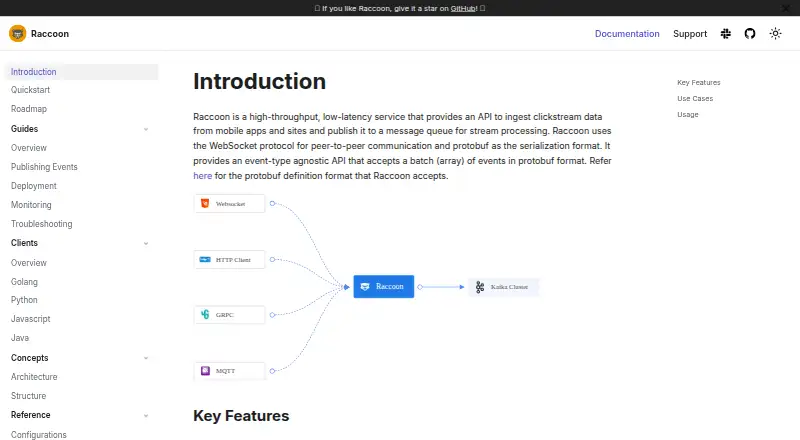
What Raccoon is
Raccoon is an open-source event ingestion service for collecting data from mobile apps, websites and services, then publishing it to message queues for stream processing. It accepts batches of events with different schemas and routes them to queue topics according to event metadata. Clients can send events over WebSocket, REST or gRPC. WebSocket and REST support JSON and Protocol Buffers; gRPC supports Protocol Buffers.
Apache Kafka is a stable destination, while Google Cloud Pub/Sub and AWS Kinesis Data Streams are marked alpha. Raccoon acknowledges whether events were consumed successfully, and its documentation describes ways to augment delivery for zero-data-loss or at-least-once guarantees. Monitoring includes latency and active connections, with telemetry through StatsD and Prometheus. Persistent WebSocket connections reduce connection setup overhead, while Protocol Buffers reduce payload sizes.
The maker documents running Raccoon with Docker and deploying it on Kubernetes, including a Helm chart. Client guides cover Go, Python, JavaScript and Java. Its documented use cases include clickstream collection, adtech streams, IoT edge systems and event sourcing. Raccoon is free under the Apache 2.0 license and is offered as an API and self-hosted platform. It does not provide application-level HTTPS or authentication; deployment guidance recommends an API gateway or separate authentication service for those needs.
Who it suits
Raccoon suits teams collecting web, mobile or service events for stream processing, including documented clickstream, adtech, IoT edge and event-sourcing use cases. It is aimed at teams able to deploy and operate an API or self-hosted service and handle HTTPS and authentication separately.
What it does well
- Accepts events over WebSocket, REST and gRPC.
- Routes varied event schemas using event metadata.
- Kafka is a stable message-queue destination.
- Monitoring covers latency and active connections.
- Docker and Kubernetes deployment paths are documented.
What to know first
- Application-level HTTPS and authentication are not provided.
- Pub/Sub and Kinesis destinations are marked alpha.
Limits
Raccoon does not provide application-level HTTPS or authentication, so deployments need an API gateway or separate authentication service for those functions. Google Cloud Pub/Sub and AWS Kinesis Data Streams are alpha destinations; Apache Kafka is stable.
Getting started
- Visit the Raccoon website and review the documentation.
- Choose an API or self-hosted deployment approach.
- Run it with Docker or deploy it on Kubernetes using the documented Helm chart.
- Configure a client to send events over WebSocket, REST or gRPC.
- Select a destination queue and arrange HTTPS termination and authentication separately.
Verdict
Choose Raccoon if you need a free, Apache 2.0-licensed service to route events from web, mobile or other sources into message queues. Look elsewhere, or plan supporting infrastructure, if you need the ingestion service itself to provide application-level HTTPS or authentication.
Questions
Is Raccoon free and open source?
Yes. Raccoon is free and its repository states that it is licensed under Apache 2.0.
Which event protocols and formats does it support?
Clients can send events over WebSocket, REST or gRPC. WebSocket and REST support JSON and Protocol Buffers, while gRPC supports Protocol Buffers.
Which message queues can receive events?
Supported destinations are Apache Kafka, Google Cloud Pub/Sub and AWS Kinesis Data Streams. Kafka is stable; Pub/Sub and Kinesis are alpha.
Does Raccoon provide HTTPS and authentication?
It does not provide application-level HTTPS or authentication. Its deployment guide recommends using an API gateway or separate authentication service.
How can Raccoon be deployed?
The maker documents running it with Docker and deploying it on Kubernetes, including a Helm chart.
What client libraries or guides are available?
The documentation provides client guides for Go, Python, JavaScript and Java.
Facts from Raccoon's own pages
- Client libraries
- The documentation provides client guides for Go, Python, JavaScript, and Java. · raystack.github.io, 9 Oct 2026
- Delivery
- Raccoon sends acknowledgments indicating whether events were consumed successfully, and its documentation describes options for delivery guarantees. · raystack.github.io, 9 Oct 2026
- Delivery acknowledgments
- The server acknowledges delivery successes and failures; the documentation says it can be augmented for zero-data-loss or at-least-once guarantees. · raystack.github.io, 4 Oct 2026
- Deployment
- Raccoon can be deployed using its Docker image or on Kubernetes, and the deployment guide says a Helm chart is available. · raystack.github.io, 9 Oct 2026
- Destinations
- Supported message queues are Apache Kafka (stable), Google Cloud Pub/Sub (alpha), and AWS Kinesis Data Streams (alpha). · raystack.github.io, 4 Oct 2026
- Event handling
- Its event-agnostic API accepts batches of events with different schemas and routes them using event metadata. · raystack.github.io, 9 Oct 2026
- Event routing
- Events are distributed to message queue topics based on event metadata. · raystack.github.io, 4 Oct 2026
- Intended use
- Documented use cases include clickstream collection, adtech streams, IoT edge systems, and event sourcing. · raystack.github.io, 4 Oct 2026
- License
- The project is licensed under Apache 2.0. · github.com, 9 Oct 2026
- Message queues
- Supported destinations listed in the architecture guide are Apache Kafka, Google Cloud Pub/Sub, and AWS Kinesis Data Streams; Pub/Sub and Kinesis are marked alpha there. · raystack.github.io, 9 Oct 2026
- Monitoring
- Raccoon reports metrics for server connections, publishers, resource usage, and event delivery through StatsD and Prometheus. · raystack.github.io, 9 Oct 2026
- Performance
- Persistent WebSocket connections reduce connection setup overhead, and Protocol Buffers reduce payload sizes. · raystack.github.io, 9 Oct 2026
- Protocols and formats
- Raccoon supports WebSocket, REST, and gRPC clients; WebSocket and REST support JSON and Protocol Buffers, while gRPC supports Protocol Buffers. · raystack.github.io, 9 Oct 2026
- Purpose
- Raccoon is a high-throughput, low-latency service for ingesting clickstream and other events from mobile apps, websites, and services and publishing them to message queues. · raystack.github.io, 9 Oct 2026
- Security
- Raccoon does not provide HTTPS or authentication itself; its deployment guide recommends terminating SSL at an API gateway and handling authentication with a separate service. · raystack.github.io, 9 Oct 2026
- Security limitation
- Raccoon does not provide application-level HTTPS or authentication; the deployment guide suggests using an API gateway or separate authentication service. · raystack.github.io, 4 Oct 2026
- Use cases
- The documentation lists adtech streams, clickstream collection, IoT edge systems, and event sourcing as potential use cases. · raystack.github.io, 9 Oct 2026
Where Raccoon stands on Freedom251
- Event Tracking Software#13 of 24