Querybook
What Querybook is
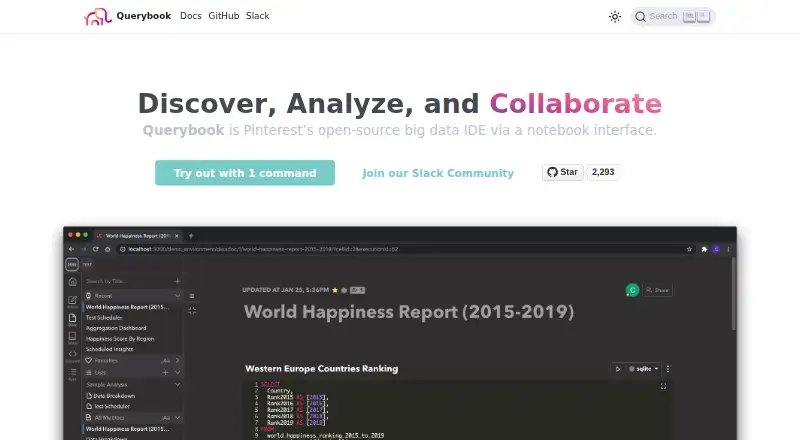
Querybook is Pinterest’s open-source big data IDE for creating, finding, and sharing analyses, queries, and tables. Its DataDocs combine rich text, queries, and charts in collaborative notebooks, with real-time collaboration and scheduled updates. The query editor provides table-aware autocomplete, syntax highlighting, and table details on hover or click. Querybook analyzes executed queries to surface lineage, examples, frequent users, and search and autocomplete ranking. Documented engines include Presto, Hive, Druid, Snowflake, BigQuery, MySQL, SQLite, PostgreSQL, SQL Server, and Oracle. Results can be stored in a database, S3, Google Cloud Storage, or local files, and exported to Google Sheets or Python. Email and Slack notifications can cover query completion and DataDoc invitations. An optional AI Assistant plugin can generate or edit SQL from prompts, repair failed SQL, suggest completions, and search tables and queries in natural language when its vector store is enabled. Querybook runs in Docker, with Docker Compose, Kubernetes, and multi-machine deployment guidance. Its architecture includes a database, Redis, Elasticsearch, and remote storage; MySQL is recommended for the database.
Who it suits
Querybook is intended for engineers and data scientists who need collaborative SQL analysis and can deploy a self-hosted tool. It suits teams that want DataDocs, query sharing, scheduling, and documented connections to a range of query engines.
What it does well
- Open-source and free to use.
- DataDocs support real-time collaboration and scheduled updates.
- Documented connections cover ten query engines.
- Supports Google Sheets and Python exports.
- Optional AI Assistant can help generate and edit SQL.
What to know first
- Self-hosted deployment runs in Docker.
- Architecture includes a database, Redis, Elasticsearch, and remote storage.
- Security advisory reports a reflected XSS issue before version 3.14.2 with specified OAuth configurations.
Getting started
- Visit https://www.querybook.org/ for Querybook information.
- Choose a Docker deployment approach, such as the documented Docker Compose demo or Kubernetes example.
- Set up the documented database, Redis, Elasticsearch, and remote storage components; MySQL is recommended.
- Configure authentication, with OAuth recommended for production use cases.
- Connect a documented query engine and create an API access token if using the API.
Verdict
Querybook combines collaborative SQL notebooks with query discovery, scheduling, and a broad list of documented engines. Teams should plan for its listed infrastructure and note the security advisory for affected pre-3.14.2 versions.
Questions
How much does Querybook cost?
Querybook is listed as free, and its pricing note identifies it as open source.
Is there a free plan or trial?
A free plan is available. There is no free trial.
Where can Querybook run?
Its listed platforms are API, self-hosted, and web. It runs in Docker, with documented Docker Compose, Kubernetes, and multi-machine deployment examples.
Which query engines does it support?
Documented engines include Presto, Hive, Druid, Snowflake, BigQuery, MySQL, SQLite, PostgreSQL, SQL Server, and Oracle.
Does Querybook include AI query assistance?
An optional AI Assistant plugin can generate or edit SQL from text prompts, fix failed SQL, suggest completions, and search tables and queries in natural language when its vector store is enabled.
What authentication and access controls are available?
Authentication options include OAuth, Google OAuth, LDAP, and user/password; OAuth is recommended for production. Environments can be public, hidden, or shareable, and private environments can use user access control lists.
Facts from Querybook's own pages
- Access controls
- Environment access can be configured as public, hidden, or shareable, with private environments managed through user access controls. · querybook.org, 3 Oct 2026
- AI features
- The optional AI Assistant plugin can generate and edit SQL from text prompts, fix failed SQL, suggest SQL completions, and search tables and queries in natural language when its vector store is enabled. · querybook.org, 2 Oct 2026
- API
- Users can create API access tokens and send them in the api-access-token request header for authentication. · querybook.org, 2 Oct 2026
- Audience
- The site describes Querybook as a tool for engineers and data scientists. · querybook.org, 3 Oct 2026
- Authentication
- Documented authentication options include username and password, OAuth including Google Cloud OAuth, and LDAP. · querybook.org, 3 Oct 2026
- Charts and scheduling
- Users can create charts in DataDocs and schedule automatic DataDoc updates at set intervals. · querybook.org, 3 Oct 2026
- Collaborative notebooks
- DataDocs combine rich text, queries, and charts, and support real-time collaboration. · querybook.org, 3 Oct 2026
- Deployment
- Querybook runs in Docker; the site describes a Docker Compose demo and production deployment options including Kubernetes. · querybook.org, 3 Oct 2026
- Exports and notifications
- Documented options include Google Sheets and Python exports, plus email and Slack notifications. · querybook.org, 2 Oct 2026
- Infrastructure requirements
- The architecture documentation lists a database, Redis, Elasticsearch, and remote storage as infrastructure components, with MySQL recommended for the database. · querybook.org, 3 Oct 2026
- Integrations
- Documented query engines include Presto, Hive, Druid, Snowflake, BigQuery, MySQL, SQLite, PostgreSQL, SQL Server, and Oracle. · querybook.org, 2 Oct 2026
- Notifications
- Query completion and DataDoc invitations can generate email or Slack notifications. · querybook.org, 3 Oct 2026
- Product
- Querybook is an open-source big data IDE for discovering, creating, and sharing data analyses, queries, and tables. · querybook.org, 3 Oct 2026
- Query analytics
- Querybook analyzes executed queries to provide lineage, example queries, frequent-user information, and search and autocomplete ranking. · querybook.org, 3 Oct 2026
- Query editor
- The query editor provides table-aware autocompletion, syntax highlighting, and table information on hover or click. · querybook.org, 3 Oct 2026
- Query engines
- Documented query engines include Presto, Hive, Druid, Snowflake, BigQuery, MySQL, SQLite, PostgreSQL, SQL Server, and Oracle. · querybook.org, 3 Oct 2026
- Result storage and export
- Query results can be stored in a database, S3, Google Cloud Storage, or local files, and exported to Google Sheets or Python. · querybook.org, 3 Oct 2026
- Scale guidance
- The setup guide describes single-machine setup for trying Querybook with fewer than five users and multi-machine setup for scaling to thousands. · querybook.org, 2 Oct 2026
- Security advisory
- The security advisories page reports a reflected XSS issue affecting versions before 3.14.2 when OAuth or Okta OAuth authentication was configured, with 3.14.2 listed as patched. · querybook.org, 2 Oct 2026
- Support
- The site provides a Slack community and lists [email protected] as a contact email. · querybook.org, 3 Oct 2026
Where Querybook stands on Freedom251
- SQL Query Tools#20 of 31