Freedom251 › Lecture Capture Software
PuMuKIT
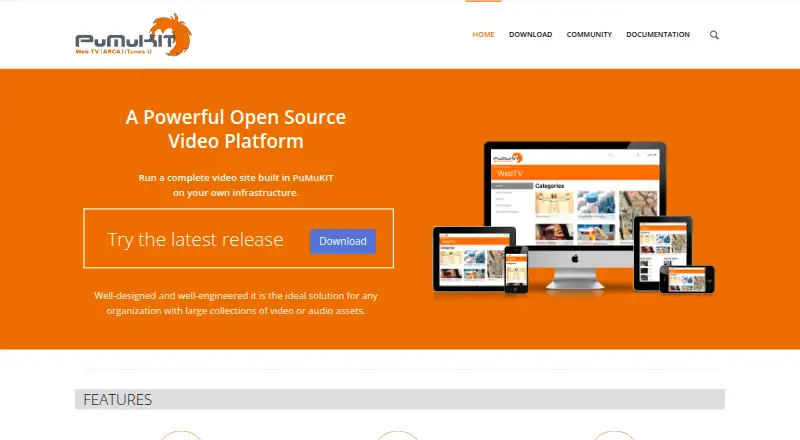
What PuMuKIT is
PuMuKIT is a free, open-source video platform for organizations managing large video or audio collections. It lets organizations host a complete media site on their own infrastructure, with a customizable web portal where viewers can browse by series and category. The portal can display related, most-viewed, and recently added videos. Publisher tools include drag-and-drop cataloguing, autocomplete, interactive forms, and UNESCO science and technology tags. An Opencast module supports presenting and cataloguing Opencast videos in the portal. Distribution options include platforms such as YouTube and iTunes U, along with learning systems such as Moodle and Open edX. Organizations can provide live event channels and keep recordings available for on-demand viewing. Playback supports HTML5 and Flash; the site describes the portal as usable from Android, iPhone, iPad, and desktop browsers. The downloads page lists version 4.2.4 as the latest stable release and recommends it for production. PuMuKIT 4.x is based on Symfony 5 and MongoDB. Community support is offered through mailing lists in English and Spanish. Older 1.x, 2.x, and 3.x versions are not supported by the community.
Who it suits
PuMuKIT suits organizations that want to host and customize a video portal on their own infrastructure. It may also fit teams distributing media to learning systems or providing live and on-demand video.
What it does well
- Self-hosts a complete media site.
- Portal supports browsing by series and category.
- Includes an Opencast integration module.
- Supports live channels and on-demand recordings.
- Free and open source.
What to know first
- Older 1.x, 2.x, and 3.x versions lack community support.
- Community support is through mailing lists.
- No security certification or compliance claim is provided.
Plans
| Plan | Billed and limits | Price |
|---|---|---|
| PuMuKIT | open-source · self-hosted · community-supported | Free |
As pumukit.org lists them, read 15 Oct 2026. The maker's own page has the final word.
Getting started
- Visit the PuMuKIT website.
- Choose the self-hosted deployment route and prepare your own infrastructure.
- Use the downloads page to get PuMuKIT 4.2.4, which is recommended for production.
- Run PuMuKIT 4.x with its Symfony 5 and MongoDB technology base.
- Contact the English- or Spanish-language community mailing lists for support.
PuMuKIT is an open-source platform for publishing, organizing, and delivering institutional video and audio collections. It is best suited to organizations that can operate their own infrastructure and need a customizable portal for both live events and an on-demand archive. Its strength is the combination of cataloguing and distribution tools; the trade-off is the responsibility of self-hosting and maintaining a supported release.
Overview
PuMuKIT brings a viewer-facing media portal and publisher tools together in a self-hosted system. Organizations can shape how viewers browse a large collection rather than relying on a generic hosted library. That control makes it a sensible option for institutions with infrastructure and staff to run the service, but a poor fit for teams seeking a managed platform with little operational overhead.
Viewers can browse by series and categories, with widgets for related, most-viewed, and recently added videos. This gives large collections useful ways to surface content beyond a basic list. Live event channels and video-on-demand spaces also let organizations keep event recordings accessible after a broadcast.
Key features
Cataloguing and distribution
The publisher interface supports drag-and-drop cataloguing, autocomplete, interactive forms, and UNESCO science and technology tags. These tools support structured metadata workflows, particularly for organizations with specialized cataloguing needs; they do not eliminate the work of deciding and maintaining those workflows.
PuMuKIT includes an Opencast integration module for presenting and cataloguing Opencast videos in the portal. It can also distribute video to services such as YouTube and iTunes U, and to learning systems including Moodle and Open edX. For organizations already using these destinations, the integrations broaden delivery options from one media site.
Playback and technical basis
The portal supports HTML5 and Flash playback and is described as usable from Android, iPhone, iPad, and desktop browsers. The 4.x release line is based on Symfony 5 and MongoDB, a technical foundation organizations should account for when assessing their ability to deploy and maintain it.
Pricing
PuMuKIT: free. This is open-source, self-hosted software with no stated paid tier. The price is attractive for organizations able to provide their own infrastructure and operations; the trade-off is that the software is not a hosted service that removes those responsibilities.
Platforms
PuMuKIT is self-hosted and web-based, with on-premise deployment, LMS delivery, and live streaming. Its browser playback spans desktop and mobile devices, including Android, iPhone, and iPad.
Who it's for
PuMuKIT is aimed at organizations with substantial video or audio collections that want to control their portal, cataloguing, and distribution. It is particularly relevant to institutions handling live events alongside a lasting media library, and to organizations working with Opencast or learning systems such as Moodle and Open edX. Individuals and teams without capacity to run their own infrastructure should look for a hosted alternative.
Pros and cons
- Pros: Self-hosting gives organizations control over the complete portal and its browsing experience.
- Pros: Cataloguing tools and specialized tags support structured management of large collections.
- Pros: Live channels, on-demand spaces, Opencast integration, and external distribution support varied institutional workflows.
- Cons: Organizations must run the platform on their own infrastructure, adding operational responsibility.
- Cons: Older 1.x, 2.x, and 3.x versions are not community-supported, so installations should use a supported release.
- Cons: No security certification or compliance claim is provided, which may matter to organizations with formal assurance requirements.
Alternatives
For a broader set of lecture-capture options, browse Lecture Capture Software.
- lectureStudio is another free option with a GPLv3 project and platforms spanning Linux, macOS, Windows, self-hosted, and web; consider it when that desktop coverage and open-source contribution model better suit your needs.
- Opencast is a free, open-source platform with Linux, web, API, and self-hosted support, plus demo instances for trying its administrative interface and portal; choose it when trying those interfaces before installation is useful.
- GoCast is free, MIT-licensed, and self-hosted; consider it if that licensing option is a better fit for your organization.
- Presentations2Go offers a free plan and trial across mobile, desktop, web, API, and self-hosted platforms; choose it if you want to compare a freemium option with trial access.
- Planet eStream is paid and uses modular pricing based on required features and, for school groups, number of schools; consider it when a modular paid product fits your requirements.
- YuJa Lumina Video Platform is a paid option with pricing from a sales specialist; consider it when you prefer a sales-led pricing process.
- Galicaster-PRO is paid and usually sold pre-installed with a Galicaster unit, with software licensing under certain conditions and education discounts; consider it when that arrangement suits your deployment.
- Vbrick Enterprise Video Platform is paid, with quotes scoped to use case, audience, library size, and network topology; consider it when you need pricing based on those deployment factors.
Verdict
Choose PuMuKIT if your organization needs a customizable self-hosted portal for a large media collection and can manage its own deployment. The combination of structured cataloguing, live and on-demand video, and distribution integrations is its clearest advantage. Look elsewhere if you need a hosted service or require security and compliance assurances not established for PuMuKIT.
Verdict
PuMuKIT offers self-hosted publishing, cataloguing, and video distribution for organizations with large media collections. The listed stable release is 4.2.4; older major versions are unsupported by the community.
Questions
Is PuMuKIT free?
Yes. PuMuKIT is free and open source.
Can an organization host PuMuKIT itself?
Yes. Organizations can run a complete PuMuKIT video site on their own infrastructure.
Which platforms can viewers use?
PuMuKIT is self-hosted and web-based. The portal is described as usable from desktop browsers, Android, iPhone, and iPad.
Does PuMuKIT support Opencast and learning systems?
It includes an Opencast module for presenting and cataloguing Opencast videos. Distribution options include Moodle and Open edX.
What is the latest stable release listed?
The downloads page lists PuMuKIT 4.2.4 as the latest stable release and recommends it for production.
How can users get community support?
The site directs users to community mailing lists in English and Spanish.
Facts from PuMuKIT's own pages
- API evidence
- The changelog records API filters, event methods, and an external API override method, but the public developer guide does not provide a standalone API reference. · github.com, 15 Oct 2026
- Company fact
- TELTEK Video Research’s LinkedIn listing describes it as a privately held EdTech company founded in 2008 with 11–50 employees and based in Vigo, Spain. · se.linkedin.com, 15 Oct 2026
- Company relationship
- TELTEK’s LinkedIn profile lists deployment of open WebTV solutions using PuMuKIT among its specialties. · se.linkedin.com, 15 Oct 2026
- Container installation
- The installation guide requires Docker Compose and Git, then uses docker-compose build and docker-compose up -d. · github.com, 15 Oct 2026
- Current architecture
- PuMuKIT 4.x uses Symfony 5 and MongoDB. · pumukit.org, 15 Oct 2026
- Customizable portal
- The web portal can be customized and lets viewers browse videos by series and categories, with related, most-viewed, and recently added widgets. · pumukit.org, 4 Oct 2026
- Device access
- The official site says media can be browsed from Android, iPhone, iPad, and desktop browsers. · pumukit.org, 15 Oct 2026
- Distribution integrations
- The product can automatically distribute uploaded video to YouTube and iTunes U. · pumukit.org, 15 Oct 2026
- Docker image
- Docker Hub lists a teltek/pumukit backend image with more than 10,000 pulls and a listed size of about 556 MB. · hub.docker.com, 15 Oct 2026
- Documentation scope
- The documentation project includes installation, user, developer and architecture, administration, migration, and third-party-bundle guides. · github.com, 15 Oct 2026
- Event hooks
- The developer guide documents events for series, multimedia objects, materials, tracks, users, groups, jobs, and annotations. · github.com, 15 Oct 2026
- Extensibility model
- The developer guide describes Symfony bundles as the product’s extension mechanism and recommends creating or overriding bundles. · github.com, 15 Oct 2026
- Latest stable release
- The downloads page identifies version 4.2.4 as the latest stable release and recommends it for production. · pumukit.org, 15 Oct 2026
- Learning-system integrations
- Official documentation names Moodle and Open edX as learning-platform destinations. · pumukit.org, 15 Oct 2026
- Legal maker identity
- The PuMuKIT site footer identifies Universidade de Vigo, and the university’s legal notice gives its address in Vigo, Pontevedra, Spain. · saves.uvigo.gal, 15 Oct 2026
- Limit: legacy requirements
- The installation guide still documents Ubuntu 18.04, PHP 7.2 paths, and older MongoDB guidance. · github.com, 15 Oct 2026
- Limit: operational ownership
- Because deployment, storage, transcoding, and database can be operated on the customer’s infrastructure, the operator must manage that infrastructure. · github.com, 15 Oct 2026
- Limit: unsupported releases
- The downloads page says older PuMuKIT versions are not supported by the community. · pumukit.org, 15 Oct 2026
- Live and on-demand video
- PuMuKIT provides live channels and keeps event recordings available as video on demand. · pumukit.org, 15 Oct 2026
- Metadata vocabulary
- Publisher metadata can use the included UNESCO science-and-technology nomenclature. · pumukit.org, 15 Oct 2026
- Multi-node deployment
- The guide supports separate transcoder nodes and NAS storage for production-style multi-node deployments. · github.com, 15 Oct 2026
- Opencast integration
- An Opencast integration module provides a customizable portal front end and cataloguing for Opencast videos. · pumukit.org, 15 Oct 2026
- Open-source licence
- The main GitHub repository is published under the GNU Affero General Public License 3.0. · github.com, 15 Oct 2026
- Playback
- The portal supports HTML5 and Flash video and is described as usable from Android, iPhone, iPad, and desktop browsers. · pumukit.org, 4 Oct 2026
Where PuMuKIT stands on Freedom251
- Lecture Capture Software#3 of 19