Freedom251 › AI Patent Search Software
PQAI
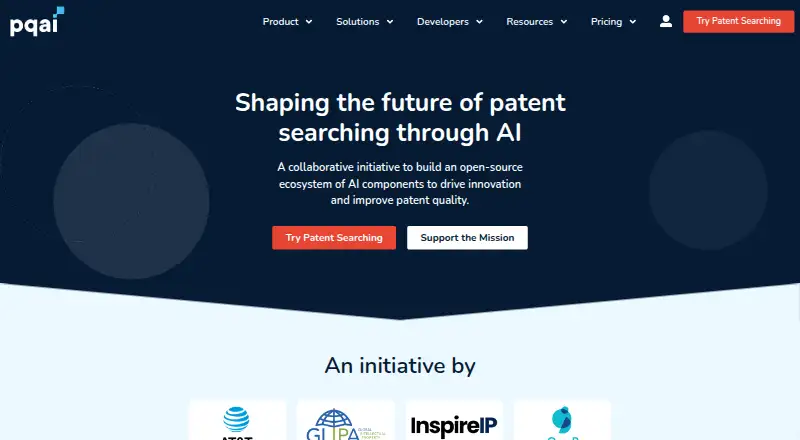
What PQAI is
PQAI is a patent-search platform that helps users locate prior art by describing an invention in natural language, without special formatting or technical expertise. Its tools include semantic search, CPC Classification Prediction, Technical Concept Extraction, Patent Data Retrieval, and claim analysis. The free plan searches across 100M+ patents and provides up to 20 results per query at standard speed. PQAI+ offers up to 500 results per query, faster search, full-text excerpts, export, and 20 API requests per month. The platform is available on the web and through an API, and PQAI describes it as open source. API plans include MCP server access and compatibility with Claude, ChatGPT, and Gemini. Commercial integration into another product requires a commercial API or Enterprise plan. PQAI also offers an iFrame embed with setup instructions for WordPress, Wix, and custom-built websites. The maker says queries are erased from its servers after results are generated. API requests use token-based authentication and HTTPS, with rate limiting and access controls. Paid plans start at $20.00 per month; annual PQAI+ costs $216.00 per year.
Who it suits
PQAI may suit individual inventors, law firms, patent examiners, enterprises, and R&D teams looking for relevant prior art. Its API options may also suit developers who need patent search in their own tools, subject to plan limits and commercial-use terms.
What it does well
- Search ideas described in natural language
- Free plan covers 100M+ patents
- Includes classification prediction and concept extraction
- API plans work with Claude, ChatGPT, and Gemini
- Maker says queries are erased after results are generated
What to know first
- Free plan limits queries to 20 results
- PQAI+ includes only 20 API requests per month
- API responses stop at plan limits until the next billing cycle
- Commercial product integration requires a commercial API or Enterprise plan
Limits
The free plan returns up to 20 results per query at standard search speed. PQAI+ provides up to 500 results per query and 20 API requests per month; after the API request limit is reached, responses stop until the next billing cycle.
Plans
| Plan | Billed and limits | Price |
|---|---|---|
| Free | forever (No credit card required) · 100M+ patents · up to 20 results/query · standard speed · CPC prediction · concept extraction · patent data retrieval · helpdesk/email support | Free |
| Developer | /mon ($0.33 per query) · 600 API queries/month · top-up: $199 for 600 more queries · experimentation and personal use · usage dashboard and audit logs | $199 a month |
| API Developer | $0.33 per query · 600 API queries/month · 600-query top-up for $199 · personal/experimental use · usage dashboard · audit logs | $199 a month |
| Starter | /mon ($0.40 per query) · 50 API queries/month · US patent REST API · MCP server access · works with Claude, ChatGPT, Gemini | $20 a month |
| PQAI+ Monthly | per month — cancel anytime · up to 500 results/query · super-fast speed · full-text excerpts · export · 20 API requests/month · priority support | $20 a month |
| API Starter | $0.40 per query · 50 API queries/month · US REST search · MCP server · Claude/ChatGPT/Gemini compatibility · token and documentation | $20 a month |
| PQAI+ Annual | billed once a year; Save 10% · up to 500 results/query · super-fast speed · full-text excerpts · export · 20 API requests/month | $216 a year |
| API Enterprise | $0.23 per query · 3,000 API queries/month · commercial-use licence · platform/product integrations · priority support · custom volume | $700 a month |
The first 8 of 10 plans, as projectpq.ai lists them, read 15 Oct 2026. The maker's own page has the final word. Every plan
Getting started
- Open https://projectpq.ai/.
- Use the web platform to describe an invention in natural language.
- Choose the free plan for up to 20 results per query, with no credit card required.
- Choose a paid plan if you need its listed higher result limits.
- For a website embed, use PQAI's iFrame and its instructions for WordPress, Wix, or custom-built sites.
PQAI turns plain-language invention descriptions into AI-assisted prior-art searches. It is best for inventors, patent professionals, and R&D teams that need a low-friction first search, while developers should examine its API quotas carefully before building around it. The free tier offers unusually broad patent coverage, but higher-volume or commercial integrations quickly require a more expensive plan.
Overview
PQAI runs on the web and through an API, so it can serve both occasional researchers and software products. Users describe an invention without specialist syntax or technical formatting, making it approachable when an idea is still being framed. The free plan searches more than 100 million patents and returns up to 20 results per query at standard speed. That is enough for an initial prior-art scan, but not for systematically reviewing a large result set.
PQAI says it erases each query from its servers after generating results rather than retaining search histories. API requests use token-based authentication over HTTPS, with rate limiting and access controls. The project is open source and invites developer contributions, which may appeal to teams that value inspectable software and community participation.
Key features
Search combines CPC Classification Prediction, Technical Concept Extraction, and Patent Data Retrieval. Together with semantic search and claim analysis, these capabilities help translate an invention into classifications, concepts, and patent records instead of relying only on exact keywords. That is particularly useful for an inventor or examiner who may not know the right patent terminology, although the free result cap limits the breadth of each investigation.
PQAI offers full-text excerpts and export on its paid search tier, plus faster searching. An iFrame embed can place the service in WordPress, Wix, or a custom-built website. API plans add MCP server access and compatibility with Claude, ChatGPT, and Gemini, giving developers a route to connect patent search with those assistants. Commercial integration into another product requires a commercial API or Enterprise plan, so the lower tiers are not a substitute for a production license.
Pricing
| Plan | Price | What it includes |
|---|---|---|
| Free | free, billed forever | 20 results per query, standard speed, CPC Classification Prediction, Technical Concept Extraction, and Patent Data Retrieval; no credit card required. |
| PQAI+ Monthly | $20 a month | 500 results per query, super-fast search, full-text excerpts, export, and 20 API requests per month; cancel anytime. |
| PQAI+ Annual | $216 a year | The same 500-result, faster-search, excerpt, export, and 20-request allowance, billed once yearly. |
| Starter | $20 a month | 50 API queries, US patent REST API, MCP server access, and compatibility with Claude, ChatGPT, and Gemini. |
| Developer | $199 a month | 600 API queries, a $199 top-up for 600 more, experimentation and personal-use terms, usage dashboard, and audit logs. |
| Enterprise | $700 a month | 3,000 API queries, commercial-use license, platform and product integrations, priority support, and custom volume on request. |
PQAI+ is the sensible choice for researchers who need larger result sets and exports rather than substantial API volume. Its 20 monthly API requests are quickly exhausted by an application, and responses stop until the next billing cycle after the limit is reached. Starter increases the allowance to 50 queries but remains aimed at light experimentation. Developer is for personal or experimental projects with materially greater usage; Enterprise is the relevant tier for commercial products, integrations, and larger workloads. Free and PQAI+ users receive support through Help Docs and a contact form, with a stated aim of replying within one business day.
Platforms
PQAI is available through its web interface and API. Website embedding supports iFrame deployment in WordPress, Wix, and custom-built sites. MCP access and stated Claude, ChatGPT, and Gemini compatibility make the API more practical for assistant-centered workflows, while token authentication, HTTPS, rate limiting, and access controls address basic integration safeguards.
Who it's for
Individual inventors benefit from natural-language input and a permanent free tier for early prior-art exploration. Law firms and patent examiners can use classification, concept extraction, claim analysis, and patent retrieval to structure searches, but broader professional review may outgrow 20 results per query. Enterprises and R&D teams gain export, excerpts, faster search, and integration options; commercial software makers should budget for Enterprise or another commercial API plan.
Pros and cons
Pros
- Free searches cover more than 100 million patents, enabling substantial initial exploration without payment.
- Natural-language input, semantic search, and claim analysis reduce dependence on specialist query syntax.
- Paid search adds 500-result queries, full-text excerpts, export, and faster speed.
- Privacy and integration controls include query deletion, HTTPS, token authentication, rate limiting, and access controls.
- MCP access and compatibility with Claude, ChatGPT, and Gemini support assistant-based workflows.
Cons
- The free tier limits each query to 20 results, restricting broad review.
- PQAI+ API access stops after 20 requests per month until renewal, making it unsuitable for sustained integration.
- Starter remains limited to 50 API queries monthly, while commercial use requires Enterprise or a commercial API plan.
- Enterprise costs $700 a month, a substantial commitment for smaller teams.
Alternatives
FindIP is a better fit when mobile access matters or when a free plan with 30 search credits, all APIs, and five jurisdictions is preferable. GoVeda suits readers wanting a free-forever option with 220M+ patents, unlimited AI semantic searches, and patentability reports, plus a free trial. Patent77 is worth considering for a low-volume workflow capped at three AI searches per month, while its Pro tier raises that to 50 searches for $49 a month. Patently is a web-only alternative centered on asset search, patent-family browsing, and chat, with a free single-user plan. PatLab.AI offers free patent searches and a 49.00 USD one-time Pro option. PatSnap is the alternative to examine when self-hosting, broader technical research, or a paid platform is required. The Lens provides anonymous free browsing and an academic workspace. Stiltn is for organizations seeking a self-hosted platform with an evaluation period and dedicated onboarding.
Verdict
PQAI is a strong starting point for inventors, legal researchers, and R&D teams that want natural-language prior-art discovery across a large corpus at no cost. Choose it for its broad free search, concept-oriented tools, and useful assistant integrations. Look elsewhere when your application needs frequent API calls, sustained commercial integration, or a result volume beyond the sharply capped lower tiers.
Verdict
PQAI offers natural-language patent search, with a free option and paid plans that add higher result limits, export, and API access. Check the query or API allowance and commercial-use terms that match your intended use.
Questions
Is PQAI free?
Yes. Its Free plan costs nothing, is billed forever, and requires no credit card. Paid plans start at $20 a month.
What does the free plan include?
It searches across 100M+ patents and allows 20 results per query at standard search speed. It includes CPC Classification Prediction, Technical Concept Extraction, and Patent Data Retrieval.
Which platforms does PQAI support?
PQAI is available on the web and through an API.
Is PQAI open source?
Yes. PQAI describes itself as an open-source platform and invites the developer community to improve it.
Which AI services are compatible with its API plans?
API plans include MCP server access and state compatibility with Claude, ChatGPT, and Gemini.
Can I use PQAI in my own commercial product?
Commercial integration into your own product or platform requires a commercial API or Enterprise plan.
Facts from PQAI's own pages
- API authentication
- API requests use unique token authentication and HTTPS transport. · projectpq.ai, 15 Oct 2026
- API documentation
- The public API guide documents routes, path/query parameters, authentication and example responses. · api.projectpq.ai, 15 Oct 2026
- API limit
- The PQAI+ plans include 20 API requests per month, and the page says responses stop until the next billing cycle after the limit is reached. · projectpq.ai, 7 Oct 2026
- Audience
- PQAI identifies individual inventors, law firms, patent examiners, enterprises, and R&D teams as users. · projectpq.ai, 7 Oct 2026
- Browser storage
- Saved or bookmarked results are stored in the user’s browser rather than uploaded to PQAI servers. · projectpq.ai, 15 Oct 2026
- Commercial API use
- Commercial integration into a user's own product or platform requires a commercial API or Enterprise plan. · projectpq.ai, 7 Oct 2026
- Company origin
- LinkedIn says AT&T initiated the PQAI project and that other groups and companies support it. · linkedin.com, 15 Oct 2026
- Company profile
- LinkedIn lists PQAI as a nonprofit software-development organization headquartered in the United States with 2–10 employees. · linkedin.com, 15 Oct 2026
- Concept extraction
- The API and search product extract technical concepts from supplied text or patents. · projectpq.ai, 15 Oct 2026
- Coverage expansion
- A December 17, 2024 update says coverage reached patents from 68 countries and more than 100 million research papers. · search.projectpq.ai, 15 Oct 2026
- CPC prediction
- PQAI predicts Cooperative Patent Classification codes from technical text. · projectpq.ai, 15 Oct 2026
- Export
- Search results can be exported for offline review, with the paid search plan allowing up to 500 results. · projectpq.ai, 15 Oct 2026
- Funding fact
- The same IFIA report said AT&T funded the PQAI project with $2 million. · ifia.com, 15 Oct 2026
- Independent availability claim
- Founders Legal describes its PQAI collaboration as offering unlimited free searches, confidential processing and downloadable reports. · founderslegal.com, 15 Oct 2026
- Independent launch news
- IFIA reported on May 13, 2021 that PQAI was an open-source nonprofit initiative launched with IFIA involvement. · ifia.com, 15 Oct 2026
- Independent result-limit complaint
- Founders Legal’s embedded PQAI tool explains that its interface intentionally presents only ten results and directs users needing broader coverage to professional services. · founderslegal.com, 15 Oct 2026
- Integrations
- The API plans include MCP server access and state compatibility with Claude, ChatGPT, and Gemini. · projectpq.ai, 7 Oct 2026
- Licence
- The public PQAI repository states that the project is open source under the MIT licence. · github.com, 15 Oct 2026
- Limit: cross-device saved results
- A G2 reviewer notes that browser-stored results are inconvenient when switching devices. · g2.com, 15 Oct 2026
- Limit: interface polish
- A G2 reviewer says the interface can feel basic or in need of refinement compared with premium commercial tools. · g2.com, 15 Oct 2026
- Local deployment
- The repository points developers to wiki instructions for deploying PQAI locally for experimentation or development. · github.com, 15 Oct 2026
- MCP integration
- The paid API plans include access to an MCP server that works with Claude, ChatGPT and Gemini. · projectpq.ai, 15 Oct 2026
- Natural-language search
- Users can describe an invention in ordinary language without special query formatting or patent-search expertise. · projectpq.ai, 15 Oct 2026
- Non-patent literature
- The search platform includes scientific and other non-patent literature alongside patents. · search.projectpq.ai, 15 Oct 2026
Where PQAI stands on Freedom251
- AI Patent Search Software#1 of 24