Freedom251 › AI Patent Search Software
Patent77
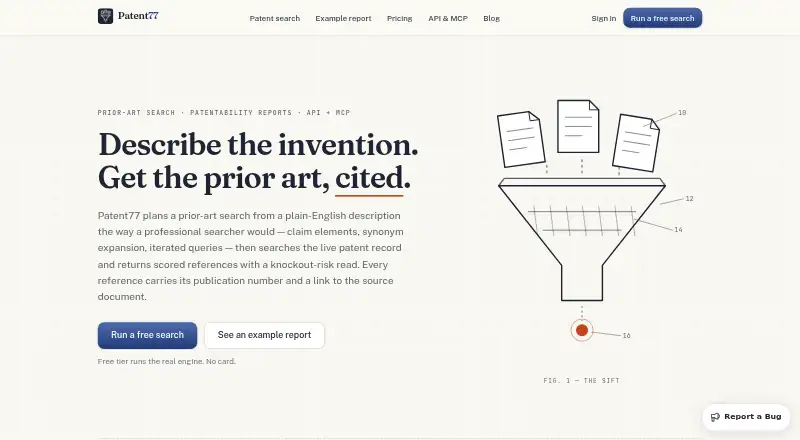
What Patent77 is
Patent77 searches the live public patent record for prior art using a plain-English description of an invention, then returns references and a knockout-risk read. Its search process breaks an invention into claim-style elements, expands synonyms, iterates queries, examines candidate documents, and scores relevant references. Searches use the live Google Patents record, including US and major international patent collections. Paid patentability reports provide an element-by-reference map, a novelty and obviousness narrative, limitations, and PDF export. Lookups by publication number are never billed. The product is available through a web app and API, and offers a hosted MCP server with tools for prior-art search, patent lookup, and patentability assessment. Anonymous API calls can search and look up patents without an account, within limits of 4 requests per minute, 20 per day, and three references per search. The Free plan costs nothing and includes 3 AI searches per month and the top 5 references; Pro is $49 a month. Patent77 says descriptions are account-scoped and not used to train models, shown to others, or sold. It is not legal advice.
Who it suits
Patent77 describes its intended users as inventors and founders, attorneys and agents at small firms, and AI agents. It may suit people seeking prior-art references from an invention description, provided they understand the search coverage limits and legal disclaimer.
What it does well
- Accepts plain-English invention descriptions for prior-art searches.
- Publication-number lookups are never billed.
- Offers a JSON API and hosted MCP server.
- Free plan includes 3 AI searches per month.
- Account deletion removes searches, reports, monitors, and keys.
What to know first
- Does not cover non-patent literature.
- Unpublished applications in the 18-month window are excluded.
- Free plan is limited to 3 AI searches monthly.
- Patent77 is not legal advice.
Limits
The Free plan provides 3 AI searches per month and the top 5 references, and is web app only. Pro includes 10 reports per month, then charges $4/report; Scale includes 60 reports per month, then charges $2.50/report. Anonymous API calls are limited to 4 requests per minute, 20 per day, and three references per search.
Plans
| Plan | Billed and limits | Price |
|---|---|---|
| Free | free forever · 3 AI searches/mo · top 5 references · web app only | Free |
| Scale | $199/ month · 300 searches/mo · 60 reports/mo, then $2.50/report · 600 requests/min · 100 monitors · priority support & uptime SLA | $199 a month |
| Pro | $49/ month · 50 searches/mo · 10 reports/mo, then $4/report · API + MCP · 10 monitors · 120 requests/min | $49 a month |
As patent77.com lists them, read 5 Oct 2026. The maker's own page has the final word.
Getting started
- Open the Patent77 website in a browser to use the web app.
- Use the Free plan for 3 AI searches per month and the top 5 references.
- Choose Pro at $49 a month for API and MCP access, 50 searches per month, and 10 reports per month.
- Choose Scale at $199 a month for 300 searches per month, 60 reports per month, and higher request and monitor limits.
- For anonymous API search and patent lookup, make calls without an account within the stated request limits.
Patent77 is a patent-focused search and reporting service for inventors, small-firm patent professionals, and AI agents that need a structured view of potentially relevant patent references. Its combination of cited results, paid patentability reports, and API and MCP access makes it a practical starting point for early assessment; its search limits make it a poor substitute for a complete clearance or legal advice.
Overview
Patent77 searches the live Google Patents record, including US and major international patent collections. It turns a plain-English invention description into claim-style elements, expands synonyms, iterates queries, reads candidate documents, and scores relevant references. The result is more useful than an undifferentiated keyword list when an inventor needs an initial view of possible overlap, though the knockout-risk read should be treated as a prompt for closer review rather than a filing decision.
Publication-number lookups are never billed, a useful distinction for users who need to inspect known patents without spending search or report capacity. The search corpus does not include non-patent literature, unpublished applications within the 18-month publication window, or collections outside its coverage. That boundary matters: Patent77 can surface patent references, but cannot establish that an invention is clear across all relevant prior art.
Key features
Search and reports
Semantic search and claim analysis support the query process. Paid patentability reports add an element-by-reference map, an examiner-style novelty and obviousness narrative, limitations, and PDF export. Those structured components can help an inventor or practitioner organize a preliminary review; users who need only occasional reference searches may not need the paid report allowance.
API and MCP access
The JSON API and hosted MCP server expose search_prior_art, get_patent, and assess_patentability. This makes Patent77 a plausible fit for developers and AI agents that need patent search and lookup in a workflow, rather than only a browser-based tool. Anonymous API access allows searches and lookups without an account, but is capped at 4 requests per minute, 20 per day, and three references per search; it is a constrained way to evaluate integration, not a production allowance.
Privacy and data handling
Patent descriptions are saved within the user's account and are not used to train models, shown to other users, or sold. Descriptions are sent to an AI provider for query planning and reference reading, while derived queries—not raw descriptions—go to the public patent corpus. The service says it uses TLS, managed Postgres through Supabase with row-level security, and hashed API keys. Deleting an account removes searches, reports, monitors, and keys, with backups expiring on a fixed schedule. Users with sensitive invention disclosures should weigh the AI-provider processing alongside these stated protections.
Pricing
Patent77 is freemium, with paid plans starting at $49 a month. There is no free trial, but the free tier is available indefinitely.
| Plan | Price | What it includes | Best fit |
|---|---|---|---|
| Free | free, free forever | 3 AI searches per month, top 5 references, web app only | Occasional searches and initial evaluation |
| Pro | $49 a month | 50 searches per month, 10 reports per month then $4/report, API and MCP, 10 monitors, 120 requests per minute | Regular individual or small-team research and integrations |
| Scale | $199 a month | 300 searches per month, 60 reports per month then $2.50/report, 600 requests per minute, 100 monitors, priority support and uptime SLA | Higher-volume use that needs more request capacity and monitoring |
The free plan keeps the cost at zero but limits both monthly search volume and references per search, and it does not include API or MCP access. Pro adds those integrations and a larger quota, but reports beyond ten cost extra. Scale raises the search, report, request, and monitor limits and adds priority support and an uptime SLA; it is hard to justify for occasional research. The published plan terms give monthly billing, but no seat allowance is stated, so the plans should not be treated as team-priced licenses.
Platforms
Patent77 is available through a web app and API; its hosted MCP server also supports agent-oriented access. The free plan is web-only, while Pro and Scale include API and MCP. That distinction makes the free tier suitable for trying the search experience, not for evaluating the paid integration workflow in sustained use.
Who it's for
Inventors and founders can use the free allowance to identify patent references before deciding whether to seek professional help. Attorneys and agents at small firms may value the claim-oriented search and structured reports as an early research aid, while AI-agent builders have a direct API and MCP route. It is less suited to work requiring non-patent literature, unpublished applications, or patent collections beyond its corpus, and its own legal limitation rules out treating a report as legal advice.
Pros and cons
Pros
- Searches start from plain-English invention descriptions and return cited references with a knockout-risk read, giving early-stage users more context than a bare lookup.
- Publication-number lookups are never billed, so checking a known patent does not consume the paid search or report budget.
- Paid reports provide an element-by-reference map, novelty and obviousness narrative, limitations, and PDF export for a more organized preliminary assessment.
- API and hosted MCP access, plus a free web tier, give both browser users and developers a way into the product.
Cons
- The corpus excludes non-patent literature, unpublished applications in the 18-month publication window, and collections outside its scope, limiting its value for exhaustive prior-art work.
- The free tier allows just 3 searches monthly and returns only the top 5 references, which can constrain repeated exploration.
- Pro charges $4 for each report beyond its monthly ten, while Scale costs $199 a month; users with sporadic needs may pay for capacity they do not use.
- Search descriptions are processed by an AI provider, a consideration for users handling confidential invention details despite the stated account and security protections.
Alternatives
For a broader comparison, browse AI Patent Search Software.
- FindIP is worth considering when mobile access or a wider free search allowance matters: it supports Android, iOS, API, and web, and its free plan includes 30 search credits, all APIs, five jurisdictions, and re-ranking.
- GoVeda may suit users prioritizing broad patent volume and generous free semantic search: its OpenPatent plan is free forever and offers 220M+ patents worldwide and unlimited AI semantic searches, as well as basic metadata filters and AI reports and summaries.
- Patently is an option for web users seeking asset search with filters, patent-family browsing, and chat with Onardo; its free plan is limited to one user and individual use.
- PatLab.AI is another web-based patent-search option, with free searches and a one-time 49.00 USD Pro Patent Search plan.
- PatSnap is worth comparing for users who want technical-research capabilities beyond patent search: its free Basic plan includes limited technical topics, basic AI technical Q&A, TRIZ innovation generation, and report previews; it also supports API, self-hosted, and web access.
- PQAI may appeal to developers who favor an open-source platform; it offers API and web access and has a free plan.
- The Lens offers anonymous free browsing and a free academic workspace, making it an alternative for users who want those access options.
- Stiltn offers a full-access evaluation with dedicated onboarding and custom configuration, and may suit users who want to assess a self-hosted or web platform.
Verdict
Patent77 is best for inventors, small-firm patent professionals, and AI-agent builders who want a claim-oriented patent search with cited references and an optional structured report. Its free tier and unbilled publication-number lookups lower the barrier to preliminary research, while Pro adds useful API and MCP access. Choose another route or consult a registered patent attorney or agent when the decision requires broader prior-art coverage or legal judgment.
Verdict
Patent77 pairs prior-art searching with cited references and paid patentability reports, and also offers API and MCP access. Its coverage excludes non-patent literature and some unpublished applications, and it is not a substitute for advice from a registered patent attorney or agent.
Questions
Is Patent77 free?
Yes. The Free plan is billed free forever and includes 3 AI searches per month and the top 5 references through the web app.
What do the paid plans cost?
Pro costs $49 a month. Scale costs $199 a month.
Which platforms does it support?
Patent77 lists web and API access. It also offers a hosted MCP server.
What does a paid patentability report include?
It includes an element-by-reference map, a novelty and obviousness narrative, limitations, and PDF export.
What patent information does it search?
It queries the live Google Patents record, including US and major international patent collections. It does not cover non-patent literature, unpublished applications in the 18-month publication window, or collections outside its corpus.
Is Patent77 legal advice?
No. Patent77 says it is not legal advice and recommends consulting a registered patent attorney or agent for filing decisions.
Facts from Patent77's own pages
- API trial
- Anonymous API calls can search and look up patents without an account, limited to 4 requests per minute, 20 per day, and three references per search. · patent77.com, 5 Oct 2026
- Data processing
- Search descriptions are sent to an AI provider for query planning and reference reading, while derived queries rather than raw descriptions are sent to the public patent corpus. · patent77.com, 5 Oct 2026
- Data source
- Searches query the live Google Patents record, including US and major international patent collections. · patent77.com, 5 Oct 2026
- Deletion
- Deleting an account removes its searches, reports, monitors, and keys, while backups expire on a fixed schedule. · patent77.com, 5 Oct 2026
- Integrations
- The product offers a JSON API and hosted MCP server, with tools named search_prior_art, get_patent, and assess_patentability. · patent77.com, 5 Oct 2026
- Intended users
- The site describes inventors and founders, attorneys and agents at small firms, and AI agents as audiences for the product. · patent77.com, 5 Oct 2026
- Legal limitation
- Patent77 states that it is not legal advice and recommends consulting a registered patent attorney or agent for filing decisions. · patent77.com, 5 Oct 2026
- Limits
- Patent77 does not cover non-patent literature, unpublished applications in the 18-month publication window, or collections outside its corpus. · patent77.com, 5 Oct 2026
- Patent lookup
- Patent lookups by publication number are never billed. · patent77.com, 5 Oct 2026
- Purpose
- Patent77 searches the live public patent record for prior art based on a plain-English invention description and returns cited references with a knockout-risk read. · patent77.com, 5 Oct 2026
- Reports
- Paid patentability reports include an element-by-reference map, an examiner-style novelty and obviousness narrative, limitations, and PDF export. · patent77.com, 5 Oct 2026
- Search method
- The engine decomposes an invention into claim-style elements, expands synonyms, runs iterated queries, reads candidate documents, and scores relevant references. · patent77.com, 5 Oct 2026
- Security
- Patent descriptions are stored as saved searches scoped to the user's account and are not used to train models, shown to other users, or sold. · patent77.com, 5 Oct 2026
- Storage and transport
- The service says it uses TLS, managed Postgres through Supabase with row-level security, and hashed API keys. · patent77.com, 5 Oct 2026
Where Patent77 stands on Freedom251
- AI Patent Search Software#6 of 24