Freedom251 › AI Patent Search Software
The Lens
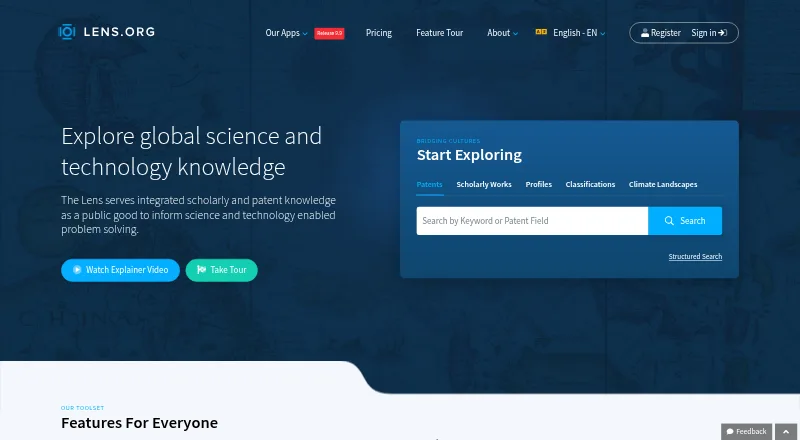
What The Lens is
The Lens is a research discovery and analysis platform that connects patent records with scholarly work. Patent search supports Boolean, structured, biological, and classification queries, with filtering and sorting. The Lens says its scholarly collection contains more than 200 million records, and citations link scholarly works to patents. PatSeq tools let users search, analyze, and share biological sequences disclosed in patents. Users can explore results through charts and dashboards, then save and share dashboards. Registered accounts can save queries and collections, add personal notes, and receive alerts when matching indexed results appear. Lens Profiles bring author and inventor records together and allow ORCID linking and synchronization. APIs provide programmatic search and retrieval, subject to approved access and a token. Anonymous browsing is free, and academic non-commercial users can use a free workspace with an academic institutional email. Individual commercial users need commercial-use permission through a subscription or institution; the Individual Professional Workspace costs US$1000/year and does not include API or bulk data access by default.
Who it suits
The Lens suits researchers and other users who need to search scholarly work alongside patent records. Academic non-commercial users can access a free workspace; individual commercial users need appropriate commercial-use permissions.
What it does well
- Patent search includes biological and classification queries.
- Scholarly records are linked to patents through citations.
- PatSeq supports biological-sequence search and analysis.
- Saved queries can trigger notifications for matching records.
- Anonymous browsing does not require an email address.
What to know first
- API access requires approval and a token.
- Commercial use requires permission through a subscription or institution.
- Professional workspace has no API or bulk data access by default.
Limits
Anonymous access is for browsing without an account. The free Academic Workspace is for academic users doing non-commercial research and requires an academic institutional email; the free API Trial requires approval and lasts 14 days.
Plans
| Plan | Billed and limits | Price |
|---|---|---|
| Academic / non-commercial access | Guest browsing · Free registered account for personal, non-commercial use · Search, collections, alerts, dashboards, and exports | On request |
| Individual commercial use | Annual subscription; single user account · 1 user | $1,000 a year |
| Academic Workspace | For academic users doing non-commercial research · requires an academic institutional email | Free |
| Anonymous access | Browse without an account · anonymous use remains free | Free |
| API Trial | Requires approval · non-commercial or limited academic use · API access valid for 14 days | Free |
| Individual Professional Workspace | US$1000/year · Single-seat · non-transferable · for professional or commercial use · no API or bulk data access by default | $1,000 a year |
| API Member | Custom Access | Contact The Lens for access · Paid · for higher or continued API access, automated downloads, integration or commercial use | On request |
As lens.org lists them, read 20 Sept 2026. The maker's own page has the final word.
Getting started
- Open The Lens website to browse anonymously for free.
- Register for an Academic Workspace with an academic institutional email if using it for non-commercial academic research.
- Choose the Individual Professional Workspace for individual professional or commercial use.
- Request API access and a token if you need programmatic search and retrieval.
Verdict
The Lens brings patent and scholarly discovery together, with saved searches, dashboards, and biological-sequence tools. Its free access options are for browsing or qualifying academic non-commercial work; individual commercial use requires permission.
Questions
Can I use The Lens for free?
Yes. Anonymous browsing is free. Academic users doing non-commercial research can also use a free workspace with an academic institutional email.
How much does the Individual Professional Workspace cost?
It costs $1,000 per year. It is a single-seat, non-transferable plan for professional or commercial use.
Does the paid individual plan include API access?
API or bulk data access is not included by default in the Individual Professional Workspace. Higher or continued API access is available through the paid API Member | Custom Access option, with pricing provided by contacting The Lens.
Which platforms are available?
The Lens lists web and API access. API access requires approved access and a token.
What does the API Trial include?
The API Trial is free, requires approval and provides API access for 14 days for non-commercial or limited academic use.
Who operates The Lens?
The Lens operates as The Lens Limited, a non-profit based in Australia. It became a wholly owned subsidiary of SPIE in 2026.
Facts from The Lens's own pages
- Account security
- The Lens supports two-factor authentication by authenticator app or email and recommends enabling it for accounts. · support.lens.org, 29 Sept 2026
- Analytics
- Users can visualize search results with dashboards and charts, then save and share dashboards. · support.lens.org, 29 Sept 2026
- API and integrations
- Patent and scholarly APIs provide programmatic search and retrieval; the API guide lists cURL and Postman as client examples and requires approved access and a token. · support.lens.org, 29 Sept 2026
- Biological sequences
- PatSeq tools let users search, analyze and share biological sequences disclosed in patents. · about.lens.org, 29 Sept 2026
- Commercial eligibility
- Individual users using The Lens for commercial purposes must obtain commercial-use permissions through a subscription or their institution. · support.lens.org, 29 Sept 2026
- Founded
- The Lens says it launched in 2001, while its predecessor Patent Lens work began in 1999. · about.lens.org, 29 Sept 2026
- Headquarters
- West End, Queensland, Australia · lens.org, 28 Sept 2026
- Organization
- The Lens became a wholly owned subsidiary of SPIE in 2026, operating as The Lens Limited, a non-profit based in Australia. · about.lens.org, 29 Sept 2026
- Patent and research search
- Patent search includes Boolean, structured, biological and classification search, with filtering and sorting options. · about.lens.org, 29 Sept 2026
- Privacy
- The privacy policy says registered users may opt out of search-history recording and web analytics, and guest use does not require providing an email address. · about.lens.org, 29 Sept 2026
- Profiles and ORCID
- Lens Profiles combine author and inventor records with aggregated data, and let users link and synchronize their ORCID records. · about.lens.org, 29 Sept 2026
- Purpose
- The Lens connects scholarly and technological knowledge, including patents and scholarly works, to support discovery, analysis, decision-making and partnering. · about.lens.org, 29 Sept 2026
- Saved work and alerts
- Registered accounts can save collections and queries, add personal notes, and receive notifications when new indexed results match saved queries or collections. · support.lens.org, 29 Sept 2026
- Scholarly coverage
- The Lens says it serves more than 200 million scholarly records and links scholarly works with patent records through citations. · about.lens.org, 29 Sept 2026
- Support
- The Lens lists [email protected] and [email protected] as contact emails and provides a support request form. · about.lens.org, 29 Sept 2026
Where The Lens stands on Freedom251
- AI Patent Search Software#9 of 24
- Academic Research Databases#17 of 35