Freedom251 › Address Verification Software
PostalUp
What PostalUp is
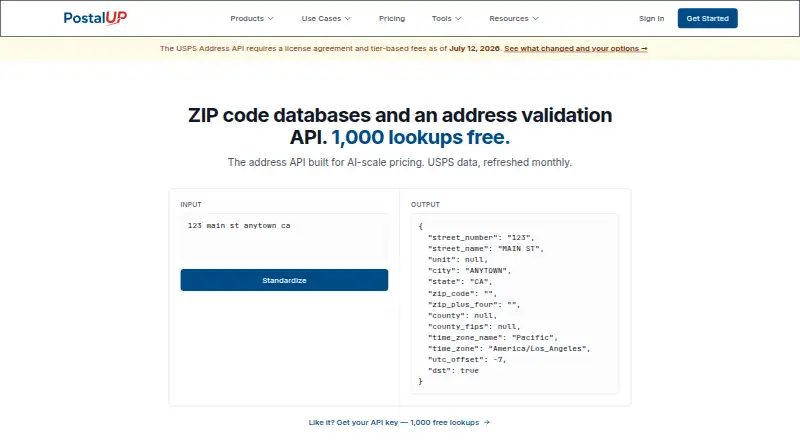
PostalUp provides ZIP code databases and an address validation API for U.S. address workflows. The API supports address standardization, verification, geocoding, and bulk processing, and PostalUp says its USPS data is refreshed monthly. Submitted addresses are processed in real time and are not permanently stored except when needed to provide the service or as allowed by the Privacy Policy. Developers can use documentation, code examples, an API playground, webhooks, a Postman collection, and an OpenAPI specification; language examples cover JavaScript, Python, PHP, Ruby, cURL, Go, and Java. Downloads vary by dataset and include CSV, JSON, Parquet, GeoJSON, and Shapefile formats, drawing on USPS, Census, OMB, HUD, and TIGER data. The free API plan includes 1,000 requests and basic validation. Paid API plans start at $29/mo, while database products are sold separately on annual plans. Internal commercial use is included with downloads, but customer redistribution requires a license.
Who it suits
PostalUp suits developers and organizations that process U.S. addresses in e-commerce, real estate, logistics, marketing, insurance, or healthcare. It offers both API validation and downloadable postal datasets.
What it does well
- Free plan includes 1,000 requests.
- Supports standardization, verification, geocoding, and bulk processing.
- Developer tools include webhooks and an OpenAPI specification.
- Downloads come in five listed data formats.
- Engineering support responds within 24 hours.
What to know first
- Free plan is limited to 1,000 requests.
- Paid API plans pause after the 20% courtesy buffer.
- Customer redistribution requires a redistribution license.
- Coverage is local, not international.
Limits
The free API plan includes 1,000 requests, allows 10 requests per minute, and provides address standardization and basic validation. Paid API plans continue serving requests through a 20% courtesy buffer past the monthly quota; after that, requests pause until an upgrade or monthly reset.
Plans
| Plan | Billed and limits | Price |
|---|---|---|
| Free to Try | 1,000 requests, never expires · 1,000 requests · 10 requests/min · address standardization · basic validation · email support | Free |
| ZIP Code Database Business | Your Price:$129/year · 110 fields · business and employment data · priority email support | $129 a year |
| ZIP Code Database Basic | Your Price:$19/year · 4 core fields · 40,000+ ZIP codes · annual updates · CSV, TSV, JSON, SQL | $19 a year |
| Starter | $29/month · 10,000 requests/month · 50 requests/min · ZIP+4 validation · batch processing | $29 a month |
| Scale | $299/month · 500,000 requests/month · 200 requests/min · batches up to 5,000 addresses · priority support | $299 a month |
| ZIP+4 Database Standard | Your Price:$299/year · 38 fields · 190M+ addresses covered · 48.7M+ delivery ranges · building coordinates · dashboard access | $299 a year |
| ZIP Code Database Standard | Your Price:$39/year · 35 fields · coordinates and mapping · monthly updates · dashboard download access | $39 a year |
| ZIP Code Database Deluxe | Your Price:$79/year · 63 fields · population and income data · metro area data · priority email support | $79 a year |
The first 8 of 10 plans, as postalup.com lists them, read 7 Oct 2026. The maker's own page has the final word. Every plan
Getting started
- Open the PostalUp website and choose the API or database product you need.
- For API use, start with the free plan or choose a paid API plan.
- Review the API documentation and select a code example or the API playground.
- Use the Postman collection or OpenAPI specification when working with the API.
- For database products, choose a plan and download from the available formats.
- Use downloaded data internally for commercial purposes; obtain a redistribution license before sharing it with customers.
Overview
PostalUp pairs a U.S.-focused address-validation API with separately sold ZIP code and ZIP+4 datasets. It suits developers and organizations working with U.S. addresses or postal data; its local coverage makes it a poor fit for international validation.
Key features
The API handles address standardization, basic validation, ZIP+4 validation, geocoding and bulk processing. Its address data uses USPS information refreshed monthly, while submitted addresses are processed in real time and not permanently stored except as needed to provide the service or as permitted by the Privacy Policy. That is a useful operational boundary for routine validation, but it does not broaden the service beyond local coverage.
Developer resources include documentation, code examples, an API playground, webhooks, a Postman collection and an OpenAPI specification. Examples or options cover JavaScript, Python, PHP, Ruby, cURL, Go and Java, which gives teams a broad set of starting points. Engineering support responds within 24 hours; paid plans add priority support at higher tiers.
Postal datasets are available in CSV, JSON, Parquet, GeoJSON and Shapefile formats, depending on the product. The downloads draw on USPS, Census, OMB, HUD and TIGER sources. Internal commercial use is included, but customer redistribution requires a redistribution license, a material condition for businesses embedding postal data in a product or service.
Pricing
The API and database products are priced separately, so a team needing both should compare the relevant subscriptions rather than treating database access as part of an API plan.
- Free to Try: free, with 1,000 requests that never expire, a 10 requests/minute limit, address standardization, basic validation and email support. It is a useful low-risk starting point, but the small request pool and rate limit suit trials or light workloads, not sustained production traffic.
- Starter: $29 a month for 10,000 requests/month, 50 requests/minute, ZIP+4 validation and batch processing. This is the entry paid API tier for modest recurring volumes; requests continue through a 20% courtesy buffer beyond quota, then pause until an upgrade or monthly reset.
- Professional: $99 a month for 100,000 requests/month, 200 requests/minute, batch and real-time processing, and priority support. It suits teams with steadier throughput that need both processing modes and a faster support channel.
- Scale: $299 a month for 500,000 requests/month, 200 requests/minute, batches of up to 5,000 addresses and priority support. The higher quota and batch size favor substantial workloads, though the same request-rate ceiling as Professional remains.
- Enterprise: custom pricing based on your needs, with unlimited requests, no rate limits, dedicated support, a custom SLA and volume discounts. It is the relevant option when standard quotas or support terms are insufficient.
Database subscriptions are annual. ZIP Code Database Basic costs $19 a year and provides four core fields, 40,000+ ZIP codes, annual updates and CSV, TSV, JSON and SQL formats. Standard costs $39 a year, adding 35 fields, coordinates and mapping, monthly updates and dashboard downloads. Deluxe is $79 a year for 63 fields, population and income data, metro-area data and priority email support. Business costs $129 a year for 110 fields, business and employment data, and priority email support. The higher tiers make sense when those added attributes or more frequent updates justify the annual spend; Basic is the narrowest option.
ZIP+4 Database Standard costs $299 a year and includes 38 fields, coverage of 190M+ addresses, 48.7M+ delivery ranges, building coordinates and dashboard access. This is a dataset purchase rather than an API quota tier. There is no free trial; the free API plan is the only no-cost API entry point.
Platforms
PostalUp is offered through an API and the web. The web dashboard provides download access for some datasets, while API plans target request-based validation and processing. Its local coverage is a decisive limitation for organizations that need international address verification.
Who it's for
PostalUp is a sensible shortlist option for developers, e-commerce teams, logistics operators, real-estate businesses, marketers, insurers and healthcare organizations handling U.S. address workflows. Its separate annual datasets may also suit teams that need postal attributes for internal commercial use. Businesses that redistribute downloaded data to customers need the additional license, and teams processing international addresses should choose a broader-coverage service.
Pros and cons
- Pros: API tiers scale from a never-expiring 1,000-request allowance to enterprise terms with no rate limits, giving teams a clear path as usage grows.
- Pros: Monthly refreshed USPS data, batch processing, several developer resources and multiple language examples support practical integration and recurring address workloads.
- Pros: Annual datasets range from core ZIP fields to business, employment, population and delivery-range data, with multiple download formats.
- Cons: Coverage is local, so PostalUp does not fit international validation requirements.
- Cons: Paid API requests pause after the 20% courtesy buffer until upgrade or reset, which can interrupt a workload that exceeds its monthly allowance.
- Cons: Dataset redistribution to customers requires a separate license, limiting how freely the downloads can be embedded in customer-facing offerings.
Alternatives
Addresser is worth considering if its listed eCommerce plan's 1,000 lookups per 30 days and autocomplete better match a small lookup workload.
Melissa Global Address Verification offers a 250-record monthly free tier and a $40 a month plan starting at 1,000 records/month; consider it if that record-based entry point or its API, self-hosted and desktop platforms fit better.
Addrex Address Validation API has a free beta with 10,000 monthly lookups, spreadsheet upload, map coordinates, usage dashboard, CSV export and no automatic overage billing. Its free allowance is larger than PostalUp's, making it an option to compare for early-stage usage.
Addressr offers a self-hosted open-source option with no hosted request limit, but the user's team supplies infrastructure, hosting, monitoring and data updates.
AddressZen offers 1,400 verified addresses free for one year and a 55,000-address bundle for 1000.00 USD once, with optional renewal. Consider it if a fixed bundle better suits the required purchasing model.
Lob Address Verification has a free Developer plan for up to 6,000 mailings, one user, and additional US and international address verification charges; its stated international option may suit teams needing both regions.
PostNL Address Validation API offers free Benelux address checks to PostNL parcel-contract customers; choose it when that regional coverage and contract relationship are the fit.
Addressify is another alternative to compare for a trial-based option.
Browse more options in Address Verification Software.
Verdict
PostalUp is best for teams building U.S.-only address workflows that want API validation alongside purchasable postal datasets, particularly when its monthly API quotas or annual ZIP data tiers match the workload. Its developer materials and tier progression are practical strengths. Look elsewhere if you need international coverage, or if customer redistribution of postal datasets is central and a separate license is not workable.
Verdict
PostalUp combines address-validation API access with separately sold ZIP and ZIP+4 datasets. Check request limits and redistribution licensing against your intended use.
Questions
Does PostalUp have a free plan?
Yes. The Free to Try API plan costs nothing and includes 1,000 requests, 10 requests per minute, address standardization, basic validation, and email support.
Is a free trial available?
No. PostalUp lists no free trial.
What do paid API plans cost?
The Starter plan is $29 a month, Professional is $99 a month, and Scale is $299 a month. Enterprise has custom pricing based on needs.
What database plans are available?
Annual plans include ZIP Code Database Basic at $19 a year, Standard at $39 a year, Deluxe at $79 a year, and Business at $129 a year. ZIP+4 Database Standard costs $299 a year.
Which platforms does PostalUp support?
The listed platforms are API and web.
Can downloaded data be redistributed to customers?
Internal commercial use is included. Redistribution to customers requires a redistribution license.
Facts from PostalUp's own pages
- Address processing
- The terms state that address data submitted for validation is processed in real time and is not permanently stored except as necessary to provide the service or as permitted by the Privacy Policy. · postalup.com, 7 Oct 2026
- API data
- The homepage says its address API uses USPS data refreshed monthly. · postalup.com, 7 Oct 2026
- Company
- The terms identify PostalUp, Inc. and give an Austin, Texas address of 13359 N Highway 183 Suite 406-528, Austin, TX 78750. · postalup.com, 7 Oct 2026
- Data sources
- The downloads page says its datasets are sourced from USPS, Census, OMB, HUD, and TIGER. · postalup.com, 7 Oct 2026
- Developer tools
- The developer page offers API documentation, code examples, an API playground, webhooks, and a Postman collection. · postalup.com, 7 Oct 2026
- Downloads
- PostalUp lists postal data downloads in CSV, JSON, Parquet, GeoJSON, and Shapefile formats, depending on the product. · postalup.com, 7 Oct 2026
- Integrations
- The developer page provides a Postman collection and an OpenAPI specification for working with the API. · postalup.com, 7 Oct 2026
- Languages
- The developer page shows examples or options for JavaScript, Python, PHP, Ruby, cURL, Go, and Java. · postalup.com, 7 Oct 2026
- License
- The downloads page says internal commercial use is included, while redistribution to customers requires a redistribution license. · postalup.com, 7 Oct 2026
- Product
- PostalUp provides ZIP code databases and an address validation API for address standardization, verification, geocoding, and bulk address processing. · postalup.com, 7 Oct 2026
- Support
- The developer page says technical support from its engineering team responds within 24 hours. · postalup.com, 7 Oct 2026
- Usage limit
- The pricing page says paid API plans continue serving requests through a 20% courtesy buffer past the monthly quota, after which requests pause until an upgrade or the monthly reset. · postalup.com, 7 Oct 2026
- Use cases
- The site lists e-commerce, real estate, logistics, marketing, insurance, and healthcare among its use cases. · postalup.com, 7 Oct 2026
Where PostalUp stands on Freedom251
- Address Verification Software#11 of 30