Freedom251 › Address Verification Software

Addressr
What Addressr is
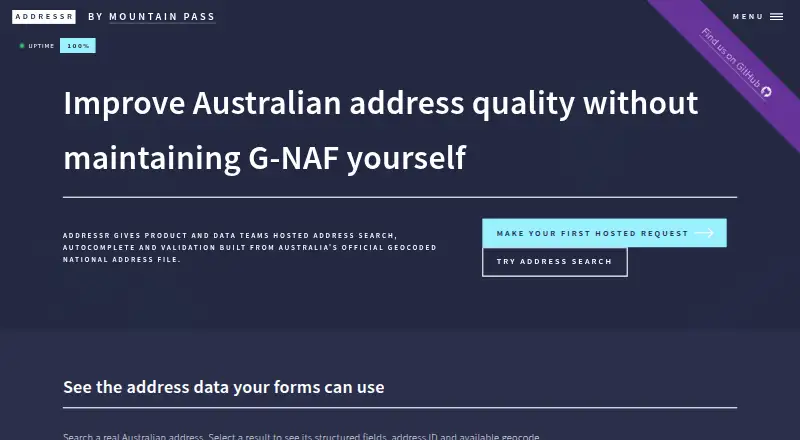
Addressr provides Australian address search, validation, and autocomplete through an API or software teams can host themselves. It uses the Geocoded National Address File (G-NAF), which the maker describes as Australia's authoritative address database, containing more than 15 million addresses. Search covers addresses, localities, postcodes, and states or territories. Results include a stable address identifier, and an address-detail endpoint returns structured fields and available geocoding.
Teams can use the hosted API through RapidAPI or self-host the software. RapidAPI handles signup, API keys, billing, and plan changes; the maker directs users there for current hosted prices and request limits. The self-hosted option is free under the Apache-2.0 license, but requires Node.js 22 or newer and OpenSearch. The first full data download and index takes about an hour, depending on the machine and options. G-NAF is released every three months, and the maker recommends scheduling data updates. Optional self-hosted latitude and longitude geocoding uses more memory and increases indexing time. The maker documents an MCP package for Claude, Cursor, VS Code Copilot, and other compatible assistants.
Who it suits
The hosted API suits teams that want Australian address services without operating G-NAF infrastructure. Self-hosting is aimed at teams that need control over infrastructure and data updates.
What it does well
- Searches more than 15 million G-NAF addresses.
- Covers addresses, localities, postcodes, and territories.
- Includes stable address identifiers and structured details.
- Free self-hosted software is available under Apache-2.0.
- Documents an MCP package for several AI assistants.
What to know first
- Hosted prices and request limits are provided through RapidAPI.
- Self-hosting requires Node.js 22 or newer and OpenSearch.
- Initial full download and indexing takes about an hour.
- Optional geocoding increases memory needs and indexing time.
Limits
The free self-hosted plan has no hosted request limit, but your team must provide infrastructure, hosting, monitoring, and data updates. Optional latitude and longitude geocoding requires more memory and increases indexing time. Hosted API prices and request limits are provided through RapidAPI.
Plans
| Plan | Billed and limits | Price |
|---|---|---|
| Self-hosted open-source software | No hosted request limit · Your team provides infrastructure, hosting, monitoring and data updates · Apache-2.0 licence | Free |
| Commercial support | Contact Mountain Pass for a quote · Implementation or operational support for self-hosted deployments | On request |
As addressr.io lists them, read 9 Oct 2026. The maker's own page has the final word.
Getting started
- Choose the hosted API through RapidAPI or the self-hosted software.
- For hosted use, sign up through RapidAPI and obtain an API key.
- Keep the hosted API key on your server, out of browser code and source control.
- For self-hosting, prepare Node.js 22 or newer and OpenSearch.
- Download and index the data; the initial full process takes about an hour depending on the machine and options.
- Schedule the loader to refresh the self-hosted index as G-NAF updates are released.
Addressr is an Australian address search and validation service built around G-NAF, with API, web and self-hosted access. It is best suited to developers and teams whose products need Australian address lookup, rather than international coverage.
The choice of hosted API or self-hosting is useful, but running it yourself means owning the infrastructure and recurring data updates.
Overview
Addressr focuses on Australian addresses, localities, postcodes, and states or territories. Its maker describes G-NAF as Australia’s authoritative address database, containing more than 15 million addresses. The service is a focused option for building Australian address search into a product; it is not a fit for teams seeking broad international coverage.
Teams can use the hosted API through RapidAPI or operate their own deployment. The hosted route avoids running the address infrastructure, while self-hosting gives the team more control over the index and its updates in exchange for operational responsibility.
Key features
Search and structured address records. The API searches addresses as well as localities, postcodes, and states or territories. Search results include a stable address identifier, and a separate detail endpoint returns structured fields and available geocoding. This makes the service useful when an application needs to move from an autocomplete suggestion to a consistent address record.
Optional geocoding. Self-hosted deployments can return latitude and longitude, but enabling this option requires more memory and increases indexing time. Teams that need coordinates should budget for a heavier setup; those that only need address lookup can avoid that added cost.
MCP package. Addressr documents an MCP package for Claude, Cursor, VS Code Copilot, and other compatible AI assistants. It may suit teams adding address lookup to those workflows, though the core service remains focused on Australian address data.
Hosted API and self-hosting. RapidAPI handles hosted signup, API keys, billing, and plan changes. The self-hosted quick start requires Node.js 22 or newer and OpenSearch, and a first full data download and index takes about an hour depending on the machine and options. That is a meaningful setup commitment for teams without existing infrastructure experience.
G-NAF is released every three months, and the maker recommends scheduling the loader to keep a self-hosted index current. The self-hosted default does not enforce proxy authentication; teams can configure gateway authentication with a header and shared secret. Hosted API keys should remain on the server, not in public browser code or source control. These requirements make deployment security and update routines part of the team's ongoing work.
Pricing
Self-hosted open-source software — free. This plan has no hosted request limit and uses an Apache-2.0 licence. It is suited to teams able to provide infrastructure, hosting, monitoring, and data updates. The absence of a hosted request cap does not remove those operating responsibilities.
Commercial support — custom pricing. Contact Mountain Pass for a quote for implementation or operational support on self-hosted deployments. This is the option for teams that want help with running or implementing their own deployment.
For the hosted API, RapidAPI handles billing and plan changes; its prices and request limits can change, so teams should check the applicable plan before choosing hosted usage. Addressr also offers community support through Gitter.
Platforms
Addressr supports API, web, and self-hosted use. The documented MCP package supports Claude, Cursor, VS Code Copilot, and other MCP-compatible AI assistants.
Who it's for
Addressr is a sensible choice for developers building Australian address forms, search, or location-aware services who need address-level results and may benefit from optional coordinates. Choose the hosted API if the priority is avoiding G-NAF infrastructure. Choose self-hosting if control over infrastructure and data updates matters enough to justify setup, security, monitoring, and quarterly refreshes.
It is a weaker fit for teams that need international address coverage or cannot maintain a self-hosted index and do not want to rely on a hosted API.
Pros and cons
- Pros: Australian-focused search spans addresses, localities, postcodes, and states or territories, with stable identifiers and structured detail results.
- Pros: Self-hosted software has no hosted request limit and an Apache-2.0 licence, giving capable teams control over their deployment.
- Pros: Optional geocoding and a documented MCP package add useful paths for teams that need coordinates or AI-assistant workflows.
- Cons: Self-hosting requires Node.js 22 or newer, OpenSearch, an initial indexing run, and recurring data updates.
- Cons: The self-hosted default lacks proxy authentication, so teams must configure gateway authentication where needed.
- Cons: Coverage is local to Australia, limiting its usefulness for international address workflows.
Alternatives
For a broader shortlist, see Address Verification Software.
Addresser is worth considering for teams that want Android or iOS alongside API and web access; its free eCommerce plan includes 1,000 lookups per 30 days and autocomplete.
Melissa Global Address Verification may suit teams needing global coverage across API, Linux, self-hosted, web, or Windows deployments; its free plan includes 250 records per month.
Addrex Address Validation API is an alternative for teams wanting a free beta allowance of 10,000 lookups per month, spreadsheet upload, map coordinates, a usage dashboard, and CSV export.
PostalUp offers a free, non-expiring allowance of 1,000 requests, with a limit of 10 requests per minute, address standardization, basic validation, and email support.
AddressZen is another option for teams seeking verified addresses, with a free-for-one-year plan covering 1,400 verified addresses.
Lob Address Verification may fit US-focused mailing workflows: its Developer plan includes up to 6,000 mailings and one user, with additional US address verifications priced at $0.05 each and international verifications at $0.07 each.
PostNL Address Validation API may suit Benelux parcel businesses: its free address-check plan requires a PostNL parcel contract.
Addressify is an alternative with a 30-day free trial that includes 1,000 daily allowable API calls and street-level validation.
Verdict
Choose Addressr if your product needs Australian address lookup and you value a choice between a hosted API and an open-source self-hosted deployment. The self-hosted plan avoids hosted request limits, but only makes sense if your team can manage its infrastructure, security, and data updates. If you need international coverage or want to avoid those operational duties, look elsewhere.
Verdict
Addressr offers a choice between a hosted API and self-hosting for Australian address lookup. Teams considering self-hosting should account for its software requirements, initial indexing, and recurring data updates.
Questions
What does Addressr cost?
The self-hosted open-source software is listed as free. Hosted API prices and request limits are available through RapidAPI.
Does Addressr have a free plan?
Yes. The self-hosted open-source software is free and has no hosted request limit; the team provides its infrastructure, hosting, monitoring, and data updates.
What addresses does Addressr cover?
It provides Australian address search, validation, and autocomplete using G-NAF.
Can Addressr be self-hosted?
Yes. The self-hosted quick start requires Node.js 22 or newer and OpenSearch, and the software is Apache-2.0 licensed.
Which integrations are documented?
The maker documents an MCP package for Claude, Cursor, VS Code Copilot, and other MCP-compatible AI assistants.
How does hosted API signup work?
RapidAPI handles hosted signup, API keys, billing, and plan changes. Addressr advises keeping the API key on your server and out of public browser code and source control.
Facts from Addressr's own pages
- Address data
- The maker describes G-NAF as Australia's authoritative address database with more than 15 million addresses. · github.com, 9 Oct 2026
- Address details
- Address search results include a stable address identifier, and the address-detail endpoint returns structured fields and available geocoding. · addressr.io, 9 Oct 2026
- API key handling
- For hosted API requests, Addressr instructs users to keep the RapidAPI key on their server and out of public browser code and source control. · addressr.io, 9 Oct 2026
- Data updates
- The maker says G-NAF is released every three months and recommends scheduling the loader to keep a self-hosted index updated. · github.com, 9 Oct 2026
- Geocoding
- Geocoding to latitude and longitude is optional for self-hosted deployments; enabling it requires more memory and increases indexing time. · github.com, 9 Oct 2026
- Headquarters
- Sydney, New South Wales, Australia · addressr.io, 28 Sept 2026
- Hosted API
- RapidAPI handles hosted signup, API keys, billing, and plan changes; the maker directs users there for current prices and request limits. · addressr.io, 9 Oct 2026
- Integrations
- The maker documents an MCP package for Claude, Cursor, VS Code Copilot, and other MCP-compatible AI assistants. · github.com, 9 Oct 2026
- Intended users
- The maker presents the hosted API for teams that do not want to operate G-NAF infrastructure and self-hosting for teams that need infrastructure and data-update control. · addressr.io, 9 Oct 2026
- Purpose
- Addressr provides Australian address validation, search and autocomplete using the Geocoded National Address File (G-NAF). · github.com, 9 Oct 2026
- Search
- The API supports searching addresses, localities, postcodes, and states or territories. · addressr.io, 9 Oct 2026
- Security configuration
- The self-hosted default does not enforce proxy authentication; optional gateway authentication can be configured with a header and shared secret. · github.com, 9 Oct 2026
- Self-host requirements
- The self-hosted quick start requires Node.js 22 or newer and OpenSearch, and says the first full data download and index takes about an hour depending on the machine and options. · addressr.io, 9 Oct 2026
- Support
- The maker offers community support through Gitter and quotes for commercial implementation or operational support. · addressr.io, 9 Oct 2026
Where Addressr stands on Freedom251
- Address Verification Software#3 of 30