Freedom251 › Overall Equipment Effectiveness Software
Point85 OEE
What Point85 OEE is
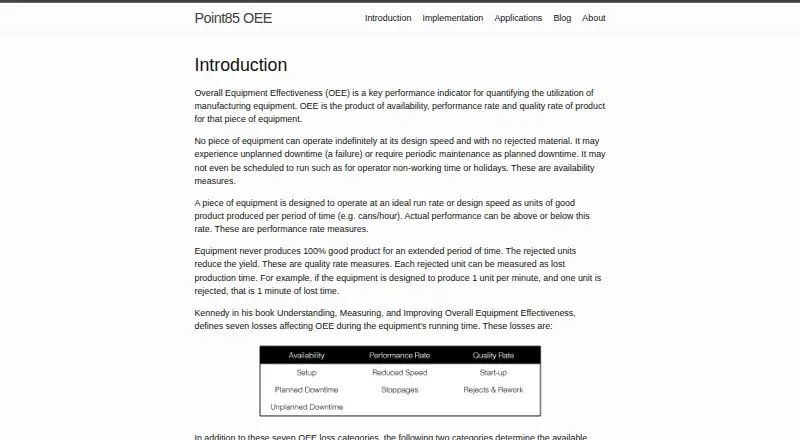
Point85 OEE collects manufacturing equipment data, calculates overall equipment effectiveness (OEE), and monitors availability, performance, and quality events. Its calculations combine availability, performance rate, and quality rate through a nine-category time-loss model. The Designer lets teams define equipment, data sources, event-resolution scripts, work schedules, availability reasons, materials, and units of measure. The Monitor shows equipment metrics, collector status and notifications, event timelines, trends, time-loss charts, and Pareto charts.
Data inputs include OPC DA/UA, HTTP/S, messaging systems, email, database tables, file shares, Modbus, cron jobs, and GE Proficy Historian. The suite includes Designer, Collector, Monitor, desktop and web operator applications, and operator apps for several desktop and mobile platforms. Collector runs as a Windows service or Unix daemon and saves events to a relational database for OEE, MTBF, and MTTR calculations. Point85 OEE is free and open source; supported databases include Microsoft SQL Server, Oracle, MySQL, PostgreSQL, and HSQLDB.
Who it suits
It suits manufacturers seeking to collect equipment data, track time losses, and monitor OEE, as well as teams configuring plant equipment and operator workflows. Its listed platforms and data sources accommodate varied deployment and integration setups.
What it does well
- Free and open source.
- Calculates OEE using a nine-category time-loss model.
- Monitors availability, performance, and quality events.
- Supports numerous listed data collection sources.
- Includes desktop, web, and mobile operator apps.
What to know first
- Web operator app requires a WAR-compatible web server.
- Collector runs as a Windows service or Unix daemon.
- Relational database storage is used for equipment events.
Getting started
- Visit the Point85 OEE website.
- Choose the suite applications that fit your workflow: Designer, Collector, Monitor or an operator application.
- Configure plant equipment, data sources, schedules and other production definitions in Designer.
- Set up the Collector to run as a Windows service or Unix daemon and store events in a relational database.
- For the web operator application, deploy its WAR file to a compatible web server.
- Use an operator application to enter events chronologically or summarize them over a period.
Point85 OEE is a manufacturing data-collection and monitoring suite for plants that need to bring equipment events into OEE calculations. It suits teams comfortable managing their own integrations and deployment. Its breadth is compelling, but the separate tools and infrastructure make it less suited to buyers seeking a turnkey service.
Overview
Point85 calculates overall equipment effectiveness from availability, performance rate and quality rate, using a nine-category time-loss model. An optional work schedule can shape the calculation. The suite also supports general-purpose equipment data acquisition, so its role can extend beyond OEE reporting.
Its workflow is split across applications: Designer configures the plant and collection rules, Collector gathers events, Monitor presents operating metrics, and operator apps record events. Collector runs as a Windows service or Unix daemon and stores equipment events in a relational database for OEE, MTBF and MTTR calculations. This modular arrangement offers distinct tools for each job, but requires technical ownership of the components and their connections.
The OEE applications are open-source projects hosted on GitHub; the OEE-Designer repository identifies an MIT license. Point 85 also maintains open-source projects for operator applications, mobile applications, units of measure and work schedules.
Key features
- Plant configuration: Designer defines equipment, data sources, event-resolution scripts, work schedules, availability reasons, materials and units of measure. That scope is useful for plants with varied equipment and operating rules, though it puts configuration work on the team.
- Collection options: Sources include OPC DA/UA, HTTP/S, RabbitMQ, JMS, MQTT, Kafka, WebSocket, email, database interface tables, file shares, Modbus, cron jobs and GE Proficy Historian. Configured systems can also send event data to RabbitMQ, JMS, MQTT or Kafka brokers for Monitor subscriptions. This range can accommodate varied plant systems, while the breadth does not remove the need to configure each connection.
- Monitoring and loss analysis: Monitor displays equipment metrics, collector status and notifications, event timelines, trends, time-loss charts and Pareto charts. Combined with downtime and quality tracking, these views give teams several ways to examine availability, performance and quality losses.
- Operator event entry: Desktop and web operator applications, plus apps for iOS, Android, macOS, Windows, Linux and Chrome/Edge, support chronological entry or summarized entry across a period. The choice can suit different shop-floor workflows; teams still need to select and deploy the relevant application.
- Database support: Supported relational databases include Microsoft SQL Server, Oracle, MySQL, PostgreSQL and HSQLDB. This gives teams several backend options, but also makes database setup part of the deployment decision.
Pricing
Point85 is free and open source, with a free plan. There is no paid tier described. The absence of a subscription cost suits teams able to run and maintain the software themselves; it is a weaker fit for buyers who want a packaged service rather than a self-managed suite.
Platforms
Point85 supports Android, iOS, Linux, macOS, Windows, web and self-hosted use. The web operator application is distributed as a WAR file for deployment to a compatible web server, such as Tomcat. That flexibility serves mixed environments, but WAR deployment and the Collector's Windows-service or Unix-daemon operation call for deployment expertise.
Who it's for
Point85 is strongest for manufacturers with varied equipment sources, an existing relational database strategy and staff able to configure integrations and operate server-side components. Its operator apps and monitoring views can support teams that need both event entry and analysis of production losses. Buyers who prioritize a single, managed application should look elsewhere.
Pros and cons
Pros
- Broad collection coverage: The range of industrial protocols, messaging systems, files and databases can fit plants with mixed data sources.
- More than headline OEE: Event timelines, trends, time-loss and Pareto charts support investigation of the losses behind availability, performance and quality measures.
- Open-source and free: The software can suit teams that want to avoid subscription pricing and can take responsibility for deployment.
Cons
- Operational complexity: Configuration, collection, monitoring and event entry are divided among multiple applications, with a database and deployment environment to manage.
- Technical setup is central: Integrations need configuration, and the web operator app requires a WAR-capable server, which may burden teams without infrastructure expertise.
Alternatives
Overall Equipment Effectiveness Software is a broader category to explore when comparing OEE tools.
- Peakboard OEE Software is worth considering for teams wanting a freemium option with a free Windows Designer download and a free Hub Online Starter plan.
- L2L Manufacturing Intelligence is a paid alternative with Android, iOS, macOS, web and Windows platforms.
- ABB Manufacturing Execution System is a paid option for teams considering an MES, with purchase information by inquiry.
- Essembi is a paid alternative whose pricing is based on production lines and data-collection devices per line, with implementation services available as needed.
- 10in6 OEE Tracking is another paid option for Windows.
- GainSeeker Suite is another paid option for Windows.
- iFactory OEE Analytics is a paid alternative with a cloud SaaS plan quoted by users, modules and production lines, as well as a Greenfield Plant plan with custom quotes.
- Nulogy OEE Tracking is a paid alternative with a Black Belt plan billed per site per year.
Verdict
Choose Point85 if your manufacturing team needs flexible equipment data collection, detailed OEE loss monitoring and operator event entry, and can own the technical setup. Its open-source model and extensive integration choices are the main reasons to pick it. Look elsewhere if you need a more turnkey system that minimizes configuration and deployment work.
Verdict
Point85 OEE combines configurable equipment data collection with OEE monitoring and operator applications. Its many listed input sources and database options may suit teams with varied manufacturing systems.
Questions
How much does Point85 OEE cost?
It is free.
Is Point85 OEE open source?
Yes. Its applications are hosted as open-source projects on GitHub, and the OEE-Designer repository identifies its license as MIT.
Which platforms are supported?
Listed platforms include Android, iOS, Linux, macOS, self-hosted, web and Windows. Operator apps are also listed for Chrome and Edge.
Which databases can it use?
The listed relational databases are Microsoft SQL Server, Oracle, MySQL, PostgreSQL and HSQLDB.
What data sources are supported?
Listed sources include OPC DA/UA, HTTP/S, RabbitMQ, JMS, MQTT, Kafka, WebSocket, email, database tables, file shares, Modbus, cron jobs and GE Proficy Historian.
Who can I contact about the software?
The site lists Kent Randall and [email protected] as the support contact.
Facts from Point85 OEE's own pages
- Applications
- The suite includes Designer, Collector, Monitor, desktop and web operator applications, and operator apps for iOS, Android, macOS, Windows, Linux, and Chrome/Edge. · point85.github.io, 30 Sept 2026
- Collector
- The Collector runs as a Windows service or Unix daemon and stores equipment events in a relational database for OEE, MTBF, and MTTR calculations. · point85.github.io, 30 Sept 2026
- Configuration
- The Designer defines plant equipment, data sources, event-resolution scripts, work schedules, availability reasons, materials, and units of measure. · point85.github.io, 30 Sept 2026
- Dashboards
- The Monitor displays equipment metrics, collector notifications and status, event timelines, trends, time-loss charts, and Pareto charts. · point85.github.io, 30 Sept 2026
- Databases
- The implementation page lists Microsoft SQL Server, Oracle, MySQL, PostgreSQL, and HSQLDB as supported databases. · point85.github.io, 30 Sept 2026
- Database support
- Supported relational databases are Microsoft SQL Server, Oracle, MySQL, PostgreSQL and HSQLDB. · point85.github.io, 30 Sept 2026
- Data collection
- Applications collect equipment data from multiple sources for OEE calculations or general-purpose data acquisition. · point85.github.io, 30 Sept 2026
- Data inputs
- Listed collection sources include OPC DA/UA, HTTP/S, RabbitMQ, JMS, MQTT, Kafka, WebSocket, email, database interface tables, file shares, Modbus, cron jobs, and GE Proficy Historian. · point85.github.io, 30 Sept 2026
- Deployment
- The web operator application is distributed as a WAR file for deployment to a web server that supports WAR deployment, such as Tomcat. · point85.github.io, 30 Sept 2026
- Designer
- Designer defines plant equipment, data sources, event-resolution scripts, work schedules, availability reasons, materials and units of measure, and includes dashboards and trending. · point85.github.io, 30 Sept 2026
- Event entry
- Operator apps support chronological event entry or summarized entry over a period of time. · point85.github.io, 30 Sept 2026
- Integrations
- Listed data sources include OPC DA, OPC UA, HTTP/S, RabbitMQ, JMS, MQTT, Kafka, WebSocket, email, database tables, file shares, Modbus, cron jobs and GE Proficy Historian. · point85.github.io, 30 Sept 2026
- License
- The OEE-Designer GitHub repository identifies its license as MIT. · github.com, 30 Sept 2026
- Maker projects
- Point 85 says it maintains open source projects for OEE, operator applications, mobile applications, units of measure, and work schedules. · point85.github.io, 30 Sept 2026
- Messaging
- Configured systems can send event data to RabbitMQ, JMS, MQTT or Kafka brokers for monitor subscriptions. · point85.github.io, 30 Sept 2026
- OEE model
- OEE is calculated from availability, performance rate, and quality rate using a nine-category time-loss model. · point85.github.io, 30 Sept 2026
- OEE monitoring
- The software calculates OEE using an optional work schedule and monitors equipment availability, performance and quality events. · point85.github.io, 30 Sept 2026
- Open source
- The OEE applications are implemented by open-source projects hosted on GitHub. · point85.github.io, 30 Sept 2026
- Purpose
- Point85 OEE quantifies manufacturing-equipment utilization using availability, performance and quality rates. · point85.github.io, 30 Sept 2026
- Support contact
- The site lists Kent Randall and [email protected]. · point85.github.io, 30 Sept 2026