Freedom251 › Overall Equipment Effectiveness Software

Essembi
What Essembi is
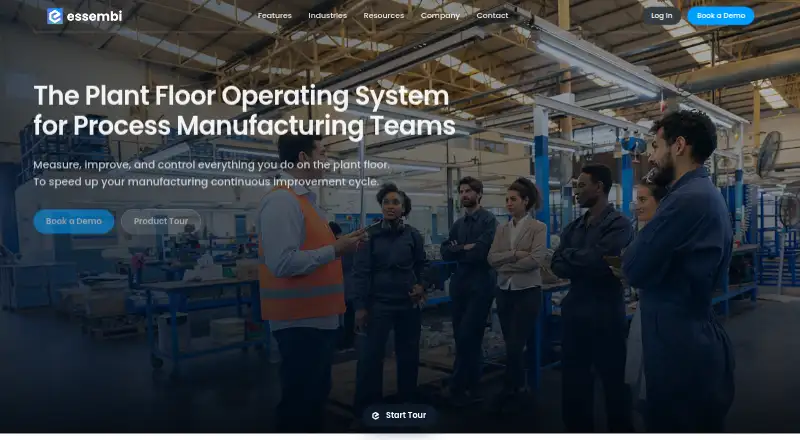
Essembi is a continuous improvement platform and plant-floor operating system for process manufacturers. Its production tools provide live OEE, downtime, job status, shift targets, and throughput information across lines, including on plant-floor tablets. Teams can record production stops by reason, line, and shift, then use Pareto views to spot major causes. Quality tools track defects and corrective actions and support root cause analysis. Maintenance tools manage work orders and asset health, while labor costing links RFID badge scans, employee time, and job costs. Essembi says its AI answers questions about live production data and prepares pre-job briefings from part history. Browser workspaces support desktops, tablets, barcode scanners, and TVs. Users can tailor tables, forms, views, automations, and role-based security. Connections include Microsoft Teams ticket creation, a REST API, and file imports, including FTP-delivered files. Pricing is on request and based on production lines and data collection devices per line. Implementation services are available, and rollout timing varies by operation.
Who it suits
Essembi suits plant-floor teams at process manufacturers, including food, beverage, nutraceutical, and pharmaceutical businesses. It is relevant to teams managing production, quality, maintenance, and labor costs.
What it does well
- Tracks OEE, downtime, shift targets, and throughput.
- Pareto views help identify major downtime causes.
- Quality tools cover defects and corrective actions.
- Browser workspaces support tablets and barcode scanners.
- Teams can customize views, automations, and forms.
What to know first
- Pricing is available on request.
- API result endpoints are limited to 10,000 cells.
- Rollout timing depends on the operation.
Limits
Pricing depends on production lines and data collection devices per line. API endpoints that return results are limited to 10,000 cells, calculated as rows times columns.
Plans
| Plan | Billed and limits | Price |
|---|---|---|
| Essembi | Pricing based on production lines and data collection devices per line · Implementation services available as needed | On request |
As essembi.com lists them, read 4 Oct 2026. The maker's own page has the final word.
Getting started
- Visit the Essembi website.
- Request pricing based on production lines and data collection devices per line.
- Arrange implementation assistance as needed, including process mapping, training, integrations, or machine connections.
- Set up browser-based workspaces for desktops, tablets, barcode scanners, or TVs.
- Connect systems through the REST API or file-based imports.
Essembi is a configurable plant-floor operating system for process manufacturers. It fits operations that need production, quality, maintenance, and labor data in the same workflow, rather than a standalone OEE screen. The trade-off is a line- and device-based commercial model that requires a tailored quote and implementation.
Overview
Essembi is positioned as a continuous-improvement platform for process plants, including food, beverage, nutraceutical, and pharmaceutical manufacturers. Its broad scope connects live production visibility with quality actions, maintenance work, and labor costing. That makes it a sensible choice where supervisors and improvement teams need one operational picture across several functions. A plant seeking a narrowly focused, self-service production dashboard may find the platform broader than necessary.
The company says its founders previously spent more than a decade building ERP software for process manufacturers. Customers can customize tables, forms, workspaces, views, automations, and role-based security, so the system can reflect local procedures. That flexibility is useful for varied plants, but it also means configuration and process decisions are part of the rollout.
Key features
Production and loss analysis
Production tools track OEE, downtime, shift targets, throughput, and job status across lines, with live reporting to plant-floor tablets. Operators can log stops by reason, line, and shift, then use Pareto views to concentrate on the largest causes of lost time. This supports structured improvement work rather than leaving downtime as an unclassified total.
Labor costing adds another operational dimension. RFID badge scans record labor by employee and tie time and cost to jobs, helping managers see the workforce cost behind output. The data-capture approach is hybrid, which can accommodate more than one collection method.
Quality, maintenance, and AI
Quality workflows cover defect tracking, corrective actions, and root-cause analysis. Maintenance tools handle work orders and asset health, giving teams a way to connect equipment issues with production performance. Plants that coordinate these activities across departments stand to gain more than users who only need OEE calculations.
Essembi says its AI answers questions about live production data and creates pre-job briefings using part history. Those capabilities are aimed at turning stored operational data into guidance for daily work, although their value will depend on the quality and consistency of the underlying records.
Integration and access control
A Microsoft Teams integration lets users create Essembi tickets from chats or channels. REST API endpoints support table-record operations, while configured imports can use files delivered by FTP. Result-returning API calls are capped at 10,000 cells, calculated as rows multiplied by columns, a constraint to account for when exporting broad datasets.
Role-based security controls access, with Microsoft and Google single sign-on supported. Browser workspaces run on desktops, tablets, barcode scanners, and TVs, alongside Android, iOS, web, and API access.
Pricing
The Essembi plan uses custom pricing based on the number of production lines and data-collection devices on each line. Implementation services are available as needed, including process mapping, customizations, training, integrations, and machine connections. This structure can align cost with a plant’s footprint, but it gives buyers no fixed entry price and makes a direct scoping discussion necessary.
There is no published free tier, seat allowance, trial term, or renewal schedule. The plan is therefore better suited to manufacturers budgeting for an operational deployment than to small teams wanting to experiment without a sales process.
Platforms
Essembi supports Android, iOS, web, and API access. Its browser-based workspaces are documented for desktops, tablets, barcode scanners, and TVs, which suits mixed shop-floor hardware and shared visual displays.
Who it's for
Choose Essembi when a process-manufacturing operation wants OEE, downtime, quality, maintenance, and labor costing connected in one configurable system. Its stated focus on food, beverage, nutraceutical, and pharmaceutical plants makes it especially relevant where traceable operational workflows matter. It is less compelling for a buyer who needs only a low-cost OEE utility, a published subscription, or a wholly self-directed deployment.
Pros and cons
- Pro: Production, quality, maintenance, and labor costing share one platform, reducing the need to join separate operational workflows.
- Pro: Downtime categorization and Pareto views give improvement teams a practical way to prioritize losses.
- Pro: Custom forms, workspaces, automations, and security can reflect plant-specific processes.
- Pro: Teams integration, REST API, FTP imports, and machine-connection services support broader system integration.
- Con: Pricing depends on lines and collection devices, so costs cannot be compared from a public rate card.
- Con: API responses are limited to 10,000 cells, which may require careful handling for large extracts.
- Con: Rollout timing varies: an initial line may go live within a week, while wider implementation can take 30–90 days depending on the operation.
Alternatives
For a broader comparison of OEE tools, see Overall Equipment Effectiveness Software.
- Peakboard OEE Software is the better starting point when a free plan, free trial, Windows designer, or self-hosted and web options matter.
- L2L Manufacturing Intelligence is an alternative for buyers wanting a paid manufacturing product across Android, iOS, macOS, web, and Windows.
- Point85 OEE suits teams prioritizing a free, open-source OEE application with broad desktop, mobile, web, and self-hosted platform support.
- 10in6 OEE Tracking is worth considering when pricing by operation and selected modules better matches the intended MES scope.
- ABB Manufacturing Execution System is another paid MES option with Android, API, iOS, web, and Windows access.
- oee.ai is a paid alternative offering a typically eight-week proof-of-value engagement.
- sfHawk OEE Monitoring is an option when a quote based on connected machines and deployed modules fits your deployment.
- TeepTrak is an alternative whose subscription terms and price are supplied through a direct sales offer.
Verdict
Essembi is a strong fit for process manufacturers that want one configurable system linking production losses, quality work, equipment health, and labor cost. Its main reason to choose it is that connected operational scope; its main reason to look elsewhere is the custom, operation-dependent commercial and rollout model. Plants that can support implementation and want more than a basic OEE tracker should shortlist it, while price-sensitive or self-service buyers should start with a simpler alternative.
Verdict
Essembi brings production visibility, quality tracking, maintenance, and labor costing into a configurable platform for process manufacturers. Its price depends on production lines and data collection devices, and rollout timing varies by operation.
Questions
How is Essembi priced?
Pricing is based on production lines and data collection devices per line. The listed plan price is not provided; pricing is on request, and implementation services are available as needed.
Which devices can access Essembi?
Its help center documents browser-based workspaces for desktops, tablets, barcode scanners, and TVs.
Does Essembi integrate with Microsoft Teams?
Yes. Users can create Essembi tickets from Teams chats or channels.
What API and import options are available?
The REST API supports table record operations and configured data imports. Imports can also run from files delivered by FTP; result-returning API endpoints have a 10,000-cell maximum.
What implementation help does Essembi offer?
Assistance can include process mapping, customizations, user training, system integrations, and machine connections. The company says customers can begin using the platform in 30–90 days, while timing for a full rollout depends on the operation.
Facts from Essembi's own pages
- AI
- Essembi's AI can answer questions about production data and provide analysis and recommendations. · essembi.com, 4 Oct 2026
- API and imports
- The REST API supports table record operations and configured data imports, and data imports can also run from files delivered by FTP. · essembi.com, 4 Oct 2026
- API limit
- API endpoints returning results have a maximum of 10,000 cells, calculated as rows times columns. · essembi.com, 3 Oct 2026
- Audience
- The company says it focuses on plant-floor teams at process manufacturers, including food, beverage, nutraceutical, and pharmaceutical businesses. · essembi.com, 3 Oct 2026
- Company
- The company says its founders spent over a decade building ERP software for process manufacturers before creating Essembi. · essembi.com, 3 Oct 2026
- Customization
- Users can customize tables, forms, workspaces, views, automations, and role-based security. · essembi.com, 4 Oct 2026
- Downtime analysis
- Teams can log and categorize production stops by reason, line, and shift, then use Pareto views to identify major causes. · essembi.com, 4 Oct 2026
- Implementation
- The services page says customers can begin using Essembi in 30–90 days, while the homepage describes a rollout reaching launch in week six. · essembi.com, 3 Oct 2026
- Integrations
- Essembi says it connects to machine PLCs, MES and SCADA systems, ERPs, industrial sensors, and production scales. · essembi.com, 4 Oct 2026
- Labor costing
- Essembi tracks labor cost by employee using RFID badge scans and ties time and cost to jobs. · essembi.com, 4 Oct 2026
- Maintenance
- Maintenance tools manage work orders, track asset health, and help teams get ahead of failures. · essembi.com, 3 Oct 2026
- Microsoft Teams
- The Microsoft Teams integration lets users create Essembi tickets from chats or channels. · essembi.com, 4 Oct 2026
- Platform access
- The FAQ says production data collection works across mobile devices, including floor scanners, and reporting is available from any web browser. · essembi.com, 4 Oct 2026
- Product
- Essembi describes itself as a continuous improvement platform for process manufacturers that helps teams measure, analyze, and improve production performance. · essembi.com, 4 Oct 2026
- Production
- The production tools track OEE, downtime, shift targets, and throughput across production lines. · essembi.com, 3 Oct 2026
- Production visibility
- The production tools report live OEE, downtime, and job status to plant-floor tablets. · essembi.com, 4 Oct 2026
- Quality
- The platform includes tools to track defects, manage corrective actions, and support root cause analysis. · essembi.com, 3 Oct 2026
- Rollout
- Essembi says an initial production line can go live within a week, while full rollout timing depends on the operation. · essembi.com, 4 Oct 2026
- Security
- Essembi documentation describes team-based role security and controls for users, permissions, and access to app data and settings. · essembi.com, 4 Oct 2026
- Support
- The contact page directs existing customers to the support team or Help Center. · essembi.com, 4 Oct 2026
- Target users
- Essembi says it focuses on process manufacturers, including food, beverage, nutraceutical, and pharmaceutical manufacturers. · essembi.com, 4 Oct 2026