Freedom251 › Content Management Systems

Plone
by Plone
What Plone is
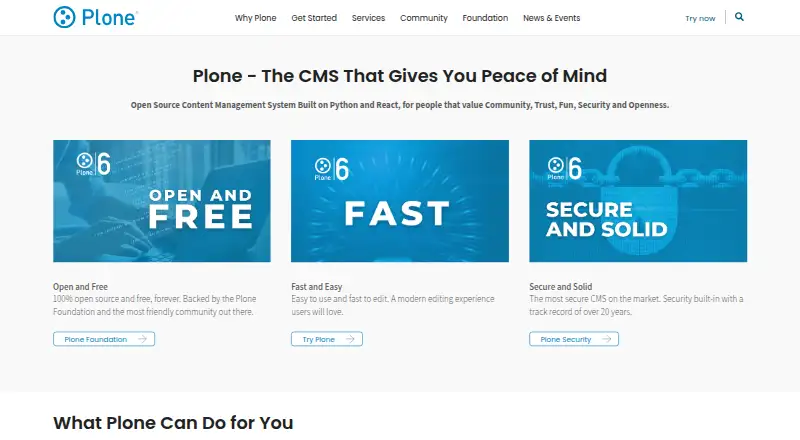
Plone is an open-source content management system for building websites, intranets, and custom applications. Plone 6 provides a block-based editor for adding text, images, video, maps, forms, and search to flexible page layouts. Editors can create content types and drag-and-drop forms through the web, without code; form submissions can be emailed or stored as CSV. A faceted search block lets visitors filter results. The platform also lists editorial workflows, custom roles, multilingual content, SEO tools, and a media library. Plone supports a React-based frontend and REST API, with more than 100 add-on products in its ecosystem. It can be hosted on premises or in the cloud, with users retaining control of their data. Plone runs on UNIX-based systems, Windows, and macOS, and is listed for web, API, and self-hosted use. The free plan costs nothing. Each major version receives five years of security support; Plone 6 support is listed through 2027-12-31.
Who it suits
Plone suits editors, developers, and decision makers building sites or intranets, including government and university teams. It may also suit organizations that need to create their own content types and manage hosting themselves.
What it does well
- Web-based creation of content types without code
- Drag-and-drop forms can email or store submissions as CSV
- Faceted search filters results
- Supports on-premises and cloud hosting
- Free plan: free
What to know first
- Plone 6 security support is listed through 2027-12-31
- Flexible layouts and custom content types may require configuration
Plans
| Plan | Billed and limits | Price |
|---|---|---|
| Plone | 100% open source and free, forever | Free |
As plone.org lists them, read 9 Oct 2026. The maker's own page has the final word.
Getting started
- Visit https://plone.org/.
- Choose a deployment on premises, on a server, or in the cloud.
- Run Plone on a supported UNIX-based system, Windows, or macOS environment.
- Use the web editing interface to create pages and content types.
- Add extensions from Plone’s ecosystem as needed.
Plone is a free, open-source content management system for websites, intranets, and custom applications. It suits organizations that need structured publishing and control over deployment, particularly where editors and developers can shape the system together. Its broad authoring toolkit comes without a license fee, while running and extending it calls for technical planning.
Overview
Plone brings editing, workflows, and application building into one system. Custom roles, multilingual content, and editorial workflows make it a strong fit for government, universities, and other organizations with varied contributors or review needs. Its open-source model and self-hosting options give teams control, but also put deployment and maintenance choices in their hands.
Key features
Plone 6’s block editor handles text, images, video, maps, forms, and search. Flexible, multi-column layouts adapt to different devices, and editors can create content types through the web without code. That combination helps teams publish varied material without making every content-model change a development task.
The drag-and-drop form builder can email submissions or store them as CSV. A faceted search block lets visitors filter results, while SEO tools and a media library support routine publishing. A React-based frontend, REST API, and more than 100 add-on products give developers room to extend a site or build a custom application; organizations seeking a ready-made, managed package may find that flexibility brings more implementation work than they want.
Pricing
Plone — free. The plan is 100% open source and free forever, with no license fee. It gives organizations a way to build on Plone without a software subscription, but the free license does not remove the need to arrange hosting and technical setup.
Platforms
Plone runs on UNIX-based systems, Windows, and macOS, and can be deployed on premises, on servers, or in the cloud. Its hybrid approach and REST API support different deployment and frontend choices. Users retain control of their data. The security team publishes fixes and asks users to report issues responsibly; each major version receives five years of security support, with Plone 6 supported through 2027-12-31.
Who it's for
Plone is a sensible choice for organizations with structured content, multiple editors, approval steps, or multilingual audiences. Its web-based content-type tools and form builder can reduce dependence on developers for everyday publishing changes, while developers can use the API, React frontend, and add-ons for more tailored work. Service providers offer development, training, customization, and deployment help. Teams without the capacity to manage a deployment should weigh that need before choosing Plone.
Pros and cons
- Pros: Free, open-source software avoids licensing fees; browser-based content-type creation and drag-and-drop forms help editors adapt publishing workflows.
- Pros: Custom roles, multilingual content, and editorial workflows serve organizations with more complex publishing needs.
- Pros: On-premises and cloud deployment options give users control over where their data resides.
- Cons: Hosting and deployment remain choices the organization must manage, so the no-cost plan is not a turnkey hosted service.
- Cons: The extensible frontend and add-on ecosystem offer flexibility, but tailoring the system can require development expertise.
Alternatives
Choose Drupal if you want another free, open-source CMS and are prepared for self-hosting and technical setup. Consider Webflow CMS if a free plan for exploring and experimenting, with limited CMS, two static pages, 1 GB bandwidth, and 50 form submissions, better suits your starting point.
HubSpot Content Hub offers a free plan for up to two users, while Joomla is another free, GPL-licensed CMS download. TYPO3 CMS is a free, self-hosted option with system requirements to meet; it also offers TYPO3 v12 ELTS for €3,200 a year.
Contao is free open-source software for commercial use, and django CMS is another open-source CMS with no license fees. Umbraco CMS offers a free open-source plan with content authoring, media and user management, multilingual setup, and headless APIs and webhooks. Browse more options in Content Management Systems.
Verdict
Choose Plone if your organization needs structured, multilingual publishing with editorial controls and wants to retain control over hosting and data. Its strongest advantage is a broad, extensible toolkit with no license fee. Look elsewhere if you need a managed service that minimizes deployment and technical work.
Verdict
Plone combines content management, editing workflows, and hosting options in an open-source system. Its free plan and web-based tools for content types and forms stand out for organizations managing structured publishing.
Questions
Is Plone free?
Yes. The Plone plan costs nothing and is listed as open source and free forever.
What can I build with Plone?
It is a content management system for building websites, intranets, and custom applications.
Which platforms does Plone support?
Its listed platforms include API, Linux, macOS, self-hosted, web, and Windows. It can run on UNIX-based systems, Windows, and macOS.
Can editors create custom content types without code?
Yes. Editors can create content types through the web.
Can Plone be self-hosted?
Yes. It can run on premises or in the cloud, and users retain control of their data.
How long does Plone 6 receive security support?
Major versions receive security support for five years from release. Plone 6 support is listed through 2027-12-31.
Facts from Plone's own pages
- Content types
- Editors can create content types through the web without code. · plone.org, 9 Oct 2026
- Custom content types
- Yes · plone.org, 22 Sept 2026
- Custom user roles
- Yes · plone.org, 22 Sept 2026
- Deployment
- Plone can run on UNIX-based systems, Windows, and macOS, as well as servers and cloud deployments. · plone.org, 9 Oct 2026
- Editing
- Plone 6 provides a modern editing interface with blocks for text, images, video, maps, forms, and search. · plone.org, 9 Oct 2026
- Editorial workflows
- Yes · plone.org, 22 Sept 2026
- Forms
- The form builder lets editors create forms by drag and drop and send submissions by email or store them as CSV. · plone.org, 9 Oct 2026
- Founded
- 2004 · plone.org, 28 Sept 2026
- Free plan
- Yes · plone.org, 22 Sept 2026
- Headquarters
- Eugene, Oregon, USA · plone.org, 28 Sept 2026
- Hosting
- Plone can be run on premises or in the cloud, and the site says users retain control of their data. · plone.org, 9 Oct 2026
- Integrations and extensions
- Plone supports a React-based frontend and REST API, and its ecosystem includes more than 100 add-on products. · plone.org, 9 Oct 2026
- Intended users
- Plone describes itself as suited to editors, developers, and decision makers, with use cases including government and universities. · plone.org, 9 Oct 2026
- Media library
- Yes · plone.org, 22 Sept 2026
- Multilingual content
- Yes · plone.org, 22 Sept 2026
- Page layouts
- Its block system supports flexible, multi-column pages that adapt to different devices. · plone.org, 9 Oct 2026
- Platform type
- hybrid · plone.org, 22 Sept 2026
- Product
- Plone is an open-source content management system for building websites, intranets, and custom applications. · plone.org, 9 Oct 2026
- Search
- Plone 6 includes a faceted search block that can filter results by facets. · plone.org, 9 Oct 2026
- Security
- Plone's security team publishes security fixes and asks users to report security issues responsibly. · plone.org, 9 Oct 2026
- Security support
- Each major version receives security support for five years from release, and Plone 6 support is listed through 2027-12-31. · plone.org, 9 Oct 2026
- SEO tools
- Yes · plone.org, 22 Sept 2026
- Support and services
- Plone service providers offer development, training, customization, and deployment help. · plone.org, 9 Oct 2026
Where Plone stands on Freedom251
- Content Management Systems#9 of 165
- Web Content Management Software#7 of 24