Freedom251 › Digital Forensics Software
Plaso
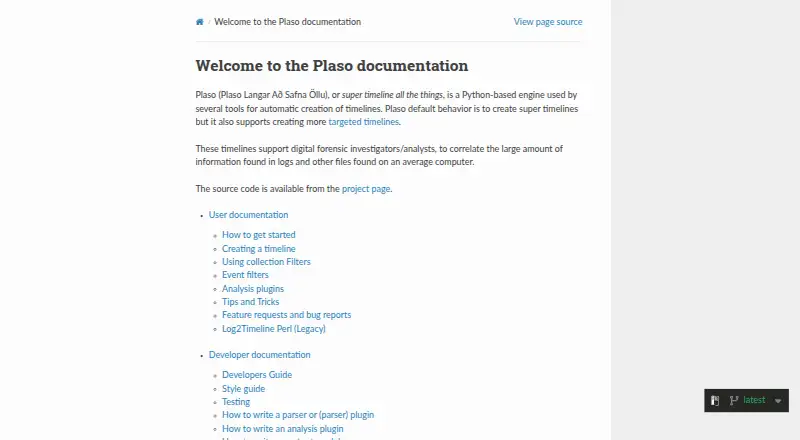
What Plaso is
Plaso is a Python-based engine that turns digital evidence into timelines for forensic analysis. Its log2timeline tool extracts events from files, folders, storage-media images, or devices and saves them in a Plaso storage file. From there, psort can filter and sort events and run automatic analysis. Other command-line tools include image_export, pinfo, and psteal. Documented inputs include Windows event logs and Registry data, browser histories, SQLite databases, text logs, and audit logs from AWS CloudTrail, Azure Activity, Google Cloud, and Microsoft 365. Plaso can produce a CSV timeline from a storage image, and its listed output formats include JSON, JSON Lines, KML, TLN, XLSX, OpenSearch, and Timesketch. The framework supports adding parsers, analysis plug-ins, and scripts for forensic tasks; documented plug-ins include VirusTotal, NSRL server, and hash tagging. Plaso is free and licensed under Apache-2.0. It supports Linux, macOS, Windows, Docker, and self-hosted use. The documentation recommends packaged releases and versions no older than six months.
Who it suits
Plaso suits digital forensic practitioners who need to collect and analyze timeline events from varied evidence sources. It may also fit teams seeking a free, extensible tool for Linux, macOS, Windows, Docker, or self-hosted use.
What it does well
- Collects events from files, devices, and storage images.
- Supports Windows, browser, database, text, and cloud logs.
- Includes filtering, sorting, and automatic analysis.
- Extensible with parsers, plug-ins, and scripts.
- Free; repository license is Apache-2.0.
What to know first
- Command-line tools are central to its workflow.
- Documentation recommends using a version no older than six months.
Plans
| Plan | Billed and limits | Price |
|---|---|---|
| Plaso | No commercial plan or usage limits are stated | Free |
| Open-source Plaso package | Python-based forensic timeline engine · self-hosted installation · no paid tiers listed | Free |
As plaso.readthedocs.io lists them, read 4 Oct 2026. The maker's own page has the final word.
Getting started
- Visit the Plaso documentation website.
- Choose a packaged release, which the documentation recommends for general use.
- Use a version no older than six months, as recommended by the documentation.
- Run log2timeline to collect events into a Plaso storage file.
- Use psort to filter, sort, or analyze the collected events.
Overview
Plaso is a Python-based engine for building and analyzing digital-forensics timelines. It suits investigators who need to correlate events across varied evidence sources and are comfortable working with command-line tools.
Its strength is a broad, extensible collection-and-analysis workflow, from media and devices to cloud audit logs. That breadth comes with a tool-oriented approach rather than a turnkey desktop experience.
Key features
Collection and analysis. The log2timeline tool extracts events from files, directories, storage-media images, or devices into a Plaso storage file. psort can then filter and sort that data or run automatic analysis. Keeping collection and timeline analysis within one workflow is useful for investigations that need to move from disparate artifacts to an ordered event record.
Broad evidence coverage. Documented inputs include Windows event logs and Registry data, browser histories, SQLite databases, and text-based logs. Cloud sources include AWS CloudTrail, Azure Activity, Google Cloud, and Microsoft 365 audit logs. Plaso also covers Android and iOS artifacts. This range makes it a strong fit when an investigation crosses endpoint, mobile, and cloud evidence; it is less compelling if the need is a focused, graphical tool for just one source type.
Analysis and output. Alongside log2timeline and psort, the command-line suite includes image_export, pinfo, and psteal. Exports include CSV, JSON, JSON Lines, KML, TLN, XLSX, OpenSearch, and Timesketch. For example, psteal can produce a CSV timeline from a storage image using the dynamic output format. Multiple formats help fit results into different downstream workflows, though they do not remove the need to operate the tools and interpret the output.
Extensibility and integrations. The framework supports additional parsers, analysis plug-ins, and scripts for forensic tasks. Documented plug-ins include VirusTotal, NSRL server, and hash tagging. This flexibility can reward teams that need to adapt analysis to their work, but it also makes Plaso a better match for practitioners prepared to work with a framework than for buyers seeking a fixed, packaged investigation interface.
Pricing
Plaso is free: the Plaso plan costs nothing and the project is licensed under Apache-2.0. No commercial plan or usage limits are stated. There is no paid tier to compare against, so the trade-off is not a feature quota but the command-line workflow and the effort required to fit the tools into an investigation process.
The documentation recommends packaged releases for general use and a version no older than six months. That guidance matters for teams maintaining a dependable workflow: keeping installations current is part of using the project responsibly.
Platforms
Plaso supports Linux, macOS, and Windows, as well as Docker and self-hosted use. The cross-platform range can suit teams working across different environments, while deployment still belongs to the user rather than a hosted service.
Who it's for
Plaso is best for digital-forensics practitioners who need to gather and analyze timelines across storage media, files, devices, logs, databases, and mobile artifacts. It is particularly useful when an investigation spans different evidence formats or benefits from custom parsers and analysis plug-ins. Readers who want a polished graphical workflow or a narrowly scoped tool may prefer a more specialized option.
Pros and cons
- Pro: Broad evidence coverage. Inputs span common computer artifacts, mobile evidence, and major cloud audit-log formats, supporting investigations that cross source types.
- Pro: Collection and timeline analysis in one toolkit. log2timeline creates the storage file and psort filters, sorts, and analyzes it, giving practitioners a coherent route from collection to review.
- Pro: Flexible exports and extensions. Several timeline formats and a framework for parsers, plug-ins, and scripts support varied workflows.
- Con: Command-line orientation. The named tools are command-line utilities, so Plaso is a poor fit for users who need a graphical, guided investigation experience.
- Con: Best-effort support. The project points users to community and issue-tracking channels, and contributions are best effort; organizations requiring assured support may need another arrangement.
- Con: Ongoing version maintenance matters. The recommendation to use releases no older than six months adds a maintenance consideration for teams standardizing their forensic environment.
Alternatives
For a different digital-forensics option, see Digital Forensics Software.
- NetworkMiner may suit readers looking for a freemium, open-source option written in managed C# for the .NET Framework, with Linux, macOS, and Windows platform support.
- Volatility 3 is another free and open-source choice for readers whose preference is the Volatility Foundation framework, available for Linux, macOS, self-hosted, and Windows environments.
- Arkime is a free, open-source option with API, Linux, self-hosted, and web platforms and no license fees or paid-only features.
- CAINE may fit readers seeking a free Linux and Windows forensic environment distributed as an approximately 4000 MB ISO; third-party software has separate licenses.
- Exterro FTK Imager offers a free Windows-only forensic imaging and preview tool; its FTK Imager Pro plan is $499 a year.
- SUMURI PALADIN is a Linux alternative whose PALADIN LTS plan lets users name a price, with corporate users required to donate at least $25.
- Tsurugi Linux is a free 64-bit Linux distribution provided as-is without warranty.
- Paraben E3 Forensic Platform has paid monthly plans, including Basic-Monthly at $60 a month and Essential-Monthly at $80 a month.
Verdict
Choose Plaso if you need a free, cross-platform engine that can turn diverse digital evidence into timelines and you are comfortable building a workflow around command-line tools. Its breadth and extensibility are the main reasons to choose it; its tooling style and best-effort support are the main reasons to look elsewhere.
Verdict
Plaso brings collection and timeline analysis into a single forensic workflow, with support for varied inputs and output formats. Its extensibility and free license may appeal to teams comfortable working with command-line tools.
Questions
How much does Plaso cost?
The listed Plaso plan is free. The project is also identified as Apache-2.0 licensed.
Which platforms does Plaso support?
Plaso lists Linux, macOS, Windows, and self-hosted use.
What data can Plaso process?
Documented inputs include files, directories, storage images, devices, Windows event logs and registry data, browser histories, SQLite databases, text logs, and several cloud audit log formats.
Which output formats are available?
Listed formats include CSV, JSON, JSON Lines, KML, TLN, XLSX, OpenSearch, and Timesketch.
Can Plaso be extended or integrated with other tools?
The framework supports additional parsers, analysis plug-ins, and scripts. Documented plug-ins include VirusTotal, NSRL server, and hash tagging.
Where can users get support?
The project points users to its discussion mailing list, Open Source DFIR Slack community, troubleshooting guide, and GitHub issue tracker. Contributions are best effort.
Facts from Plaso's own pages
- Analysis plugins
- Analysis plugins can calculate hashes, apply YARA rules and tag events of interest. · plaso.readthedocs.io, 15 Oct 2026
- Cloud log formats
- The supported formats page lists AWS CloudTrail, Azure Activity, Google Cloud, and Microsoft 365 audit logs. · plaso.readthedocs.io, 4 Oct 2026
- Collection
- Collection recursively scans images, directories and files, with support for archives and compressed streams. · plaso.readthedocs.io, 15 Oct 2026
- Command-line tools
- The project includes image_export, log2timeline, pinfo, psort, and psteal command-line tools. · plaso.readthedocs.io, 4 Oct 2026
- Company identity
- PyPI identifies the maker as the community-run Log2Timeline maintainers group rather than a named commercial corporation. · pypi.org, 15 Oct 2026
- Core workflow
- log2timeline extracts events into a Plaso storage file, while pinfo and psort inspect or process that file. · github.com, 15 Oct 2026
- Docker
- Official instructions provide a Docker Hub image, Dockerfile build, bind mounts and commands for log2timeline, psort, pinfo and psteal. · plaso.readthedocs.io, 15 Oct 2026
- Extensibility
- The project supports adding parsers, parser plugins, analysis plugins, output modules, tagging rules and automation scripts. · github.com, 15 Oct 2026
- Independent defect
- Kali reported that Plaso packages in Kali 2024.2 could fail at startup with a missing MacOSLocalTime artifact; Kali marked the issue fixed in version 2024.3. · bugs.kali.org, 15 Oct 2026
- Independent praise: artifact correlation
- A computer-forensics Reddit commenter praised Plaso for combining MFT, event-log, registry, link-file and browser-history timestamps into one reference timeline. · reddit.com, 15 Oct 2026
- Independent praise: customization
- The same Reddit discussion highlighted Plaso's customizable output formatting through formatter configuration files. · reddit.com, 15 Oct 2026
- Integrations
- The documented analysis plug-ins include VirusTotal, NSRL server, and hash tagging. · plaso.readthedocs.io, 4 Oct 2026
- Latest package
- PyPI records version 20260720 as released on July 21, 2026. · pypi.org, 15 Oct 2026
- Licence
- PyPI and GitHub identify the project as Apache-2.0 licensed. · pypi.org, 15 Oct 2026
- License
- The GitHub project page identifies the repository license as Apache-2.0. · github.com, 4 Oct 2026
- Limit: processing speed
- A Reddit practitioner described Plaso as heavyweight and slow, especially when it generates many events that are not needed. · reddit.com, 15 Oct 2026
- Limit: resource usage
- Official troubleshooting documentation says workers can be killed by out-of-memory conditions and that components may consume excessive memory or leak it. · plaso.readthedocs.io, 15 Oct 2026
- Limit: setup complexity
- The project recommends packaged releases for ordinary users because development installations can break and require troubleshooting. · github.com, 15 Oct 2026
- Maintainers
- PyPI credits two maintainers, joachimmetz and onager, under the Log2Timeline maintainers group. · pypi.org, 15 Oct 2026
- Operating systems
- The user guide documents Docker use on Linux, macOS and Windows plus native Fedora, macOS and Ubuntu alternatives. · plaso.readthedocs.io, 15 Oct 2026
- Output
- Plaso can produce a CSV timeline from a storage image using psteal with the dynamic output format. · plaso.readthedocs.io, 4 Oct 2026
- Output formats
- Built-in output modules include dynamic delimited text, JSON, JSON Lines, KML, legacy CSV/TLN, raw Python and null output. · plaso.readthedocs.io, 15 Oct 2026
- Parser development
- Parser documentation provides a complete example covering parser code, registration, event data, tests, timeliner configuration and message formatters. · plaso.readthedocs.io, 15 Oct 2026
- Parsers
- Plaso uses parsers and parser plugins to extract events from supported forensic formats. · plaso.readthedocs.io, 15 Oct 2026
Where Plaso stands on Freedom251
- Digital Forensics Software#3 of 30