Freedom251 › Photo Mosaic Software
photomosaic
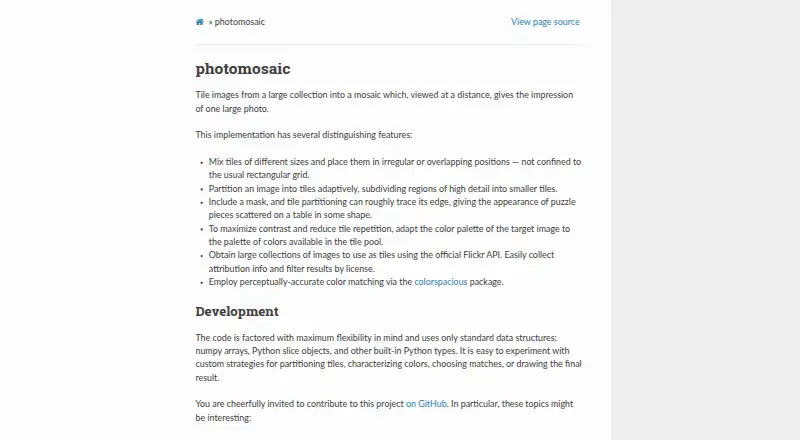
What photomosaic is
photomosaic is a free, open-source Python package for building a large image out of smaller images from a tile collection. Viewed from a distance, the assembled tiles form the target photograph. The package supports layouts with different tile sizes, including irregular placement and overlap. It can use smaller tiles in detailed regions, and a mask can guide the partition so it roughly follows an outline. For color matching, photomosaic can adjust the target palette to the colors present in the tile pool. It also uses colorspacious for perceptually accurate matching.
The package can retrieve tile images from Flickr search results or albums through Flickr’s public API. Downloaded images come with JSON attribution information. Search queries can be filtered by license, while album downloads do not programmatically check licenses. The documentation suggests that a pool of about 300 images is typically the minimum for good results. Install it with pip; the installation page specifies Python 3.5 or later. An optional parallel extra provides experimental parallelism features. Users can also experiment with custom tile partitioning, color characterization, matching, and drawing strategies. The project supports custom tile libraries and tile reuse controls, and can output PNG or JPG files.
Who it suits
photomosaic suits Python users who want to create image mosaics from their own tile collection, with control over tile layout, color matching, and partitioning. It may also suit users who want Flickr-sourced tiles and accompanying attribution information.
What it does well
- Supports mixed-size tiles and irregular or overlapping layouts.
- Can use smaller tiles in high-detail regions.
- Adapts target colors to the available tile pool.
- Flickr downloads include JSON attribution information.
- Supports custom tile libraries and tile reuse controls.
- Can export PNG and JPG images.
What to know first
- Good results typically require about 300 tile images.
- Flickr album downloads do not programmatically check licenses.
- Parallelism features are described as experimental.
Plans
| Plan | Billed and limits | Price |
|---|---|---|
| photomosaic | Python package; install with pip or from source | Free |
As danielballan.github.io lists them, read 9 Oct 2026. The maker's own page has the final word.
Getting started
- Install the package with pip.
- Use Python 3.5 or later.
- Gather a tile image pool; the documentation suggests about 300 images as a typical minimum.
- Optionally install the parallel extra for experimental parallelism features.
- Use a tile collection or download images from Flickr search results or albums.
- Create and save the mosaic as PNG or JPG.
Photomosaic is a free, open-source Python package that turns a library of small images into a larger mosaic image. It suits developers, technical artists, and image teams who want to control tile geometry and matching in code.
Overview
The package is designed for mosaics that resolve into one picture from a distance while retaining visible source tiles up close. Its BSD-3-Clause license permits use and modification, and the project welcomes contributions around matching, partitioning, and image-harvesting algorithms. The documented release history ends with version 0.3.1 from 21 June 2019, so it is a better fit for users comfortable with a mature, contribution-friendly codebase than for buyers expecting a recently refreshed commercial application.
Installation uses pip or a source checkout and requires Python 3.5 or later. Generated mosaics can be saved as PNG or JPG files, or displayed with matplotlib.
Key features
Non-grid layouts and adaptive detail
Photomosaic can mix tile sizes and place them in irregular or overlapping positions. That lets a composition follow visual structure instead of forcing every image into a rectangular grid, which is valuable for portraits, silhouettes, and art-directed work. High-detail regions can be subdivided into smaller tiles, while a mask can make the partition roughly trace an edge. These controls provide unusual compositional latitude, but they also require more configuration than preset-based mosaic makers.
Color matching
The package can adapt a target image's palette to the colors present in the tile pool, then uses colorspacious for perceptually accurate matching. This is useful when your available photos do not naturally contain the target's full color range: the matching process is designed around what your library can actually supply rather than assuming an ideal collection.
Flickr sourcing and attribution
Built-in tools can download tile images from Flickr search results or albums through Flickr's public API. Downloaded images are accompanied by JSON attribution data, and search queries can be filtered by license. Album downloads do not programmatically check licenses, so an album-based workflow leaves rights verification to you. The documentation recommends roughly 300 tile images as a typical minimum for good results; smaller collections are unlikely to provide the same matching variety.
Custom strategies and performance
The project uses standard data structures so users can experiment with custom tile partitioning, color characterization, matching, and drawing strategies. An optional parallel extra exposes experimental parallelism features. Drawing is typically the slowest stage; reusing a cache of resized pool images can accelerate repeated renders, which matters when iterating on layouts or targets.
Pricing
| Plan | Price | Includes |
|---|---|---|
| photomosaic | free | Python package; install with pip or from source; custom tile library; tile reuse controls; PNG and JPG output |
There is no paid tier, trial period, seat charge, or usage quota. The free plan is the complete open-source package, so the cost advantage is strongest for users who can install Python software and maintain their own image collections. It does not replace the time required to gather about 300 suitable tiles or review licensing for album downloads.
Platforms
Photomosaic targets Linux. It requires Python 3.5 or later, with optional dependencies available through the parallel extra.
Who it's for
Choose it for scripted or research-oriented mosaic work where irregular geometry, adaptive subdivision, masks, or custom matching matter more than a graphical workflow. It is also a sensible choice for teams that want Flickr search ingestion with attribution records and license-filtered queries. Look elsewhere if you need a cross-platform desktop or web editor, a recently updated release cadence, or automatic license checking for album imports.
Pros and cons
Pros
- Flexible geometry: mixed-size, irregular, and overlapping tiles support compositions beyond a fixed grid.
- Detail-aware partitions: high-detail areas can split into smaller tiles, and masks can follow an edge approximately.
- Perceptual matching: colorspacious-based matching and palette adaptation work with the colors your tile pool actually contains.
- Open and extensible: BSD-3-Clause licensing and standard data structures make custom strategies practical.
- Attribution support: Flickr downloads retain JSON attribution information, with license filtering for search queries.
Cons
- Linux-focused: the published platform is Linux, limiting suitability for Windows and macOS users.
- Large library requirement: documentation puts a typical good-result minimum at about 300 tile images.
- Album licensing gap: Flickr album downloads do not programmatically check licenses.
- Older documented release: version 0.3.1 is dated 21 June 2019, which may concern users prioritizing recent maintenance.
Alternatives
Photo Mosaic Software is the broader directory starting point when you want to compare mosaic tools by platform and pricing.
AndreaMosaic is a better fit for a cross-platform freemium desktop workflow, with Linux, macOS, and Windows support and a free Standard plan covering 200 megapixels, 30,000 tiles, 50,000 images, and creation and printing features.
phomo suits users who want a free Python package and CLI on Linux, macOS, or Windows; CUDA acceleration is available when compatible GPU and CUDA tooling are present.
Picture Mosaics Online Mosaic Tool is preferable for account-based web or iOS creation, with free making but paid downloads, prints, and video files.
EasyMoza fits browser users who can accept low-resolution free downloads and pay $595 per XL-code for its listed high-resolution option.
Photo Mosaica is an iOS/macOS freemium alternative with a free tier for adjustable diversity and size.
PhotoMosaic.ai is a web option offering an always-free lower-resolution tier with unlimited creation and 4,800×4,800px output.
PicTiler is a web service with free standard-quality output for personal and commercial use, plus a paid HD service.
Rapid-Mosaic suits Windows users who want local creation, with a free Standard edition and a 29.00 GBP one-time Professional upgrade.
Verdict
Photomosaic is a strong choice for Linux-based developers and image makers who need genuinely flexible tile layouts, adaptive detail, and code-level control over matching. Its free BSD-licensed package and Flickr attribution tooling are compelling. Choose another tool if you need a polished cross-platform interface, current release activity, or automated rights checks for album downloads.
Verdict
Choose photomosaic if you want an open-source Python package with flexible tile layouts and customizable image-matching strategies. Its Flickr search downloads can be filtered by license and include attribution data. Users relying on album downloads should account for the fact that those downloads do not programmatically check licenses.
Questions
Is photomosaic free?
Yes. Its pricing model is free, and the project is open source.
What Python version does it require?
The installation page specifies Python 3.5 or later.
Can it download tile images from Flickr?
Yes. It can download from Flickr search results or albums using Flickr’s public API.
Does it check licenses for Flickr downloads?
Flickr search queries can be filtered by license. Album downloads do not programmatically check licenses.
What output formats does it support?
PNG and JPG.
What license does the project use?
The GitHub repository identifies the project license as BSD-3-Clause.
Facts from photomosaic's own pages
- Adaptive detail
- It can subdivide regions with high detail into smaller tiles. · danielballan.github.io, 4 Oct 2026
- Adaptive partitioning
- It can split high-detail regions into smaller tiles and use a mask to make tile partitions roughly trace an edge. · danielballan.github.io, 9 Oct 2026
- Attribution and licenses
- Downloaded images are accompanied by JSON attribution information, and Flickr search queries can be filtered by license; album downloads do not programmatically check licenses. · danielballan.github.io, 4 Oct 2026
- Color matching
- It adapts the target image’s palette to colors in the tile pool and supports perceptually accurate color matching through colorspacious. · danielballan.github.io, 9 Oct 2026
- Contribution
- The documentation invites contributions and names alternative matching and tile-partitioning algorithms as possible areas of interest. · danielballan.github.io, 4 Oct 2026
- Customization
- The project uses standard Python data structures and allows custom tile partitioning, color characterization, matching, and drawing strategies. · danielballan.github.io, 9 Oct 2026
- Dependencies
- Installation requires Python 3.5 or later, and optional parallelism dependencies can be installed with the parallel extra. · danielballan.github.io, 9 Oct 2026
- Flickr integration
- The package can download tile images from Flickr search results or albums using Flickr’s public API. · danielballan.github.io, 4 Oct 2026
- Founded
- 2012 · danielballan.github.io, 28 Sept 2026
- Image pool size
- The documentation says about 300 tile images is typically the minimum for good results. · danielballan.github.io, 4 Oct 2026
- Image source
- The package includes tools to obtain tile images through Flickr’s public API and save attribution information with each image. · danielballan.github.io, 9 Oct 2026
- Installation
- The package can be installed with pip and requires Python 3.5 or later according to the installation page. · danielballan.github.io, 4 Oct 2026
- Irregular tiles
- It can use tiles of different sizes in irregular or overlapping positions rather than only a rectangular grid. · danielballan.github.io, 9 Oct 2026
- License filtering
- Flickr search queries can be filtered by license, while downloading a Flickr album URL does not programmatically check licenses. · danielballan.github.io, 9 Oct 2026
- Maintenance history
- The documentation lists version 0.3.1 dated 21 June 2019 as its newest release note. · danielballan.github.io, 4 Oct 2026
- Masks
- A mask can make the tile partition roughly trace its edge. · danielballan.github.io, 4 Oct 2026
- Optional parallelism
- An optional parallel extra is available for experimental parallelism features. · danielballan.github.io, 4 Oct 2026
- Output
- The tutorial demonstrates saving a generated mosaic as an image file or displaying it with matplotlib. · danielballan.github.io, 9 Oct 2026
- Performance
- Drawing is typically the slowest step because pool images must be resized; the documentation recommends reusing a resized-image cache for repeated draws. · danielballan.github.io, 9 Oct 2026
- Pool size
- The documentation says about 300 images is typically the minimum for good results. · danielballan.github.io, 9 Oct 2026
- Project license
- The GitHub repository identifies the project license as BSD-3-Clause. · github.com, 4 Oct 2026
- Purpose
- Photomosaic assembles images from a collection into a mosaic that looks like one large photo when viewed from a distance. · danielballan.github.io, 9 Oct 2026
- Security
- The opened project documentation does not state security certifications or compliance claims. · danielballan.github.io, 9 Oct 2026
- Support and contribution
- The project invites contributions on GitHub and names alternative matching, partitioning, and image-harvesting tools as areas of interest. · danielballan.github.io, 9 Oct 2026
Where photomosaic stands on Freedom251
- Photo Mosaic Software#7 of 24