Freedom251 › Manufacturing Scheduling Software
Phoenix APS
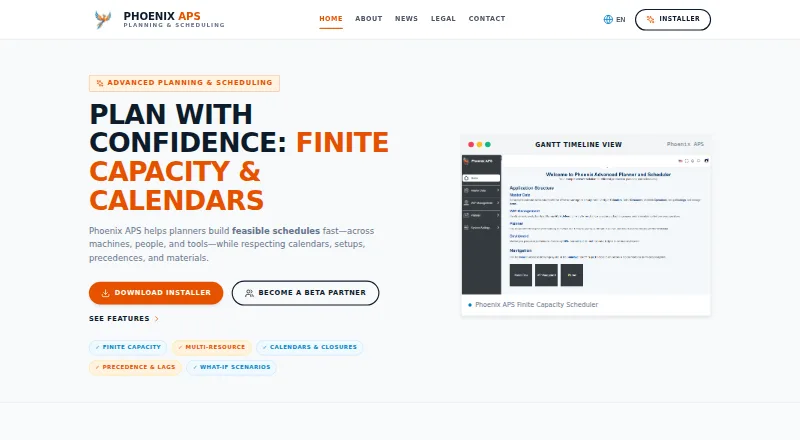
What Phoenix APS is
Phoenix APS helps planners build feasible production schedules across machines, people and equipment while accounting for calendars, setups, dependencies and materials. It enforces capacity limits for machines, lines and human skills, and supports parallel, alternative and sequential operation routings. A single plan can schedule machines, operators and equipment together. The software handles closures, working-time variations, finish-to-start dependencies with configurable lags, and bill-of-material availability under specified consumption laws. Planners can change assignments and rules to see the impact; infeasible jobs can be parked with reasons and retried using targeted relaxations. The interface includes a Gantt timeline, an operations table with filters and a what-if solver. HTTP JSON endpoints let ERP or MES systems send master data and retrieve dated plans. The maker describes its approach as heuristic and rule-based, focused on fast, explainable feasible plans; optimization modules are on the roadmap. The free Windows beta is for temporary evaluation only, not production use.
Who it suits
Phoenix APS suits planners evaluating finite-capacity scheduling for machines, labor and equipment. Its beta should not be used for production, safety-critical or regulated deployments.
What it does well
- Schedules machines, operators and equipment in one plan.
- Models capacity limits for machines, lines and human skills.
- Checks material availability against listed consumption laws.
- ERP and MES systems can exchange data through HTTP JSON endpoints.
- Free Windows beta installer is publicly available.
What to know first
- Temporary evaluation license does not permit production use.
- Optimization modules are on the roadmap.
- Maker advises against safety-critical or regulated beta deployment.
- Multi-site scheduling is not supported.
Limits
The free beta evaluation license is temporary and does not permit production use. Starter and Demo include SQL Server database backups.
Plans
| Plan | Billed and limits | Price |
|---|---|---|
| Free beta evaluation | free · temporary evaluation · non-commercial R&D · no production use · Windows installer | Free |
As phoenixaps.com lists them, read 15 Oct 2026. The maker's own page has the final word.
Getting started
- Visit the Phoenix APS website.
- Download the publicly available Windows installer.
- Install the application, which includes Angular, .NET APIs, and nginx.
- Use the free beta evaluation license for a temporary evaluation.
- Contact the maker for guidance on an industrial pilot.
Overview
Phoenix APS is a Windows-based finite-capacity planner for coordinating production work across machines, people, equipment, and materials. It suits planners evaluating constraint-aware scheduling or developing a non-commercial R&D pilot. Its broad scheduling controls make it worth evaluating, but its temporary beta license bars production use.
Key features
Phoenix APS models machine, line, and human-skill limits to prevent conflicting assignments, and supports parallel, alternative, and sequential routings at the operation level. It can schedule machines, operators, and equipment together, which is useful when a job’s feasibility depends on several resources being available at once. Multi-site scheduling is not supported, so teams planning across sites will need another approach.
Calendars handle closures and working-time variations, while finish-to-start dependencies can include configurable lags. Material checks use bill-of-material availability with Fixed or Proportional requirements and AtStart, Uniform, or AtEnd laws. This level of constraint modeling can help planners represent real production dependencies, but it also makes accurate inputs important.
For scenario planning, users can change assignments and rules and see the impact immediately. Infeasible jobs can be parked with reasons and retried using targeted relaxations, giving planners a way to investigate blocked work. The interface combines a Gantt timeline, an operations table with quick filters, and a what-if solver.
HTTP JSON endpoints let ERP or MES systems send master data and retrieve dated, feasible plans. The full Windows installer includes Angular, .NET APIs, and nginx; SQL Server database backups are provided for Starter and Demo. The maker describes the scheduling approach as fast, explainable plans built with heuristics and rules, with optimization modules on the roadmap. That approach favors feasible, rule-driven schedules over optimization capabilities that are not yet available.
Pricing
Free beta evaluation: free. The plan provides a free installer and temporary evaluation license, but is not licensed for production use. It is suitable for evaluation and non-commercial R&D, not operational deployment. The project is described as personal and non-commercial; the maker offers guidance for industrial pilots.
The maker advises reasonable safeguards and says not to deploy the beta in safety-critical or regulated environments. Those restrictions matter for any organization considering a pilot: this is not a production-ready license or a suitable tool for sensitive regulated operations.
Platforms
Phoenix APS is available for Windows, with API connectivity for ERP and MES integration. The public Windows installer includes the application components needed to run it, while the SQL Server backup provisions apply to Starter and Demo.
Who it's for
Phoenix APS is a fit for planners who need to explore finite-capacity schedules with combined machine, labor, equipment, calendar, routing, and material constraints. Its what-if workflow and ERP or MES endpoints also make it relevant to industrial teams assessing an integration or a non-commercial R&D pilot. It is not suitable for production use, multi-site scheduling, or safety-critical and regulated environments.
Pros and cons
- Pros: Detailed resource, routing, calendar, and material constraints can represent interdependent production requirements in a single plan.
- Pros: What-if changes and reasoned handling of infeasible jobs help planners explore bottlenecks and alternative rules.
- Pros: HTTP JSON endpoints support exchanging master data and dated plans with ERP or MES systems.
- Cons: The temporary beta license prohibits production use, sharply limiting its role to evaluation and non-commercial R&D.
- Cons: Multi-site scheduling is absent, ruling it out for planners who need to coordinate multiple sites.
- Cons: The maker advises against safety-critical or regulated deployment, and optimization modules remain on the roadmap.
Alternatives
frePPLe is worth considering for teams that want a free open-source edition, or a cloud option with a stated maximum of six scenarios; it also offers a free trial.
GE Vernova Proficy Plant Applications is a paid alternative for teams seeking hosted or on-premises deployment across process, discrete, and mixed manufacturing.
NETVIBES is a paid alternative with a free plan and trial, aimed at teams considering its Enterprise Data Science offering, which lists 17 portfolio roles.
Asprova APS may suit buyers seeking a Windows or self-hosted APS package and willing to request a distributor quote; implementation, training, consultation, and integration may add costs.
PlanetTogether APS is another self-hosted or web APS option, with subscription or perpetual licensing and subscription fees paid annually in advance.
SyncManufacturing is a paid web-based alternative.
MangoGem APS Optimizer is a paid, self-hosted or web alternative offered by custom quote.
Smart Factory Advance Production Scheduling is a paid web-based alternative with quote-based pricing.
Browse Manufacturing Scheduling Software, Production Scheduling Software, and Advanced Planning and Scheduling Software for more options.
Verdict
Choose Phoenix APS if you need to evaluate detailed finite-capacity planning, scenario changes, and ERP or MES data exchange in a Windows-based beta. Its constraint breadth and explainable, rule-driven scheduling are the reasons to try it. Look elsewhere if you need production licensing, multi-site plans, or a beta suitable for safety-critical or regulated work.
Verdict
Phoenix APS offers detailed finite-capacity planning with what-if tools and ERP or MES connectivity. Its free beta is suitable for evaluation, but the temporary license rules out production use.
Questions
How much does Phoenix APS cost?
The Free beta evaluation plan is free.
Can I use Phoenix APS for free?
Yes. A free installer is available, with a temporary beta evaluation license.
Can I use the beta for production scheduling?
No. The beta evaluation license does not permit production use.
Which platforms does Phoenix APS support?
The listed platforms are API and Windows.
Can it connect to ERP or MES systems?
HTTP JSON endpoints let ERP or MES systems send master data and retrieve dated plans.
Who makes Phoenix APS?
It is described as a personal, non-commercial R&D project. The maker offers guidance for industrial pilots.
Facts from Phoenix APS's own pages
- API
- HTTP JSON endpoints are intended to let ERP or MES systems send master data and retrieve dated feasible plans. · phoenixaps.com, 15 Oct 2026
- Availability and support
- The Windows installer is publicly available, and the maker offers guidance for industrial pilots. · phoenixaps.com, 29 Sept 2026
- Calendars and dependencies
- It handles closures and working-time variations, plus finish-to-start precedence relationships with configurable lags. · phoenixaps.com, 29 Sept 2026
- Calendars and exceptions
- The product handles closures, exceptions and varying working times. · phoenixaps.com, 15 Oct 2026
- Company fact
- The project says it is independently created and not affiliated with, endorsed by or sponsored by an employer or organization. · phoenixaps.com, 15 Oct 2026
- Custom routing
- Operations can be modeled as parallel, alternative or sequential routings with operation-level detail. · phoenixaps.com, 15 Oct 2026
- Deployment components
- The full Windows installer includes Angular, .NET APIs, and nginx, with SQL Server database backups for Starter and Demo. · phoenixaps.com, 29 Sept 2026
- ERP and MES connectivity
- HTTP JSON endpoints let ERP or MES systems send master data and retrieve dated, feasible plans. · phoenixaps.com, 29 Sept 2026
- ERP connectivity
- The FAQ describes Phoenix as API-first and designed to map ERP master data to a scheduling graph and return dated plans. · phoenixaps.com, 15 Oct 2026
- Evaluation licence
- Beta users receive a revocable, non-exclusive, non-transferable, royalty-free temporary evaluation licence. · phoenixaps.com, 15 Oct 2026
- Finite capacity
- The scheduler enforces real capacity limits on machines, lines and human skills to prevent double booking. · phoenixaps.com, 15 Oct 2026
- GitHub activity
- The repository page shows zero forks, zero issues and zero security or quality alerts at the time read. · github.com, 15 Oct 2026
- GitHub assets
- The v1.0 release page lists three release assets and points to README.md for installation instructions. · github.com, 15 Oct 2026
- GitHub release
- GitHub identifies Phoenix APS v1.0 as the latest release and shows it was published on August 7, 2026. · github.com, 15 Oct 2026
- GitHub repository
- The installer is hosted in a public GitHub repository named phoenix-aps-installer. · github.com, 15 Oct 2026
- Infeasibility handling
- Infeasible jobs can be parked with reasons and retried using targeted relaxations. · phoenixaps.com, 15 Oct 2026
- Installation documentation
- The maker says an installation guide is included under help\documentation\. · phoenixaps.com, 15 Oct 2026
- Installer contents
- The Windows package includes an Angular frontend, .NET APIs, nginx and SQL Server backups for Starter and Demo. · phoenixaps.com, 15 Oct 2026
- Interface
- The interface includes a Gantt timeline, an operations table with quick filters, and a what-if solver. · phoenixaps.com, 29 Sept 2026
- Languages
- The interface is fully translated into English, French, Spanish, German, Italian, Portuguese and Russian. · phoenixaps.com, 15 Oct 2026
- Licence status
- The legal notice reserves rights over the software and forbids copying, redistribution, sublicensing or commercial use without written permission. · phoenixaps.com, 15 Oct 2026
- License and use limit
- Phoenix APS is described as a personal, non-commercial R&D project; its beta evaluation license is temporary and does not permit production use. · phoenixaps.com, 29 Sept 2026
- Limit: documentation depth
- Public documentation is limited to an installation guide bundled in the installer; no public API reference or SDK is linked on the site. · phoenixaps.com, 15 Oct 2026
- Limit: mobile availability
- The published delivery is a Windows installer; no iOS or Android application is described on the maker's pages. · phoenixaps.com, 15 Oct 2026