Freedom251 › Secrets Management Tools

Phase
What Phase is
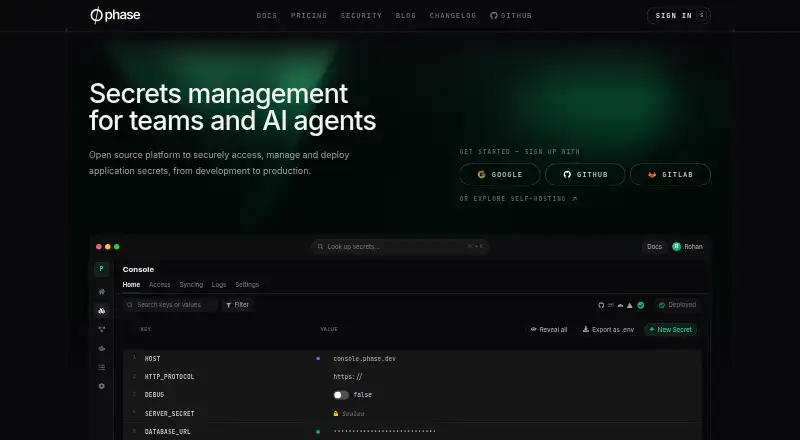
Phase is an open-source platform for managing and deploying application secrets from development through production. It can run as a managed cloud service or be self-hosted, including in air-gapped environments. Phase says end-to-end encryption is enabled by default and that its servers store only ciphertext in that mode. Its CLI caches secrets locally encrypted at rest and can inject them while offline. Access controls include managed and custom roles scoped by app and environment, plus IP allow-lists for users and service accounts. Phase records access, changes, and grants, and describes point-in-time rollback for secrets. Listed integrations include AWS, Azure, HashiCorp Vault, Docker, Kubernetes, Cloudflare, GitHub, GitLab, Vercel, and Railway. The CLI also installs skills for Claude Code, Codex, Cursor, OpenCode, and VS Code Copilot to manage secrets using natural language. The Free plan allows up to 5 users or service accounts, 3 apps, and 3 environments. Pro is $10 per month, billed annually at $120 ($144 shown), and includes a 14-day free trial.
Who it suits
Phase suits teams that need to manage application secrets across development and production, including organizations requiring self-hosting or air-gapped deployment. The Free plan is limited to 5 users or service accounts, 3 apps, and 3 environments.
What it does well
- Managed cloud and self-hosted deployment are available.
- Default end-to-end encryption stores ciphertext on servers.
- CLI supports encrypted local caching and offline injection.
- Roles can be scoped by app and environment.
- Point-in-time rollback is described for secrets.
What to know first
- Free plan is limited to 5 users or service accounts.
- Free plan allows only 3 apps and 3 environments.
- Pro is $10 per month, billed annually.
Limits
The Free plan allows up to 5 users or service accounts, 3 apps, and 3 environments. Pro includes 10 custom environments; Enterprise lists unlimited custom environments.
Plans
| Plan | Billed and limits | Price |
|---|---|---|
| Free | Up to 5 Users or Service Accounts · Up to 3 Apps · 3 Environments · OAuth SSO · AI Agent Integration · Phase Agents Relay | Free |
| Pro | $120 billed annually ($144 shown) · Unlimited Users & Service Accounts · Unlimited Apps · 10 Custom Environments · Teams · Custom Roles · Network Access Policies · Point-in-time Recovery · Automated Secret Rotation · 90-day Audit Logs · 14 days free trial | $10 a month |
| Enterprise | $300 billed annually ($360 shown) · Unlimited Custom Environments · OIDC SSO · SCIM Provisioning · Dynamic Secrets · Global Network Access Policies · Third-party KMS · Audit Log Forwarding · SIEM Integration · SOC 2 Type 2 Audit Report · External Penetration Testing Reports · 14 days free trial | $25 a month |
As phase.dev lists them, read 30 Sept 2026. The maker's own page has the final word.
Getting started
- Visit https://phase.dev/ and choose the Free, Pro, or Enterprise plan.
- Select managed cloud or self-hosted deployment for your infrastructure.
- Use the Phase CLI to manage and deploy application secrets.
- Connect relevant services from the listed integrations, such as AWS, Docker, or Kubernetes.
- Optionally install CLI skills for a supported coding assistant.
Overview
Phase is an open-source platform for managing application secrets across development and production, with managed-cloud and self-hosted deployment options. It is best suited to teams that need fine-grained access controls and operational safeguards; its free tier is useful for a small setup, but its caps make a paid plan the likely destination as teams grow.
Its integrations span cloud providers, infrastructure tools and code-hosting platforms, while its CLI extends secret management into several AI coding tools. Those conveniences sit alongside the more consequential choices: where to run Phase, who can access each app and environment, and how to recover or rotate secrets.
For a broader category comparison, see Secrets Management Tools.
Key features
Encryption and controlled access
Phase says end-to-end encryption is enabled by default, with its servers storing only ciphertext in that mode. Managed and custom RBAC roles can be scoped to individual apps and environments, and IP allow-lists apply to users and service accounts. This combination gives administrators useful ways to limit access rather than treating every credential as equally available.
Deployment and integrations
Teams can use Phase as a managed Cloud service or host it on their own infrastructure, including air-gapped environments. That flexibility matters for organizations that cannot place secrets in a managed service, though self-hosting also means operating the deployment themselves. Listed integrations include AWS, Azure, HashiCorp Vault, Docker, Kubernetes, Cloudflare, GitHub, GitLab, Vercel and Railway, covering common infrastructure and delivery tools.
Audit, recovery and offline CLI
Phase records access, changes and grants, and describes point-in-time rollback for any secret. Pro includes 90-day audit logs and point-in-time recovery, while Enterprise adds audit-log forwarding and SIEM integration. The CLI caches secrets locally encrypted at rest and can inject them while offline, a practical option when connectivity is unavailable. Secret rotation and CI/CD injection are also supported.
AI coding tools
The Phase CLI installs skills for Claude Code, Codex, Cursor, OpenCode and VS Code Copilot, allowing those tools to manage secrets using natural-language requests. This is a relevant workflow addition for teams using those assistants, but it does not replace the need to define appropriate permissions.
Pricing
Phase uses a freemium model, with a 14-day free trial for Pro. The Free plan costs nothing and allows up to 5 users or service accounts, 3 apps and 3 environments. It includes OAuth SSO, AI Agent Integration and Phase Agents Relay. Those caps make it a reasonable starting point for a small team, but a fourth app or environment or a sixth user exceeds its stated limits.
Pro is $10 a month, billed $120 billed annually ($144 shown). It removes user and app limits, supports 10 custom environments, and adds Teams, custom roles, network access policies, point-in-time recovery, automated secret rotation and 90-day audit logs. This is the natural tier for teams that outgrow Free or need those operational controls; the annual billing term is material to the commitment.
Enterprise is $25 a month, billed $300 billed annually ($360 shown). It includes unlimited custom environments, OIDC SSO, SCIM provisioning, dynamic secrets, global network access policies, third-party KMS, audit-log forwarding, SIEM integration, a SOC 2 Type 2 audit report and an external penetration testing report. It is aimed at organizations with identity, key-management, compliance or monitoring requirements beyond Pro. Dedicated live support and SLAs are optional add-ons; community, email and Slack support are listed for plans.
Platforms
Phase supports API, Linux, macOS, web and Windows, and can be self-hosted. Its CLI and offline secret injection are particularly relevant to developers who need credentials during local work or without a network connection.
Who it's for
Phase suits development and operations teams coordinating secrets across multiple apps or environments, especially those that need scoped permissions, auditable changes or self-hosting. Its air-gapped deployment option and offline CLI also fit environments with limited connectivity. A solo user or very small project can start on Free, but the five-user, three-app and three-environment ceilings leave little room for expansion.
Teams that need unlimited custom environments, SCIM provisioning, third-party KMS or SIEM integration should look at Enterprise. Readers who only need a smaller, simpler secrets setup may find Phase's broad control and deployment model more than they need.
Pros and cons
- Pros: Managed cloud and self-hosted deployment, including air-gapped use, accommodate different infrastructure constraints.
- Pros: App- and environment-scoped roles, IP allow-lists, audit records and rollback address access governance and recovery in one platform.
- Pros: Encrypted offline caching and injection help preserve CLI workflows when connectivity is unavailable.
- Cons: Free is capped at five users or service accounts, three apps and three environments, limiting its usefulness for expanding teams.
- Cons: Pro is billed annually, and key enterprise identity and monitoring features are reserved for the higher tier.
Alternatives
Envshed is a fit for developers who want a free plan with up to two members, three projects, unlimited secrets and CLI and API access; its stated allowance is narrower on members and projects than Phase's.
Keyway offers Pro at €9 a month for 10 private repos, unlimited environments and collaborators, making it worth comparing for teams organized around repositories and those limits.
Kubermatic Kubernetes Platform is an alternative for readers specifically considering a Kubernetes platform; its Community Edition is open source under Apache License 2.0.
SikkerKey offers a Developer plan with 10 machines, one month of audit retention and 20 webhook deliveries per day, with additional machines at $5 per month each; that usage-based machine allowance may suit a small deployment.
dotenvx is described by its maker as free and open source, and may suit readers looking for that model.
Infisical has a free Secrets Management plan with five identities, unlimited projects and 100+ integrations, a useful comparison for teams prioritizing project count and integrations.
KeyEnv offers a free plan with up to three projects, 100 secrets per environment, CLI access, end-to-end encryption and community support, giving small teams a defined project-and-secret allowance.
Stashbase is another freemium secrets-management option to compare.
Verdict
Choose Phase if your team needs secrets management that combines scoped access, audit and recovery features with the option to self-host or work offline. Its deployment flexibility and controls are the strongest reasons to choose it; the Free tier's low caps and Pro's annual billing are reasons to look elsewhere or plan for a paid commitment as usage grows.
Verdict
Phase combines secret management with deployment options, access controls, and offline CLI support. The Free plan has clear user, app, and environment limits, while Pro is billed annually at $120 ($144 shown).
Questions
Is Phase free?
Yes. The Free plan costs nothing and allows up to 5 users or service accounts, 3 apps, and 3 environments.
How much does Pro cost?
Pro is listed at $10 a month, billed $120 billed annually ($144 shown). It includes a 14-day free trial.
Can Phase be self-hosted?
Yes. It can run on your own infrastructure, including air-gapped environments, or as a managed cloud service.
Which integrations are listed?
They include AWS, Azure, HashiCorp Vault, Docker, Kubernetes, Cloudflare, GitHub, GitLab, Vercel, and Railway.
Is Phase open source?
Yes. Phase is described as an open-source platform.
Who makes Phase?
The site identifies the company as Phi Security Inc. and lists its address in Dover, Delaware, United States.
Facts from Phase's own pages
- Access control
- Phase offers managed and custom RBAC roles, scoped per app and environment, plus IP allow-lists for users and service accounts. · phase.dev, 30 Sept 2026
- AI agents
- The Phase CLI installs skills that let Claude Code, Codex, Cursor, OpenCode and VS Code Copilot manage secrets using natural language. · phase.dev, 30 Sept 2026
- Audit and recovery
- Phase records access, changes and grants, and its home page describes point-in-time rollback for any secret. · phase.dev, 30 Sept 2026
- Company
- The site identifies the company as Phi Security Inc. and lists its address in Dover, Delaware, United States. · phase.dev, 30 Sept 2026
- Deployment
- Phase can run as fully managed Cloud or self-hosted on your own infrastructure, including air-gapped environments. · phase.dev, 30 Sept 2026
- Headquarters
- Dover, Delaware, United States · phase.dev, 28 Sept 2026
- Integrations
- Listed integrations include AWS, Azure, HashiCorp Vault, Docker, Kubernetes, Cloudflare, GitHub, GitLab, Vercel and Railway. · phase.dev, 30 Sept 2026
- Notable limits
- The Free plan allows up to 5 users or service accounts, 3 apps and 3 environments. · phase.dev, 30 Sept 2026
- Offline mode
- The CLI caches secrets locally encrypted at rest and supports injecting them while offline. · phase.dev, 30 Sept 2026
- Product
- Phase is an open source platform to securely access, manage and deploy application secrets from development to production. · phase.dev, 30 Sept 2026
- Security
- Phase says end-to-end encryption is enabled by default and its servers store only ciphertext in that mode. · phase.dev, 30 Sept 2026
- Security audit
- Phase says it is independently audited under SOC 2 Type 2 and penetration tested by Oneleet. · phase.dev, 30 Sept 2026
- Support
- Pricing lists community, email and Slack support, with dedicated live support and SLAs as an optional add-on. · phase.dev, 30 Sept 2026
Where Phase stands on Freedom251
- Secrets Management Tools#11 of 46