Freedom251 › Payment Orchestration Platforms

PayOrc
What PayOrc is
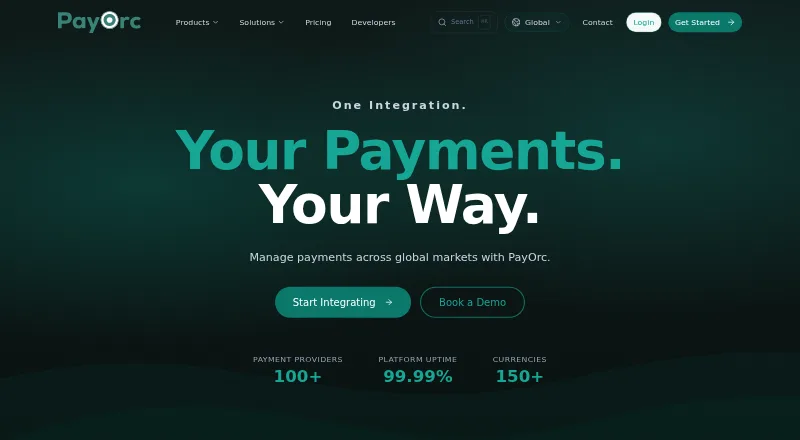
PayOrc is a payment orchestration layer for merchants, payment providers, banks, and technology platforms. Its routing engine selects a processor in real time, and automatic retries use predefined fallback chains when payments fail. The product lineup includes payment links, QR payments, subscriptions, invoicing, branded checkout, POS, and fraud risk tools. Supported methods include cards, wallets, Apple Pay, Google Pay, SEPA, and BNPL. PayOrc says it connects to 100+ providers and systems, including Stripe, Adyen, Razorpay, WooCommerce, Shopify, Salesforce, and SAP. Developers can use a REST API, webhooks, SDKs for Node.js, Python, PHP, Java, Ruby, and Go, plus web, Android, iOS, and Flutter SDKs. Listed protections include tokenization, a card vault, AES-256 encryption at rest, TLS 1.3 in transit, and controlled vault access. Fraud detection combines configurable rules and machine learning. Starter is free, limited to one PSP and up to USD 5k monthly TPV. Growth costs $25/month and covers more than USD 5k to USD 100k monthly TPV with five PSPs.
Who it suits
PayOrc suits merchants and platforms seeking to route payments across providers, retry failed payments, or offer multiple payment tools. Its plan limits make monthly TPV and provider count important when choosing between Starter and Growth.
What it does well
- Routing engine selects a processor in real time.
- Automatic retries use predefined fallback chains.
- Connects to 100+ providers and systems.
- Offers REST API, webhooks, and SDKs.
- Fraud controls combine rules and machine learning.
What to know first
- Starter supports only one PSP.
- Starter is limited to up to USD 5k monthly TPV.
- Growth costs $25/month.
- Enterprise pricing is custom and not listed.
Limits
Starter is free and limited to one PSP and no more than USD 5k monthly TPV. Growth costs $25 per month, supports five PSPs, and covers more than USD 5k through USD 100k monthly TPV. Domestic card fees are 2.90% + $0.30 for Starter and 2.70% + $0.30 for Growth; displayed MDRs are indicative and tax-exclusive.
Plans
| Plan | Billed and limits | Price |
|---|---|---|
| Starter | ≤ USD 5k monthly TPV · 1 PSP · 2.90% + $0.30 domestic card fee · 0.80% SEPA fee capped at $5 | Free |
| Growth | monthly · > USD 5k to USD 100k monthly TPV · 5 PSPs · 2.70% + $0.30 domestic card fee · 0.70% SEPA fee capped at $5 | $25 a month |
| Enterprise | > USD 100k monthly TPV · unlimited PSPs · custom transaction fees | On request |
As payorc.com lists them, read 15 Oct 2026. The maker's own page has the final word.
Getting started
- Visit https://payorc.com/.
- Select Starter, Growth, or contact PayOrc about Enterprise pricing.
- Connect through the REST API, webhooks, or an available SDK.
- Choose from the provider and system integrations that fit your setup.
PayOrc is a payment orchestration service for merchants and platforms coordinating payment providers and related tools. It is most compelling for businesses that need routing, retries and several PSP connections in one integration. Starter offers a low-risk entry point, but its single-PSP cap limits its value for multi-provider routing.
The product’s breadth is a strength; the practical choice hinges on whether your monthly payment volume and provider needs fit the plan limits.
Overview
PayOrc brings processor selection, failed-payment recovery and checkout tools under one orchestration layer. Its real-time routing engine selects a processor, and PayOrc says authorization rates can improve by up to 15%. That is a stated potential gain, not a guaranteed outcome. Automatic retries through predefined fallback chains can give failed transactions another path, a more useful capability when a merchant has multiple PSPs available.
The wider toolkit covers payment links, QR payments, subscriptions, invoicing, branded checkout, POS and fraud tools. Supported methods include cards, wallets, Apple Pay, Google Pay, SEPA and BNPL. PayOrc says it connects to more than 100 providers and systems, including Stripe, Adyen, Razorpay, WooCommerce, Shopify, Salesforce and SAP. This breadth could help teams consolidate payment operations, though a plan’s PSP allowance may restrict how much of that network a business can use.
Key features
Routing and retries
Real-time routing and fallback retries address processor choice and payment recovery, rather than just providing another checkout. They are most relevant to merchants using more than one PSP; Starter’s one-PSP allowance cannot provide much room for multi-provider routing. Growth raises that limit to five, while Enterprise allows unlimited PSPs.
Payment tools and integrations
Payment links, QR payments, subscriptions, invoicing, branded checkout and POS give businesses several ways to collect payment within the same product. Recurring payments and marketplace payouts are also among the listed capabilities. The range is useful for teams seeking a broader payment stack, but the product’s breadth alone does not remove the need to check whether a particular workflow fits their operation.
Developer and security provisions
The developer offering includes a REST API, webhooks and SDKs for Node.js, Python, PHP, Java, Ruby and Go, plus web, Android, iOS and Flutter SDKs. Developer support is available through Slack, email and video calls. PayOrc lists PCI DSS Level 1, ISO/IEC 27001:2022 and ISO 9001 certifications, and describes tokenization, a card vault, AES-256 encryption at rest, TLS 1.3 in transit and controlled vault access. Fraud controls combine rules and machine learning with configurable risk thresholds.
Pricing
| Plan | Price and limits | Best fit |
|---|---|---|
| Starter | free; up to USD 5k monthly TPV and one PSP. Domestic card fees are 2.90% + $0.30. | Small-volume businesses assessing the service or operating with one PSP. |
| Growth | $25/month; above USD 5k to USD 100k monthly TPV and five PSPs. Domestic card fees are 2.70% + $0.30. | Businesses needing multiple PSPs and monthly TPV within the stated range. |
| Enterprise | Custom pricing; above USD 100k monthly TPV and unlimited PSPs. | Higher-volume operations requiring more than five PSPs. |
The free Starter tier makes entry inexpensive, but its TPV ceiling and one-PSP limit make it a constrained option for businesses whose main goal is multi-provider orchestration. Growth costs $25/month and expands both capacity and provider choice; its lower domestic card fee is a further difference, though displayed MDRs are indicative and tax-exclusive. Enterprise moves to custom pricing and removes the stated PSP ceiling. No seat quota or trial term is stated for these plans.
Platforms
PayOrc supports web, Android, iOS and API access. Its SDK range also includes Flutter, which gives development teams mobile and server-side integration options across several common environments.
Who it's for
PayOrc is a sensible candidate for merchants and technology platforms that want payment routing, fallback retries and a collection of payment tools connected through one layer. Teams building integrations can draw on its API, webhooks and multiple SDKs, while businesses handling sensitive payment data may value the listed certifications and vault protections.
It is less suited to a business that needs several PSPs but wants to remain on the free tier: Starter allows only one. Companies above USD 100k monthly TPV or needing more than five PSPs would need Enterprise’s custom pricing. A single-provider merchant with simple payment needs may not have much reason to pay for orchestration breadth it does not use.
Pros and cons
- Pros: Real-time routing and automatic fallback retries can help multi-PSP merchants manage authorization and failed payments from one layer.
- Pros: The product combines payment links, QR payments, recurring payments, invoicing, checkout, POS and fraud controls, alongside a broad set of payment methods.
- Pros: Growth raises the allowance to five PSPs for $25/month, with a lower listed domestic card fee than Starter.
- Cons: Starter’s one-PSP and USD 5k monthly TPV caps restrict its usefulness for growing or multi-provider operations.
- Cons: Enterprise uses custom pricing, so businesses above the Growth range do not have a stated monthly price to compare.
- Cons: The claimed authorization improvement of up to 15% is a potential result, not a promised performance level.
Alternatives
Juspay Hyperswitch is worth considering for teams that prefer a self-managed community edition: its free plan includes 90+ payment integrations and public Slack and GitHub discussion support, while PayOrc’s Starter is capped at one PSP.
Orchestra may suit teams focused on testing before accepting live payments: its free Sandbox offers unlimited test transactions and 130+ provider sandboxes, but it does not support live payments.
PayServ Multi-PSP Platform offers a free sandbox connection, 500 test transactions per month, 50+ test scenarios and a daily AI Copilot allowance, making it an option for teams whose priority is a structured test environment.
OpenSwitch is another option for buyers evaluating payment orchestration.
MoneyHash is a paid alternative for teams comparing payment platforms.
Gr4vy may fit buyers seeking a paid platform with pricing tailored to their business needs.
Primer offers tailored pricing plans for businesses that want to discuss pricing and ROI with its team.
Amatyx is another paid option for teams comparing API- and web-based platforms.
Browse more options in Payment Orchestration Platforms.
Verdict
PayOrc is best for merchants and platforms that need payment routing, retries and a broad set of payment tools, and can use Growth’s five-PSP allowance within its USD 100k monthly TPV ceiling. The $25/month plan offers a clear step up from Starter’s one-provider limit. Look elsewhere if you need a self-managed community edition, a testing-only sandbox, or cannot justify custom pricing for needs beyond Growth.
Verdict
PayOrc combines payment routing, retries, payment tools, and developer integrations. Starter is free within its one-PSP and TPV limits; Growth costs $25/month for five PSPs and a higher TPV range.
Questions
Does PayOrc have a free plan?
Yes. Starter is free and includes one PSP, with a limit of up to USD 5k monthly TPV.
How much does PayOrc Growth cost?
Growth costs $25 per month. It includes five PSPs and covers more than USD 5k to USD 100k monthly TPV.
What does Enterprise cost?
Enterprise pricing is custom. The plan covers more than USD 100k monthly TPV and unlimited PSPs.
Which payment methods does PayOrc support?
The site lists cards, wallets, Apple Pay, Google Pay, SEPA, and BNPL among its supported methods.
Which integrations and developer tools are available?
PayOrc says it connects to 100+ providers and systems, including Stripe, Adyen, Razorpay, WooCommerce, Shopify, Salesforce, and SAP. Developer tools include a REST API, webhooks, language SDKs, and web, Android, iOS, and Flutter SDKs.
Is PayOrc open source?
The listed facts do not establish whether PayOrc is open source.
Facts from PayOrc's own pages
- Analytics
- A unified dashboard provides real-time payment analytics with drill-down from cohorts to individual transactions. · payorc.com, 15 Oct 2026
- API and SDKs
- The developer page lists a REST API, webhooks, and SDKs for Node.js, Python, PHP, Java, Ruby, and Go, plus web, Android, iOS, and Flutter SDKs. · payorc.com, 29 Sept 2026
- API documentation
- Public documentation describes more than 60 API endpoints, 10-plus payment methods, five-plus PSP integrations and API version 3.0.0. · docs.payorc.com, 15 Oct 2026
- API endpoint
- The payment-request API creates orders through POST https://api.payorc.com/orders/v1/create using merchant-key and merchant-secret headers. · docs.payorc.com, 15 Oct 2026
- API features
- The API supports hosted checkout, iframe checkout, server-to-server payments, token payments, split payments, MID groups, refunds, voids, settlements, payouts and webhooks. · docs.payorc.com, 15 Oct 2026
- Cascade retries
- Failed transactions can be retried automatically through fallback providers, with the company claiming recovery of up to 40% of failed payments. · payorc.com, 15 Oct 2026
- Company legal name
- The terms identify PayOrc as Vallwork Tech FZCO, incorporated in the United Arab Emirates. · payorc.com, 15 Oct 2026
- Cost optimization
- PayOrc says it can route transactions to lower-cost processors and reduce processing fees by 20–30%. · payorc.com, 15 Oct 2026
- Data protection
- PayOrc says it uses tokenization and a card vault, AES-256 encryption at rest, TLS 1.3 in transit, and controlled vault access. · payorc.com, 29 Sept 2026
- Fees
- The pricing page lists domestic card fees of 2.90% + $0.30 for Starter and 2.70% + $0.30 for Growth, and says displayed MDRs are indicative and tax-exclusive. · payorc.com, 29 Sept 2026
- Founded
- PayOrc's company timeline says it was founded in 2025 Q2 and achieved PCI DSS Level 1 certification from day one. · payorc.com, 29 Sept 2026
- Fraud controls
- The platform offers rule-based and machine-learning fraud detection with configurable risk thresholds. · payorc.com, 15 Oct 2026
- Google Play app
- The Android merchant app manages transactions, payment links, subscriptions and QR collections with real-time tracking and insights. · play.google.com, 15 Oct 2026
- Google Play data safety
- Google Play says the app shares no data with third parties, may collect personal and financial information, encrypts data in transit and supports deletion requests. · play.google.com, 15 Oct 2026
- Google Play developer
- Google Play identifies the developer as VALLWORK TECH - FZCO at IFZA Property FZCO, Building A1, Dubai Digital Park, Dubai Silicon Oasis. · play.google.com, 15 Oct 2026
- Google Play update
- The PayOrc Android app was updated on August 10, 2026 with stability improvements and support for current Android platform requirements. · play.google.com, 15 Oct 2026
- Headquarters
- Dubai, United Arab Emirates · payorc.com, 28 Sept 2026
- Hosted checkout
- PayOrc-hosted pages collect card details, reducing the merchant's PCI scope; the API returns payment and iframe links and sends webhook notifications. · docs.payorc.com, 15 Oct 2026
- Integrations
- PayOrc lists more than 100 integrations spanning e-commerce platforms, payment methods, wallets, banks, PSPs, ERP systems and CRMs. · payorc.com, 15 Oct 2026
- Intelligent routing
- Its routing engine selects a payment processor in real time using transaction context and claims authorization improvements of up to 15%. · payorc.com, 15 Oct 2026
- Licence
- The terms grant only a limited, non-exclusive, non-transferable subscription right and prohibit reverse engineering, indicating proprietary software rather than open-source licensing. · payorc.com, 15 Oct 2026
- Limit: indicative pricing
- Published merchant-discount rates are indicative and tax-exclusive; final pricing depends on underwriting, provider approval, payment method, volume and commercial agreement. · payorc.com, 15 Oct 2026
- Limit: non-refundable fees
- The terms say monthly subscriptions are billed in advance and fees are generally non-refundable except where the refund policy provides otherwise. · payorc.com, 15 Oct 2026
- Limit: provider dependence
- Provider, method and country availability depends on merchant eligibility, provider approval, technical availability and commercial agreements. · payorc.com, 15 Oct 2026
Where PayOrc stands on Freedom251
- Payment Orchestration Platforms#4 of 26