Freedom251 › Payment Orchestration Platforms
Orchestra
What Orchestra is
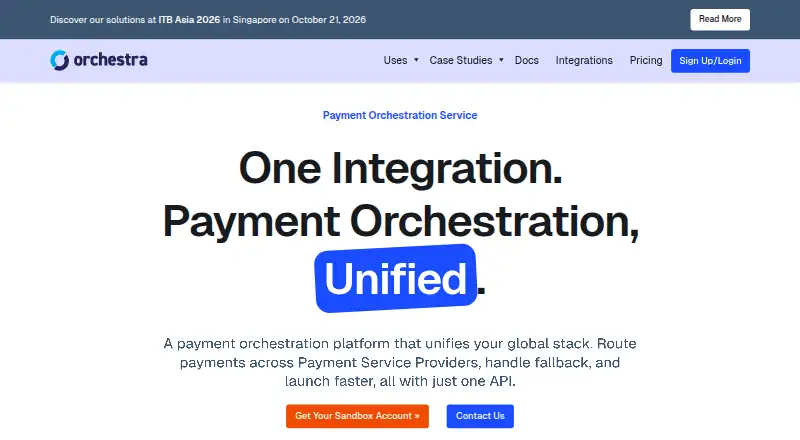
Orchestra is a payment orchestration platform that connects payment providers through one API and can route payments across multiple processors. It connects to more than 130 providers, gateways, alternative payment services and financial services. Routing rules can send failed payments to backup processors. Cards, wallets, bank transfers and local payment methods are available through the same integration. A REST API supports backend charges, refunds and recurring billing; a JavaScript SDK supports capturing cards, wallets and local methods. The company says the SDK keeps card data off customer servers and offers outsourced PCI compliance. Orchestra states that it is PCI-DSS Level 1 and ISO/IEC 27001:2022 certified, supports PSD2 strong customer authentication, and is GDPR compliant. It monitors integrated providers for API changes and handles updates, and says new integrations are added without additional cost. Standard integrations typically take 2–4 weeks; complex ones may take 4–6 weeks. Starter costs nothing and includes 100 live requests monthly. Growth costs $350 a month plus $0.03 per request.
Who it suits
Orchestra is presented for businesses such as hotel marketing companies, healthcare SaaS, eSIM providers and gym management software vendors. Starter may suit teams with up to 100 live requests per month; Growth offers unlimited live requests and 24/7 on-call live support.
What it does well
- Connects to 130+ payment providers
- Routes failed payments to backup processors
- Supports charges, refunds and recurring billing
- New integrations have no additional cost
What to know first
- Sandbox transactions are testing-only, with no live payments
- Starter is limited to 100 live requests monthly
- Growth costs $350 a month plus $0.03 per request
Limits
The free Sandbox is limited to testing and does not process live payments. Starter is limited to 100 live requests per month; Growth has unlimited live requests and costs $350 a month plus $0.03 per request.
Plans
| Plan | Billed and limits | Price |
|---|---|---|
| Sandbox | Testing only · unlimited transactions · no live payments · all 130+ provider sandboxes · JavaScript SDK or REST API · priority email support | Free |
| Starter | $0/month · 100 live requests/month · all 130+ live integrations · JavaScript SDK or REST API · priority email support | Free |
| Growth | $350/month + $0.03/request · Unlimited live requests · everything in Starter · 24/7 on-call support · no minimum contract | $350 a month |
| Enterprise | Custom pricing · Everything in Growth · advanced analytics · team permissions · priority support · white-label options · custom contract terms | On request |
As orchestrasolutions.com lists them, read 15 Oct 2026. The maker's own page has the final word.
Getting started
- Visit the Orchestra website.
- Choose Sandbox for testing or Starter for up to 100 live requests per month at no cost.
- Connect through the JavaScript SDK or REST API.
- Select payment providers to integrate; most standard integrations take 2–4 weeks, while complex ones may take 4–6 weeks.
Overview
Orchestra is a payment orchestration platform for businesses that want to connect multiple payment providers without building and maintaining each connection themselves. It is most compelling for software companies that need varied payment methods and processor fallback; the main caveat is that its free live plan allows only 100 requests a month.
Key features
Orchestra connects to more than 130 payment providers, gateways, alternative payment services and financial services through one integration. It supports cards, wallets, bank transfers and local payment methods, helping businesses offer more ways to pay without separate regional integrations. That breadth can reduce integration work, though onboarding a provider still takes time: most standard integrations take 2–4 weeks, and complex ones take 4–6 weeks.
Multi-provider routing and automatic retries can redirect failed payments to backup processors. Tokenization and a vault support recurring payments, while the REST API handles backend charges, refunds and recurring billing. A JavaScript SDK captures cards, wallets and local payment methods. It keeps card data off customer servers, and Orchestra offers outsourced PCI compliance.
Orchestra states that it is PCI-DSS Level 1 and ISO/IEC 27001:2022 certified, supports PSD2 strong customer authentication, and handles regional regulations and data localization. As an EU-based organization, it also states that it is fully GDPR compliant. The company monitors integrated providers for API changes and applies updates without requiring customer code changes. New integrations, including development, testing and ongoing maintenance, are added at no additional cost. That reduces the long-term burden of keeping connections current, but does not eliminate the initial integration timeline.
The platform supports API and web access. It does not support marketplace payouts, so businesses whose payment flow depends on paying out to marketplace sellers should look elsewhere.
Pricing
Sandbox costs nothing and provides unlimited transactions for testing only; it does not process live payments. It includes 130+ provider sandboxes, the JavaScript SDK or REST API, and full-priority email support. This suits development and evaluation, not production.
Starter costs nothing, billed $0/month. It includes 100 live requests/month, 130+ live provider integrations, either the JavaScript SDK or REST API, and full-priority email support. The free tier gives teams a way to begin processing live payments, but the monthly cap is restrictive for sustained transaction volume.
Growth costs $350 a month, billed $350/month + $0.03/request. It includes unlimited live requests, everything in Starter, and 24/7 on-call live support, with no minimum contract. This is the production tier for businesses that need room to grow beyond Starter’s cap and want around-the-clock support; the per-request charge remains relevant as volume rises.
Enterprise has custom pricing and includes everything in Growth plus advanced analytics, team permissions, priority support, white-label options and custom contract terms. It is the fit for organizations that need those additional controls or a tailored contract, rather than a low-cost route to basic payment routing.
Who it's for
Orchestra presents itself for hotel marketing companies, healthcare SaaS businesses, eSIM providers and gym management software vendors. Its single integration, local payment support and fallback routing are useful for software businesses that need to serve different payment preferences or keep multiple processors in the flow. It is less suitable for marketplace operators that need payouts, or for low-volume teams unwilling to move beyond a tightly capped free live tier.
Pros and cons
- Broad provider and method coverage: 130+ connections and support for cards, wallets, bank transfers and local methods give businesses flexibility through one integration.
- Reduced maintenance burden: Orchestra monitors provider API changes, handles updates without customer code changes, and adds integrations at no additional cost.
- Free live entry point is tightly capped: Starter allows just 100 live requests/month, limiting its usefulness for production beyond small volumes.
- Provider onboarding takes weeks: Standard integrations take 2–4 weeks and complex ones 4–6 weeks, so new coverage is not immediate.
- No marketplace payouts: Businesses needing that capability will need another platform.
Alternatives
Juspay Hyperswitch is worth considering for teams that want a self-managed option: its free Self-Host Community Edition includes 90+ integrations and public Slack and GitHub discussion support.
PayOrc may suit smaller businesses seeking a lower-cost paid step-up, with a free Starter tier for ≤ USD 5k monthly TPV and a $25/month Growth plan covering > USD 5k to USD 100k monthly TPV and 5 PSPs.
BridgerPay is another API and web option with a free tier and free trial.
PayServ Multi-PSP Platform offers a free testing-focused tier with one PSP sandbox connection, 500 test transactions/month and community support.
OpenSwitch is an alternative for teams considering API-based or self-hosted orchestration.
BR-DGE, MoneyHash and ACI Automated Dispute Manager are other alternatives.
For a broader comparison, see Payment Orchestration Platforms.
Verdict
Choose Orchestra if your software business needs broad provider coverage, varied payment methods and automatic fallback behind one integration, and can plan around provider onboarding times. Its maintenance handling and free development sandbox are meaningful strengths. Look elsewhere if you need marketplace payouts, immediate new integrations, or a free live plan that can handle more than 100 monthly requests.
Verdict
Orchestra brings multiple payment providers, methods and routing behind one API, with both REST and JavaScript interfaces. Its free live tier has a monthly request limit, while higher-volume use has a listed per-request charge on Growth.
Questions
How much does Orchestra cost?
Sandbox costs nothing, and Starter costs nothing. Growth is $350 a month plus $0.03 per request; Enterprise uses custom pricing.
Can I process live payments on the free plans?
Sandbox is for testing only and processes no live payments. Starter includes 100 live requests per month.
What platforms and integration methods does Orchestra support?
The listed platforms are API and web. Orchestra provides a REST API and a JavaScript SDK.
Which payment methods does Orchestra support?
It supports cards, wallets, bank transfers, and local payment methods through one integration.
Does Orchestra support recurring payments?
Yes. Its REST API supports recurring billing.
Does Orchestra support marketplace payouts?
No. Marketplace payouts are listed as unsupported.
Facts from Orchestra's own pages
- 3-D Secure
- The product includes 3-D Secure authentication flows across supported payment providers. · orchestrasolutions.com, 15 Oct 2026
- Additional certifications
- Orchestra Solutions states that it is ISO/IEC 27001:2022 certified and fully GDPR compliant as an EU-based organization. · orchestrasolutions.com, 1 Oct 2026
- API example
- The homepage shows a POST charge call to api.orchestrasolutions.com using an X-Api-Key header. · orchestrasolutions.com, 15 Oct 2026
- APIs and SDK
- Orchestra provides a REST API for backend charges, refunds and recurring billing, plus a JavaScript SDK for capturing cards, wallets and local payment methods. · orchestrasolutions.com, 1 Oct 2026
- Changelog update
- The changelog records an August 19, 2026 update documenting stored-card selection in library sessions. · developers.orchestrasolutions.com, 15 Oct 2026
- Company origin
- The company says its team evolved from InterFAX and PCI Booking before creating Orchestra in 2022. · orchestrasolutions.com, 15 Oct 2026
- Custom integrations
- New integrations are added at no additional cost, including development, testing and ongoing maintenance. · orchestrasolutions.com, 1 Oct 2026
- Documentation depth
- Public documentation includes quickstarts, account setup, API keys, architecture, library guides, REST endpoint guides, troubleshooting and a changelog. · developers.orchestrasolutions.com, 15 Oct 2026
- Founded
- 2022 · orchestrasolutions.com, 28 Sept 2026
- Gateway failover
- Built-in sequential failover can try backup gateway accounts when a primary transaction fails. · developers.orchestrasolutions.com, 15 Oct 2026
- Global payment methods
- The platform supports cards, digital wallets, PayPal, bank transfers, UPI and other alternative payment methods. · developers.orchestrasolutions.com, 15 Oct 2026
- Headquarters
- Dublin, Ireland · orchestrasolutions.com, 28 Sept 2026
- Independent company news
- A May 27, 2026 podcast listing describes CEO Eyal Nevo discussing Orchestra’s evolution and its deliberate choice not to embed AI in the product. · podfollow.com, 15 Oct 2026
- Integration maintenance
- Orchestra says it tests every listed integration against live accounts on each release. · orchestrasolutions.com, 15 Oct 2026
- Integration timing
- Most standard payment providers can be integrated within 2–4 weeks, while complex providers may take 4–6 weeks. · orchestrasolutions.com, 1 Oct 2026
- ISO certificate details
- The published ISO certificate is issued to PCI Booking Ltd, valid through February 12, 2028 subject to annual assessments. · orchestrasolutions.com, 15 Oct 2026
- JavaScript library
- The frontend Payments Library captures cards and wallets while keeping card data out of the merchant’s servers. · developers.orchestrasolutions.com, 15 Oct 2026
- Legal company record
- SoloCheck lists PCI Booking Limited as an Irish company incorporated on February 23, 2018 with a Dublin registered address and small-company status. · solocheck.ie, 15 Oct 2026
- Legal maker
- The site footer identifies PCIBooking Ltd as the company behind Orchestra Solutions. · orchestrasolutions.com, 15 Oct 2026
- Limit: loading speed
- A G2 reviewer reports that large analytics or lineage views can sometimes load slowly. · g2.com, 15 Oct 2026
- Limit: pricing complexity
- One G2 reviewer says pricing based on dbt-model counts can make project costs difficult to predict. · g2.com, 15 Oct 2026
- Limit: third-party metrics
- A G2 reviewer wants deeper integrations and metrics collection from services such as Estuary. · g2.com, 15 Oct 2026
- Limit: visual editor
- A G2 reviewer says the visual pipeline editor is functional but less polished than some competing workflow tools. · g2.com, 15 Oct 2026
- Payment methods
- Cards, wallets and bank transfers are supported through one integration, including local payment methods without regional integrations. · orchestrasolutions.com, 1 Oct 2026
Where Orchestra stands on Freedom251
- Payment Orchestration Platforms#7 of 26