Freedom251 › Payment Orchestration Platforms
OpenSwitch
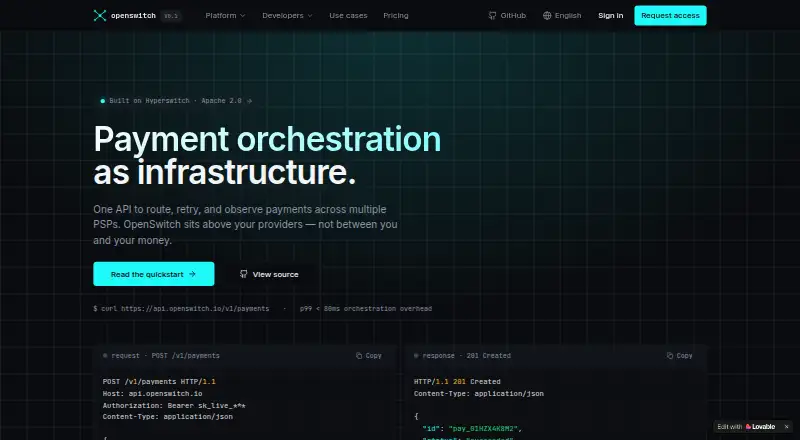
What OpenSwitch is
OpenSwitch gives fintechs, marketplaces, and SaaS teams a shared API for routing and monitoring payments across multiple payment service providers (PSPs). Rules can direct transactions according to cost, success rate, currency, BIN, geography, or custom expressions. Configurable retries and connector fallback chains can reroute soft declines. Its common schema covers payments, refunds, disputes, mandates, and webhooks across enabled connectors. The connector directory lists 18 integrations, including Stripe, Adyen, Checkout.com, Braintree, Paymob, Klarna, PayPal, and Razorpay. OpenSwitch also describes a network-token-aware vault, with tokens portable across PSPs that the customer controls. Teams can view latency, authorization rates, and decline reasons by connector, and export events through webhooks or S3. Developer materials document REST and JSON, an npm SDK, a Docker image, and a self-hosted Rust binary. OpenSwitch says it does not custody funds; settlement goes directly between PSPs and customers’ bank accounts. Open Source is self-hosted at no cost, with unlimited transactions, open-source connectors, and community support. Cloud is priced on request, billed per orchestrated request, with volume tiers from 1M req/mo. Enterprise offers single-tenant or VPC deployment, custom connectors and SLAs, and dedicated support under an annual contract.
Who it suits
OpenSwitch suits fintechs, marketplaces, and SaaS teams that work across multiple PSPs. It may fit teams seeking shared payment operations, configurable routing, retries, and connector-level monitoring.
What it does well
- Routing rules can use cost, success rate, currency, BIN, geography, or custom expressions.
- Fallback chains and configurable retries can reroute soft declines.
- Common API schema covers payments, refunds, disputes, mandates, and webhooks.
- Lists 18 integrations, including Stripe, Adyen, PayPal, and Razorpay.
- Offers self-hosted Open Source with unlimited transactions.
- Events can be exported through webhooks or S3.
What to know first
- Open Source is self-hosted and comes with community support.
- Cloud is billed per orchestrated request, with volume tiers from 1M req/mo.
- Enterprise pricing is by annual contract, with no price stated.
Limits
Open Source is self-hosted and includes community support. Cloud is billed per orchestrated request, with volume tiers from 1M req/mo; the listed Cloud details do not state a transaction quota.
Plans
| Plan | Billed and limits | Price |
|---|---|---|
| Cloud | per orchestrated request; volume tiers from 1M req/mo · Hosted · 99.99% SLA · Managed connector upgrades · Email + Slack support | Free |
| Open Source | Self-hosted · Unlimited transactions · All open-source connectors · Community support | Free |
| Enterprise | Annual contract · Single-tenant or VPC deployment · Custom connectors & SLAs · 24/7 on-call + dedicated SE | On request |
As openswitch.tech lists them, read 2 Oct 2026. The maker's own page has the final word.
Getting started
- Visit the OpenSwitch website.
- Choose the self-hosted Open Source plan or the hosted Cloud plan.
- For self-hosted use, use the documented Docker image or Rust binary.
- Use the REST and JSON documentation or npm SDK to work with the API.
- Configure enabled connectors and routing rules for your PSPs.
OpenSwitch is a payment-orchestration API for teams that operate with more than one payment service provider (PSP). It suits fintechs, marketplaces and SaaS businesses that need shared payment operations rather than another processor. Its strongest case is flexible routing and recovery across PSPs, while teams wanting fund custody or a conventional checkout processor should look elsewhere.
Overview
OpenSwitch puts payments, refunds, disputes, mandates and webhooks behind one common API schema across enabled connectors. That reduces the need to maintain separate PSP integrations and gives operations teams one place to apply routing and inspect outcomes. It remains an orchestration layer: the PSPs process transactions, and settlement goes directly between those PSPs and customers’ bank accounts. Businesses seeking a service that receives or holds funds will need a different product.
Key features
Routing, retries and failover
Rules can choose a connector by cost, authorization success rate, currency, card BIN, geography or a custom expression. Configurable retry policies and fallback chains can reroute soft declines. This is useful when a business has meaningful volume across providers and wants to tune approval rates or cost; it is more infrastructure than a small merchant with one PSP needs.
Unified API and vault
The shared schema covers core payment operations, so applications can keep one integration while connector choices change underneath. OpenSwitch also describes a network-token-aware vault whose tokens can be moved between PSPs that the customer controls. That portability can reduce dependence on one provider, but it does not remove the need to manage those PSP relationships and credentials.
Observability and connectors
Per-connector latency, authorization rates and decline reasons help teams identify where payment performance is being lost. Events can be exported through webhooks or S3 for downstream analysis. The connector directory lists 18 integrations, including Stripe, Adyen, Checkout.com, Braintree, Paymob, Klarna, PayPal and Razorpay. OpenSwitch says its connector framework is inherited from Hyperswitch, with new connectors added through a connector trait, which favors engineering teams able to extend the system themselves.
Developer and security controls
Documentation covers REST and JSON, an npm SDK, a Docker image and a self-hosted Rust binary. Requests use bearer keys with restricted scopes, while webhooks are HMAC-signed and protected against replay. Enterprise adds mTLS and a SOC 2 / PCI evidence pack. These controls are a sensible baseline for payment infrastructure, but the higher-assurance options sit behind the Enterprise tier.
Pricing
| Plan | Price and terms | What you get |
|---|---|---|
| Open Source | free | Self-hosted, unlimited transactions, all open-source connectors and community support |
| Cloud | price on request, billed per orchestrated request; volume tiers from 1M req/mo | Hosted service, 99.99% SLA, managed connector upgrades, email and Slack support |
| Enterprise | Custom pricing, billed annual contract | Single-tenant or VPC deployment, custom connectors and SLAs, 24/7 on-call and a dedicated solutions engineer |
Open Source is the practical choice for teams with the capacity to run infrastructure and accept community support; unlimited transactions remove a usage ceiling, but hosting and operational work remain yours. Cloud shifts that work to OpenSwitch and adds a stated SLA and managed upgrades, making it better for teams that prefer a hosted control plane. Its charge is tied to orchestrated requests and starts at volume tiers from 1M requests per month, so high-throughput buyers should model request volume carefully. Enterprise is for organizations requiring isolated deployment, bespoke connectors, contractual SLAs and dedicated response; its annual contract and custom pricing make it unsuitable for a small or exploratory implementation.
Platforms
OpenSwitch is offered through an API and as self-hosted software. The developer materials provide Docker and a Rust binary, while the npm SDK supports JavaScript-based clients. There is no listed native mobile or browser application.
Who it's for
Fintechs, marketplaces and SaaS teams coordinating several PSPs are the natural audience. Routing by geography or currency can support varied payment footprints, and marketplace payouts, recurring payments and tokenization are supported capabilities. A company using one PSP with straightforward payment flows will gain less from the orchestration layer and may prefer a direct PSP integration.
Pros and cons
Pros
- Rules based on cost, performance, payment data and geography give multi-PSP teams precise control over traffic.
- Retries and fallback chains provide a defined response to soft declines instead of forcing every application to build its own recovery logic.
- One API spans payments, refunds, disputes, mandates and webhooks, with portable vault tokens across customer-controlled PSPs.
- Self-hosted Open Source supports unlimited transactions and the connector framework can be extended.
Cons
- It does not custody or settle funds, so it cannot replace a processor or acquiring relationship.
- Self-hosting requires the team to operate the system, while community support is the only support tier on Open Source.
- Enterprise-only isolation, custom connectors, contractual SLAs and 24/7 support raise the bar for regulated or mission-critical deployments.
- Cloud billing is based on orchestrated requests, which may complicate forecasting for very high-volume traffic.
Alternatives
Choose Payment Orchestration Platforms to compare the wider category. Juspay Hyperswitch is worth considering if you want 90+ integrations and self-managed hosting with a free community edition across API, web and mobile platforms. PayOrc fits a smaller operation that can start with one PSP and a free tier capped at USD 5k monthly TPV, then move to its USD 25.00-per-month Growth plan for up to USD 100k and five PSPs. BridgerPay suits teams wanting a web-based option with a free-forever plan limited to 200 transactions per month, one user, one checkout and two connections. Orchestra is a better fit when the immediate need is sandbox testing, with unlimited test transactions and 130+ provider sandboxes. PayServ Multi-PSP Platform offers a free test environment with one PSP sandbox connection and 500 test transactions per month. BR-DGE, CellPoint Digital and MoneyHash are paid alternatives for teams evaluating other multi-platform payment products.
Verdict
Choose OpenSwitch when your engineering team needs one programmable layer over several PSPs, with rule-based routing, retry recovery and connector-level visibility. Its free self-hosted plan and broad API make it especially compelling for technically capable fintech, marketplace and SaaS operators. Look elsewhere if you need the platform to hold or settle money, a turnkey single-PSP checkout, or enterprise isolation and dedicated support without an annual custom contract.
Verdict
Choose OpenSwitch if your team needs to coordinate payments across multiple PSPs using routing rules, retries, and shared payment APIs. Its self-hosted Open Source plan includes unlimited transactions, while Cloud is priced per orchestrated request. Teams needing single-tenant or VPC deployment, custom connectors, or dedicated on-call support can consider Enterprise, whose price is by annual contract.
Questions
Is OpenSwitch free?
Yes. Open Source is free, and Cloud is priced on request, billed per orchestrated request.
What platforms does it support?
Its listed platforms are API and self-hosted.
Can I host it myself?
Yes. Open Source is self-hosted, and developer materials document a Docker image and a self-hosted Rust binary.
Which payment providers does it connect to?
The connector directory lists 18 integrations, including Stripe, Adyen, Checkout.com, Braintree, Paymob, Klarna, PayPal, and Razorpay.
Does OpenSwitch hold or settle funds?
OpenSwitch says it does not custody funds. Settlement occurs directly between PSPs and customers’ bank accounts.
What support comes with each plan?
Open Source lists community support; Cloud lists email and Slack support. Enterprise lists 24/7 on-call support and a dedicated solutions engineer.
Facts from OpenSwitch's own pages
- Connector framework
- OpenSwitch says it inherits Hyperswitch’s connector framework and allows new connectors to be added through its connector trait. · openswitch.tech, 2 Oct 2026
- Developer support
- The developer page documents REST and JSON, an npm SDK, a Docker image, and a self-hosted Rust binary. · openswitch.tech, 2 Oct 2026
- Enterprise security
- The pricing page lists mTLS and a SOC 2 / PCI evidence pack among Enterprise offerings. · openswitch.io, 2 Oct 2026
- Funds flow
- The homepage says OpenSwitch does not custody funds and that settlement occurs directly between PSPs and customers’ bank accounts. · openswitch.tech, 2 Oct 2026
- Integrations
- The connector directory lists 18 integrations, including Stripe, Adyen, Checkout.com, Braintree, Paymob, Klarna, PayPal, and Razorpay. · openswitch.tech, 2 Oct 2026
- Observability
- It provides per-connector latency, authorization rates, and decline reasons, with event export through webhooks or S3. · openswitch.tech, 2 Oct 2026
- Retry and failover
- Configurable retry policies and connector fallback chains can reroute soft declines. · openswitch.tech, 2 Oct 2026
- Routing
- Its routing rules can route payments by cost, success rate, currency, BIN, geography, or custom expressions. · openswitch.tech, 2 Oct 2026
- Security
- The developer page says requests use bearer keys with restricted scopes and that webhooks are HMAC-signed with replay protection. · openswitch.tech, 2 Oct 2026
- Support
- The pricing page lists community support for Open Source, email and Slack support for Cloud, and 24/7 on-call plus a dedicated solutions engineer for Enterprise. · openswitch.io, 2 Oct 2026
- Unified API
- The API provides a common schema for payments, refunds, disputes, mandates, and webhooks across enabled connectors. · openswitch.tech, 2 Oct 2026
- Vault
- The product describes a network-token-aware vault with tokens portable across PSPs the customer controls. · openswitch.tech, 2 Oct 2026
- What it does
- OpenSwitch provides one API to route, retry, and observe payments across multiple payment service providers (PSPs). · openswitch.tech, 2 Oct 2026
- Who it is for
- The use-cases page describes the product for fintechs, marketplaces, and SaaS teams that need to work across multiple PSPs. · openswitch.io, 2 Oct 2026
Where OpenSwitch stands on Freedom251
- Payment Orchestration Platforms#6 of 26