Freedom251 › Legal Payments Software

Payload
What Payload is
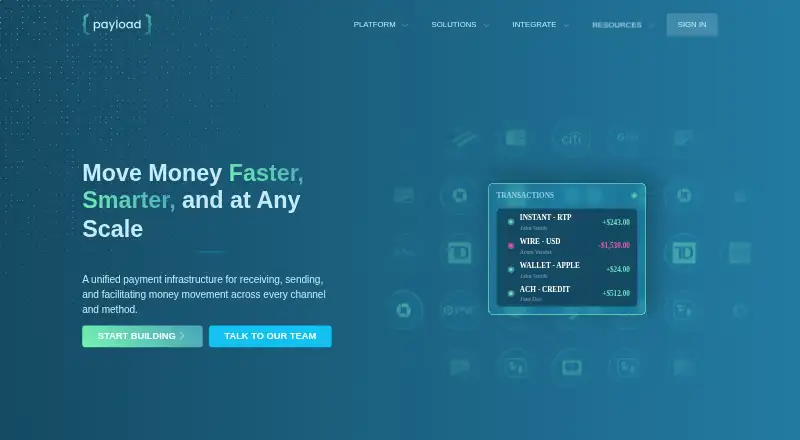
Payload provides payment infrastructure for businesses that receive, send, or facilitate money across payment channels. Incoming payment methods include cards, pay by bank, checks, synthetic accounts, Apple Pay, and Google Pay. For payouts, Payload supports direct deposit, synthetic accounts, virtual cards, instant payments, wires, and push to debit. Its payment services also cover customer management, billing and invoicing, and payouts.
Billing tools include branded invoices, recurring billing, subscriptions, autopay, automatic retries, and invoice payment through embedded forms, email, or a customer portal. Businesses can also use checkout, secure-input forms, payment links, and an API-controlled mobile card reader. Payload offers smart enrollment with KYC and identity verification, configurable billing and fee splits, dynamic funding, and embedded banking with synthetic accounts and virtual cards.
Developers can work with REST APIs, native SDKs for Node.js, Python, Go, Ruby, Java, and .NET, plus modular embedded UI components. A built-in Plaid integration supports secure bank-detail collection and payment method creation. Payload describes encryption, risk monitoring, transaction flagging, alerts for suspicious activity, and a tokenization vault that keeps sensitive financial data out of merchants’ servers. It was founded in 2019 and is headquartered in Ohio, United States. Pricing is based on transaction volume and business profile, with rates available by contacting Payload.
Who it suits
Payload may suit platforms, enterprises, and small and medium businesses that need to collect payments, send payouts, or manage billing through APIs and payment interfaces. Its stated use cases include real estate, legal payments, and professional services.
What it does well
- Accepts cards, pay by bank, checks, Apple Pay, and Google Pay.
- Supports multiple payout methods, including instant payments and wire.
- Includes recurring billing, subscriptions, autopay, and retries.
- Provides SDKs for seven programming languages.
- Lists PCI, KYC, and OFAC compliance tools.
What to know first
- Pricing details require contacting Payload.
- Rates vary by industry, volume, and payment type.
Plans
| Plan | Billed and limits | Price |
|---|---|---|
| Custom pricing | Rates tailored to transaction volume and business profile · Interchange-plus pricing · no monthly minimums, setup fees, or long-term contracts | On request |
As payload.com lists them, read 9 Oct 2026. The maker's own page has the final word.
Getting started
- Visit the Payload website.
- Contact Payload for pricing based on transaction volume and business profile.
- Review the REST API, SDKs, or embedded UI components.
- Choose payment interfaces and methods for your workflow.
- Use the support center or API documentation.
Verdict
Choose Payload if your business needs payment collection, payouts, and billing tools connected through APIs or embedded payment interfaces. Its range of payment methods and developer tools can support varied payment workflows. Buyers who need to compare a fixed published rate will need to contact Payload for a tailored quote.
Questions
How much does Payload cost?
Payload describes volume-based, interchange-plus pricing with zero platform fees and no monthly minimums, setup fees, or long-term contracts. Rates vary by industry, volume, and payment type; contact Payload for details.
What payment methods can it accept?
Incoming methods include cards, pay by bank, checks, synthetic accounts, Apple Pay, and Google Pay.
What payout methods does Payload support?
Payout options include direct deposit, synthetic accounts, virtual cards, instant payments, wires, and push to debit.
Which developer tools are available?
Payload offers REST APIs, modular embedded UI components, and native SDKs for Node.js, Python, Go, Ruby, Java, and .NET.
What security features does Payload list?
It lists encryption, risk monitoring, transaction flagging, suspicious-activity alerts, and a tokenization vault. Its enterprise page names SOC 2 Type II, PCI DSS Level 1, and end-to-end encryption.
Which businesses does Payload serve?
Payload describes solutions for platforms, enterprises, and small and medium businesses, with use cases including real estate, legal payments, and professional services.
Facts from Payload's own pages
- Billing
- Features include branded invoices, recurring billing, subscriptions, autopay, automatic retries, and invoice payment through embedded forms, email, or a customer portal. · payload.com, 8 Oct 2026
- Company
- Payload says it was founded in 2019 by Ian Halpern and Ryan Rybolt. · payload.com, 8 Oct 2026
- Developer tools
- Payload lists native SDKs for Node.js, Python, Go, Ruby, Java, and .NET, alongside RESTful APIs. · payload.com, 9 Oct 2026
- Enterprise integrations
- The enterprise page says Payload connects with Salesforce, NetSuite, and SAP via API. · payload.com, 8 Oct 2026
- Enterprise security
- Payload's enterprise page lists SOC 2 Type II, PCI DSS Level 1, and end-to-end encryption as built-in security features. · payload.com, 8 Oct 2026
- Founded
- Payload says it was founded in 2019 by Ian Halpern and Ryan Rybolt. · payload.com, 9 Oct 2026
- Headquarters
- Payload describes itself as a Cincinnati-based embedded payments platform. · payload.com, 9 Oct 2026
- Integrations
- Payload’s Plaid integration lets account holders select bank accounts through Plaid’s embedded authorization flow for use with Payload. · docs.payload.com, 9 Oct 2026
- Payment interfaces
- Payload offers checkout, secure-input forms, payment links, and an API-controlled mobile card reader. · docs.payload.com, 9 Oct 2026
- Payments
- The platform supports incoming payments by card, pay by bank, check, synthetic account, Apple Pay, and Google Pay. · payload.com, 8 Oct 2026
- Payment services
- Its APIs cover integrated payments, customer management, billing and invoicing, and payouts. · docs.payload.com, 9 Oct 2026
- Payouts
- Payload supports outbound payouts including direct deposit, synthetic account, virtual card, instant payment, wire, and push to debit. · payload.com, 8 Oct 2026
- Platform features
- Payload offers smart enrollment with KYC and identity verification, configurable billing and fee splits, dynamic funding, and embedded banking with synthetic accounts and virtual cards. · payload.com, 8 Oct 2026
- Pricing
- Payload describes volume-based pricing tailored to transaction volume and business profile, interchange-plus pricing, and zero platform fees with no monthly minimums, setup fees, or long-term contracts. · payload.com, 9 Oct 2026
- Pricing details
- The documentation says rates can vary based on industry, volume, and payment type, and directs customers to contact Payload for more information. · docs.payload.com, 8 Oct 2026
- Product
- Payload provides unified payment infrastructure for receiving, sending, and facilitating money movement across payment channels and methods. · payload.com, 8 Oct 2026
- Security
- Payload says it is PCI Level 1 and SOC 2 Type 2 certified and uses end-to-end encryption, penetration and vulnerability testing, and machine-learning risk monitoring. · support.payload.com, 9 Oct 2026
- Sensitive data handling
- Payload says its tokenization vault stores sensitive financial data and its client-side tools route that data directly to Payload to keep it out of merchants’ servers. · docs.payload.com, 9 Oct 2026
- Support
- Payload lists support hours as 9 a.m. to 5 p.m. Eastern Time and offers support by email and phone. · support.payload.com, 9 Oct 2026
- What it does
- Payload provides payment infrastructure for receiving, sending, and facilitating money movement across payment methods and channels. · payload.com, 9 Oct 2026
- Who it serves
- Payload describes its platform as built for software platforms, businesses, and marketplaces that need payment and funds-flow services. · docs.payload.com, 9 Oct 2026
Where Payload stands on Freedom251
- Legal Payments Software#39 of 43