Freedom251 › Secure Notes Apps
Paste
What Paste is
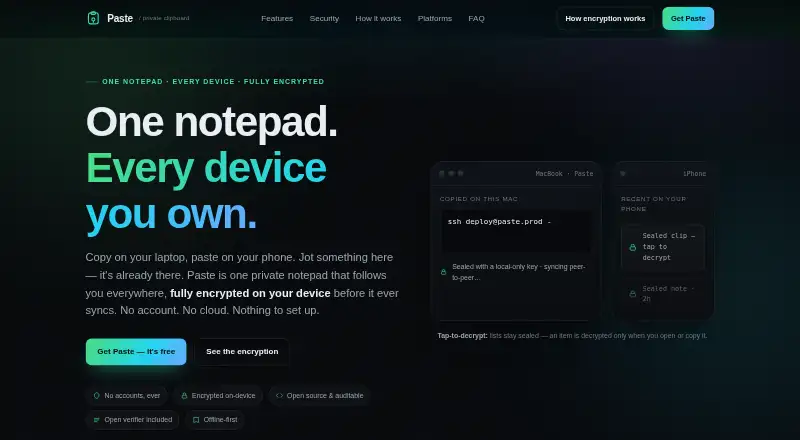
Paste is a private notepad and clipboard that syncs text, links, and code snippets across macOS, Linux, and Windows devices. Notes can be plain text, Markdown, or code, and frequently used notes can be pinned. The app works offline and reconciles changes when devices reconnect. Its local search is described as finding entries in under 30 ms across 10,000 items. Devices pair using a QR scan, short code, or recovery phrase, and each receives a revocable signing key. Paste says it encrypts content on the device with XChaCha20-Poly1305 before storage or syncing, using keys derived from the recovery phrase. Optional relays store encrypted blocks and can observe network metadata, but cannot read note contents or keys. The encryption envelope, sync engine, relay client, and verifier are open source; Paste also includes a verifier and standalone command-line tool. Desktop versions run through the Pear runtime, which is required by the installers. On Windows, the first launch fetches the app over peer-to-peer and may take about one minute. Paste is free, open source, and requires no account. iOS and Android are in development, and Paste does not provide anonymity or provable physical deletion of ciphertext held on third-party disks.
Who it suits
Paste suits people who want an offline-capable notepad and clipboard for text, links, and code across desktop devices. It may appeal to users who want open-source encryption components and do not require anonymity or guaranteed physical deletion.
What it does well
- Free, open source, and requires no account.
- Notes can be plain text, Markdown, or code.
- Offline changes converge when devices reconnect.
- Devices pair through a QR scan, short code, or recovery phrase.
- Desktop support covers macOS, Linux, and Windows.
What to know first
- Installers require the Pear runtime.
- Windows first launch may take about one minute.
- iOS and Android are still in development.
- It does not provide anonymity or provable physical deletion.
Plans
| Plan | Billed and limits | Price |
|---|---|---|
| Paste | Free · no account · open source and auditable | Free |
As paste.global lists them, read 8 Oct 2026. The maker's own page has the final word.
Getting started
- Visit https://www.paste.global/.
- Install the Pear runtime.
- Install Paste on macOS, Linux, or Windows.
- Pair devices using a QR scan, short code, or recovery phrase.
- On Windows, allow about one minute for the first launch to fetch the app over peer-to-peer.
Verdict
Paste combines offline notes and clipboard syncing with on-device encryption and open-source components. Its desktop setup depends on Pear, while mobile versions are still in development.
Questions
How much does Paste cost?
The Paste plan is free.
Does Paste require an account?
No. The free plan is described as requiring no account.
Which platforms does Paste support?
Desktop versions are available for macOS, Linux, and Windows. iOS and Android are in development.
Is Paste open source?
Yes. Its encryption envelope, sync engine, relay client, and verifier are open source. Paste also includes a verifier and standalone CLI.
Can Paste work offline?
Yes. Notes work offline, and changes converge automatically when devices reconnect.
What are Paste's privacy limits?
Paste says it does not provide anonymity or provable physical deletion of ciphertext retained on third-party disks.
Facts from Paste's own pages
- Desktop availability
- Desktop runs through the Pear runtime on macOS, Linux, and Windows; the site lists iOS and Android as in development. · paste.global, 8 Oct 2026
- Device pairing
- Devices can be paired by QR scan, short code, or recovery phrase, and each device gets a revocable signing key. · paste.global, 8 Oct 2026
- Encryption
- Paste says it encrypts content on the device with XChaCha20-Poly1305 before storage or syncing, using keys derived from the recovery phrase. · paste.global, 8 Oct 2026
- Install requirements
- The desktop installers require the Pear runtime; the Windows first launch fetches the app over peer-to-peer and may take about one minute. · paste.global, 8 Oct 2026
- Integrations and stack
- The site identifies the Pear peer-to-peer stack and Pear runtime as Paste's underlying platform. · paste.global, 8 Oct 2026
- Notes
- Notes can be plain text, Markdown, or code, and users can pin frequently used notes. · paste.global, 8 Oct 2026
- Offline use
- Notes work offline, and changes converge automatically when devices reconnect. · paste.global, 8 Oct 2026
- Privacy limits
- Paste says it does not provide anonymity or provable physical deletion of ciphertext retained on third-party disks. · paste.global, 8 Oct 2026
- Relays
- Optional relays store encrypted blocks and can see network metadata, but the site says they cannot read note plaintext or keys. · paste.global, 8 Oct 2026
- Search
- The site says local search can find items in under 30 ms across 10,000 entries. · paste.global, 8 Oct 2026
- Verification and code
- The encryption envelope, sync engine, relay client, and verifier are open source, and Paste includes a verifier and standalone CLI. · paste.global, 8 Oct 2026
- What it does
- Paste is a private notepad and clipboard that syncs text, links, and code snippets across your devices. · paste.global, 8 Oct 2026
Where Paste stands on Freedom251
- Secure Notes Apps#16 of 30