Freedom251 › AI 3D Model Generators
PartCrafter
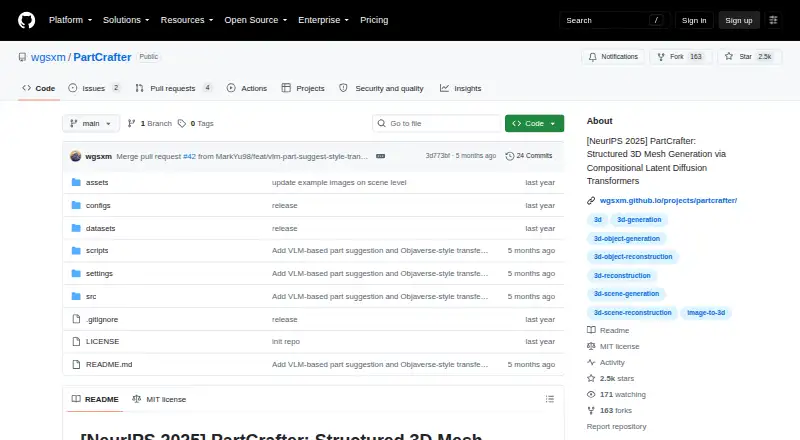
What PartCrafter is
PartCrafter is an open-source model that turns one RGB image into multiple 3D parts or objects, including objects in complex scenes. It produces distinct meshes with meaningful part structure without requiring the image to be segmented beforehand. Its local inference scripts can remove backgrounds and optionally apply style transfer to make real-world photos closer to the rendered-image domain used for training. An optional vision-language feature suggests how many parts to generate; Gemini is the default, and the provider architecture can be extended. Pretrained object- and scene-level weights are hosted on Hugging Face. Installation is from the GitHub repository in a Python environment, and inference requires a CUDA-enabled GPU with at least 8 GB of VRAM. The linked Hugging Face demo is paused, though its page says users can ask the authors to restart it. PartCrafter is free under the MIT license and is provided as-is, without warranty.
Who it suits
It suits people seeking local image-to-3D generation with part-level outputs, provided they have a CUDA-enabled GPU with at least 8 GB of VRAM. Its documented platforms include Linux, Windows, and self-hosted use.
What it does well
- Creates part-level meshes from one RGB image.
- Supports individual objects and complex scenes.
- Optional background removal and style transfer.
- Pretrained object and scene weights are available.
- Free, MIT-licensed software.
What to know first
- Inference requires a CUDA GPU with at least 8 GB VRAM.
- The linked Hugging Face demo is paused.
- The software is provided without warranty.
Limits
The free MIT-licensed software requires local inference on a CUDA-enabled GPU with at least 8 GB of VRAM. The linked hosted demo is paused.
Plans
| Plan | Billed and limits | Price |
|---|---|---|
| PartCrafter (MIT-licensed open-source software) | MIT license · local installation requires a CUDA-enabled GPU with at least 8GB VRAM | Free |
As github.com lists them, read 9 Oct 2026. The maker's own page has the final word.
Getting started
- Open the PartCrafter GitHub repository.
- Set up a Python environment and install the project from its repository.
- Use the pretrained object-level or scene-level weights hosted on Hugging Face.
- Run an inference script locally on a CUDA-enabled GPU with at least 8 GB of VRAM.
- Optionally enable background removal, style transfer, or Gemini-powered part suggestions.
Verdict
PartCrafter offers image-to-3D generation with distinct parts and scene support, alongside local inference scripts and pretrained weights. It requires suitable CUDA hardware, and its linked demo is currently paused.
Questions
How much does PartCrafter cost?
PartCrafter is free under the MIT license.
What does PartCrafter generate?
It generates part-level 3D objects or scenes from a single RGB image. Text-to-3D is not supported.
What hardware does inference require?
Inference requires a CUDA-enabled GPU with at least 8 GB of VRAM.
Can I use PartCrafter on Windows?
The project points Windows users to community-contributed setup guidance.
Is PartCrafter open source?
The repository lists an MIT license and provides the software as-is, without warranty.
Is the hosted demo available?
The linked Hugging Face demo is paused; its page says users can ask the authors to restart it.
Facts from PartCrafter's own pages
- Architecture
- Its method uses disentangled latent tokens for parts and a hierarchical attention mechanism for information flow within and across parts. · wgsxm.github.io, 9 Oct 2026
- Compositional architecture
- The model represents each 3D part with disentangled latent tokens and uses hierarchical attention across parts. · wgsxm.github.io, 9 Oct 2026
- Demo availability
- The linked Hugging Face demo is paused, and its page says users can ask its authors to restart it. · huggingface.co, 9 Oct 2026
- Deployment
- The official instructions install the project from its GitHub repository in a Python environment and run inference scripts locally. · github.com, 9 Oct 2026
- Hardware requirement
- The README specifies a CUDA-enabled GPU with at least 8 GB of VRAM for inference. · github.com, 9 Oct 2026
- Image preprocessing
- The inference scripts support background removal and optional style transfer to adapt real-world photos to the rendered-image domain used for training. · github.com, 9 Oct 2026
- Image styling
- An optional Gemini-powered style-transfer step converts real-world photos toward an Objaverse-style rendering before generation. · github.com, 9 Oct 2026
- Integrations
- The README documents Gemini for part suggestions and style transfer, and says the provider architecture can be extended with other providers. · github.com, 9 Oct 2026
- License
- The repository lists an MIT license. · github.com, 9 Oct 2026
- License and warranty
- The repository uses the MIT License and provides the software “AS IS,” without warranty. · github.com, 9 Oct 2026
- Model weights
- Pretrained object-level and scene-level model weights are hosted on Hugging Face. · huggingface.co, 9 Oct 2026
- Object generation
- The repository provides an inference script for generating part-level 3D objects from images. · github.com, 9 Oct 2026
- Part-aware output
- It generates semantically meaningful, geometrically distinct 3D meshes without requiring pre-segmented input images. · wgsxm.github.io, 9 Oct 2026
- Part suggestions
- An optional VLM feature can suggest the number of parts, using Gemini by default. · github.com, 9 Oct 2026
- Purpose
- PartCrafter generates multiple structured 3D parts and objects from a single RGB image in one pass. · wgsxm.github.io, 9 Oct 2026
- Scene generation
- The model supports image-to-3D generation for complex scenes as well as individual objects. · wgsxm.github.io, 9 Oct 2026
- Security and compliance
- The official pages opened provide no security certification or compliance claim. · github.com, 9 Oct 2026
- Support
- The repository invites users to contact the maintainer by email or open an issue with questions or suggestions. · github.com, 9 Oct 2026
- Tested environment
- The maintainers say they tested installation on Debian 12 with NVIDIA H20 GPUs and provide community-contributed Windows setup guidance. · github.com, 9 Oct 2026
- Tested setup
- The project says its installation was tested on Debian 12 with NVIDIA H20 GPUs and points Windows users to a community guide and fork. · github.com, 9 Oct 2026
- Training resources
- The project describes training scripts suited to 8 NVIDIA H20 GPUs with 96GB VRAM each. · github.com, 9 Oct 2026
- Training scale
- The training scripts are described as suitable for eight NVIDIA H20 GPUs with 96 GB of VRAM each. · github.com, 9 Oct 2026
Where PartCrafter stands on Freedom251
- AI 3D Model Generators#10 of 24