Freedom251 › Governance, Risk and Compliance Software
Origami Risk GRC
What Origami Risk GRC is
Origami Risk GRC helps organizations identify, assess, and mitigate enterprise risk while managing governance and compliance. Its coverage includes enterprise risk management, business continuity, third-party risk, policy and procedure management, internal controls, internal audit, and compliance management. Teams can score risks using heat maps, lenses, and multifactor models aligned to their risk appetite, manage control effectiveness, connect controls to frameworks and mitigation plans, and track issues with assigned action plans. Interactive Bowtie models depict links between risks, consequences, and controls. The native AI Risk and Control Explorer analyzes GRC data to identify risk relationships, assess controls, and surface emerging risks. AI-enabled workflows can route assessments, send escalation alerts, and remind teams about control testing. The cloud-native, low-code platform has drag-and-drop workflow builders and API-driven connections to existing tools. A mobile app supports data capture on the go. The vendor describes implementation help with configuration, historical data migration, and phased deployment. Pricing is available on request.
Who it suits
Origami Risk GRC suits organizations coordinating risk across departments, including teams managing enterprise risk, continuity, and vendor risk programs. Its modules cover governance and compliance activities such as internal audit, policy management, and controls.
What it does well
- Includes enterprise, continuity, and third-party risk management.
- Risk scoring supports heat maps and multifactor models.
- AI tools analyze risk and control data.
- API access supports data connections.
- Mobile app supports on-the-go data capture.
What to know first
- Pricing is available on request.
- Requires organizational risk and compliance workflows to benefit from its GRC coverage.
Plans
| Plan | Billed and limits | Price |
|---|---|---|
| Origami Risk GRC | Pricing not shown; request a demo | On request |
As origamirisk.com lists them, read 4 Oct 2026. The maker's own page has the final word.
Getting started
- Visit the Origami Risk website.
- Request a demo to discuss the paid GRC plan.
- Use the implementation team for configuration, historical data migration, and phased rollout.
- Connect existing tools through API-driven integration.
- Use the Android, iOS, or web platform, or API access.
Origami Risk GRC is a broad, configurable system for coordinating enterprise risk, controls, compliance, continuity, audit, and vendor-risk work. It suits organizations that need several departments and programs to share one operating model; teams wanting a small, free, single-purpose tool should look elsewhere. The main decision is whether its breadth and implementation support justify a custom-priced deployment.
Overview
The platform combines enterprise risk management, business continuity, third-party risk, policy and procedure management, internal controls, internal audit, and compliance management. Risk teams can identify, assess, manage, and monitor exposure against strategic objectives, while a centralized data model is intended to give departments one cross-functional view. That scope is valuable when programs are interdependent, but excessive for an organization handling only one narrow compliance process.
Origami Risk describes a cloud-native, low-code platform with drag-and-drop workflow builders. API-driven connections can exchange data with existing systems, and a developer hub provides API references and guides. An implementation team can configure the deployment, migrate historical data, and phase in capabilities; that support is useful for a staged rollout, though it also signals that the product is a program implementation rather than an instant utility. A mobile app supports data capture away from a desk.
Key features
Risk, controls, and issues
Structured risk assessment uses heat maps, lenses, and multifactor models aligned with an organization’s risk appetite. Users can manage control effectiveness, link controls to frameworks and mitigation plans, and assign issue action plans with automated workflows. Interactive, shareable Bowtie models map relationships among risks, consequences, and controls, giving teams a clearer way to communicate causal chains than a flat register alone.
The product includes policy management, a risk register, audit management, and evidence collection. Supported frameworks include NIST, COSO, COBIT, ISO 27001, ISO 31000, SOX, Title IX, OSHA, HIPAA, and GDPR, which can reduce the need to build common mappings from scratch.
AI and automation
The native AI Risk and Control Explorer analyzes GRC data to identify relationships, assess controls, recommend actions, verify risk data, surface blind spots, and flag emerging threats through natural-language prompts. AI-enabled workflows can route assessments, send escalation alerts, and remind teams about control testing. These capabilities can reduce repetitive coordination, but their value depends on maintaining reliable, centralized data and appropriate review of recommendations.
Third-party and continuity programs
Dedicated tools cover third-party risk across the vendor network and business continuity alongside enterprise, compliance, audit, controls, and policy programs. Organizations running several of these disciplines can keep related work in one environment instead of stitching together separate registers and workflows.
Pricing
Origami Risk GRC: custom pricing; request a demo. No public seat, usage, trial, renewal, or free-plan terms are provided. This model fits organizations prepared to scope a broad implementation with the vendor, but it makes early budget comparison difficult and offers no low-cost path for a small team to validate the product.
Platforms
Origami Risk GRC is offered on web, Android, and iOS, with API access for integrations. The mobile options support on-the-go capture, while the API and developer hub are aimed at organizations that need to connect operational data sources.
Who it's for
It is a strong candidate for organizations managing enterprise risk across departments, including continuity, compliance, internal audit, controls, policies, and third-party programs. It is especially relevant where risk appetite models, framework links, issue workflows, and shared data need to operate together. Smaller teams with a single assessment workflow, limited implementation capacity, or a firm requirement for published pricing should consider a simpler alternative.
Pros and cons
- Pros: Broad GRC coverage joins risk, continuity, vendors, policies, controls, audit, and compliance in one platform.
- Pros: Heat maps, lenses, multifactor scoring, Bowtie models, framework links, and action plans support structured analysis and follow-through.
- Pros: AI analysis and workflow automation can expose relationships, blind spots, emerging risks, routing needs, and testing reminders.
- Pros: Low-code builders, APIs, mobile apps, and implementation assistance support tailored, phased deployments.
- Cons: Custom pricing and no published plan limits make total cost and capacity hard to assess before a sales process.
- Cons: Configuration, historical-data migration, and phased rollout require planning, so it is not the quickest choice for a narrowly defined need.
Alternatives
CISO Assistant is the better starting point for teams wanting a freemium option, including a self-hosted Community plan at no cost with unlimited users, or a 39.00 EUR-per-month Pro SaaS plan.
Eramba suits buyers seeking an open, self-hosted Community edition at no cost, with an Enterprise On-Premise option from €2,500 a year.
SimpleRisk is worth choosing when an unlimited-user self-hosted Core plan at no cost or a 5000.00 USD-per-year Starter Package is preferable.
OpenGRC is an alternative for organizations wanting self-hosting, full source-code access, and a free Community plan.
NAVEX EthicsPoint Incident Management focuses on incident-management programs with pricing tailored to organization size, needs, and selected solutions.
Ncontracts offers risk and compliance solutions with API and web access and demo-based pricing.
Quantivate Business Continuity Software is a focused continuity option with Android, iOS, web, and API access.
Riskonnect is another paid integrated-risk platform whose pricing depends on project size, complexity, and customization.
For a wider comparison, see Governance, Risk and Compliance Software.
Verdict
Choose Origami Risk GRC when a multi-department organization needs one configurable system for risk, controls, compliance, continuity, audit, and third-party oversight, with AI analysis and integration support. Look elsewhere if you need transparent pricing, a free starting tier, or a lightweight deployment for one isolated task.
Verdict
Origami Risk GRC brings risk, control, and compliance workflows together, with AI analysis and API connections. Pricing is available on request.
Questions
How much does Origami Risk GRC cost?
Pricing is available on request; the GRC plan does not show a listed price.
Which platforms does it support?
Android, iOS, web, and API are listed. The vendor also offers a mobile app for capturing data on the go.
What does Origami Risk GRC cover?
Its GRC offerings include enterprise risk management, business continuity, third-party risk, policy and procedure management, internal audit, internal controls, and compliance management.
Which frameworks are supported?
Listed frameworks include NIST, COSO, COBIT, ISO 27001, ISO 31000, SOX, Title IX, OSHA, HIPAA, and GDPR.
Does it provide API access?
Yes. Origami Risk describes API access and API-driven integration for connecting and exchanging data with existing tools.
Who makes Origami Risk GRC?
Origami Risk is the vendor. Its headquarters are in Chicago, Illinois, United States.
Facts from Origami Risk GRC's own pages
- AI
- The AI Risk and Control Explorer provides recommendations and helps surface blind spots, verify risk data, and identify emerging threats using natural-language prompts. · origamirisk.com, 4 Oct 2026
- AI analysis
- The native AI Risk and Control Explorer analyzes GRC data to help teams identify risk relationships, assess controls, and surface emerging risks. · origamirisk.com, 4 Oct 2026
- API
- Origami provides API access for connecting data sources and a developer hub with API references and guides. · developers.origamirisk.com, 4 Oct 2026
- Automation
- AI-enabled workflows can automate routine risk and compliance activities, including assessment routing, escalation alerts, and control testing reminders. · origamirisk.com, 4 Oct 2026
- Bowtie modeling
- Interactive, shareable Bowtie models show connections between risks, consequences, and controls. · origamirisk.com, 4 Oct 2026
- Centralized data
- The GRC page describes unifying organizational data into a single source of truth for cross-departmental risk visibility. · origamirisk.com, 4 Oct 2026
- Controls and issues
- Users can manage control effectiveness, link controls to frameworks and mitigation plans, and track issues through assigned action plans and automated workflows. · origamirisk.com, 4 Oct 2026
- GRC coverage
- The GRC solution includes enterprise risk management, business continuity, third-party risk, policy and procedure management, internal controls, and compliance management. · origamirisk.com, 4 Oct 2026
- GRC modules
- Its GRC offerings include business continuity, compliance, enterprise risk management, internal audit, internal controls, policy and procedure management, and third-party risk management. · origamirisk.com, 4 Oct 2026
- Headquarters
- Chicago, Illinois, United States · origamirisk.com, 28 Sept 2026
- Integrations
- Origami Risk describes API-driven integration for connecting and exchanging data with existing tools. · origamirisk.com, 4 Oct 2026
- Intended users
- The ERM page describes support for enterprise risk programs, including risk leaders coordinating risk planning, response, and reporting. · origamirisk.com, 4 Oct 2026
- Mobile
- Origami Mobile supports audits, inspections, findings, incident reports, and photo and video uploads, including when connectivity is unavailable. · origamirisk.com, 4 Oct 2026
- Platform
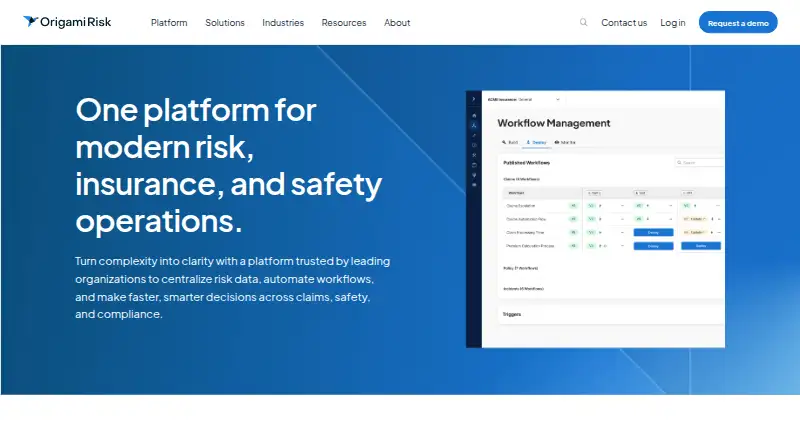
- Origami Risk describes its platform as cloud-native and presents GRC as part of a connected platform for risk, insurance, and safety operations. · origamirisk.com, 4 Oct 2026
- Purpose
- Origami Risk GRC helps organizations identify, assess, and mitigate enterprise risk. · origamirisk.com, 4 Oct 2026
- Risk assessment
- The ERM solution supports structured risk scoring with heat maps, lenses, and multifactor models aligned to an organization’s risk appetite. · origamirisk.com, 4 Oct 2026
- Risk workflows
- Its GRC workflows support identifying, assessing, managing, and monitoring risks in line with an organization’s strategic objectives. · origamirisk.com, 4 Oct 2026
- Security
- The vendor links to a Trust Center and describes its platform as built for security; the Trust Center page opened without readable detail. · origamirisk.com, 4 Oct 2026
- Support
- The company says its implementation team helps configure the platform, migrate historical data, and phase in capabilities. · origamirisk.com, 4 Oct 2026
- Third-party risk
- The GRC solution includes tools to identify, assess, and mitigate risks across an organization’s third-party network. · origamirisk.com, 4 Oct 2026