Freedom251 › Revenue Cycle Management Software
Oracle Health Revenue Cycle
What Oracle Health Revenue Cycle is
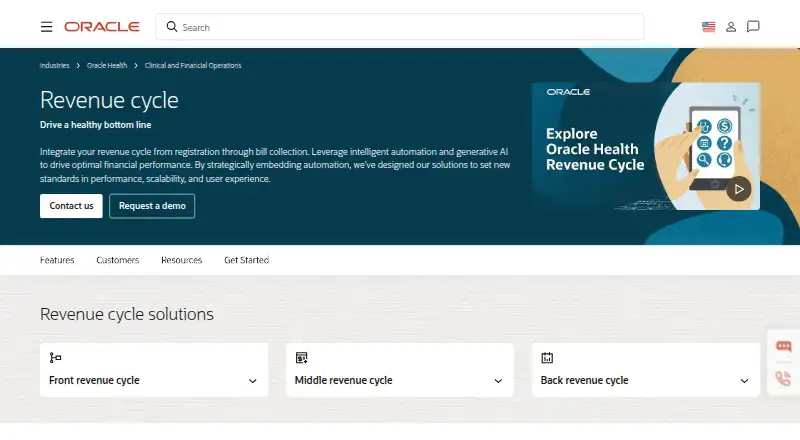
Oracle Health Revenue Cycle brings together healthcare revenue workflows from patient registration through bill collection, using intelligent automation and generative AI. Patient Administration supports self-service scheduling, registration, and check-in on desktop and mobile. Acute Case Management connects clinical and financial information in patient records to help teams manage readmissions, avoidable days, and denials. Oracle Health HIM brings information from multiple systems into an EHR workflow with tools for grouping and editing patient information. Patient Accounting provides cloud-enabled billing workflows, analytics, payer rules, contract management, and automation for acute and ambulatory settings. Oracle Health Payment supports automated payment processing. The cloud-native Revenue Cycle and Consumer Management Platform runs on Oracle Cloud Infrastructure and can be deployed independently of an EHR. Patient Accounting supports workflows across Oracle Health products, third-party technologies, and organizations, and is described as EHR-agnostic. The product is paid, with pricing on request; Oracle offers contact and demo requests rather than self-service purchase. Revenue Cycle API sandbox access requires contacting Oracle Health API Services Support.
Who it suits
It is aimed at healthcare providers managing billing and reimbursement across acute and ambulatory settings. Organizations evaluating it should expect to contact Oracle for pricing and API sandbox access.
What it does well
- Covers workflows from registration through bill collection
- Connects clinical and financial data in case management
- Supports billing across acute and ambulatory settings
- Platform can be deployed independently of an EHR
What to know first
- Pricing is available on request
- Purchase is through Oracle Health, not self-service
- API sandbox access must be requested from support
Plans
| Plan | Billed and limits | Price |
|---|---|---|
| Oracle Health Revenue Cycle | contract · No published monthly or yearly plans · contracts often multi-year · implementation, training, integrations and support may add costs | On request |
As oracle.com lists them, read 21 Oct 2026. The maker's own page has the final word.
Getting started
- Visit the Oracle Health Revenue Cycle website.
- Contact Oracle for pricing or request a demo.
- For Revenue Cycle API use, register a system account and obtain bearer-token and OAuth credentials.
- Request sandbox access from Oracle Health API support.
Overview
Oracle Health Revenue Cycle is a broad healthcare revenue-cycle suite covering the path from patient access to collected payment. It suits providers operating across acute and ambulatory care that need clinical and financial workflows connected in one cloud service. The main attraction is scope and deployment flexibility; the main drawback is an enterprise buying process with custom pricing and no self-service purchase.
Key features
Patient Administration supports self-service scheduling, registration, and check-in through responsive desktop and mobile interfaces. That can shift routine front-desk work toward patients while keeping the same workflow usable on different screen sizes. Acute Case Management links clinical and financial data in patient records and focuses on readmissions, avoidable days, and denials, making it more relevant to organizations that manage utilization and reimbursement together than to billing-only operations.
Oracle Health HIM brings information from multiple systems into an EHR workflow and supplies tools for content, grouping, and editing. This is useful when patient information is spread across systems, although the value depends on how well an organization governs those records. Patient Accounting combines cloud billing workflows with analytics, embedded payer rules, contract management, and automation for acute and ambulatory settings. Eligibility verification, coding support, denial management, payment posting, and patient payments give it coverage across core revenue-cycle stages rather than limiting it to claims submission.
Patient Accounting is described as EHR-agnostic and can support workflows across Oracle Health products, third-party technologies, and organizations. The Revenue Cycle and Consumer Management Platform is cloud-native SaaS on Oracle Cloud Infrastructure and can be deployed independently of an EHR, which gives providers more architectural choice than an EHR-bound module. Oracle also describes OCI controls for accessing, processing, and storing sensitive health records and personally identifiable information, with threat detection and monitoring. Privacy Analytics tracks end-user access to confidential patient data, supports investigations and alerts, and monitors unusual behavior; those functions matter for organizations with demanding privacy oversight.
Payment processing is automated through Oracle Health Payment, which is described as offering transparent pricing and flexible contracting. That claim applies to the payment component, while the suite overall still uses contact-based pricing. API use requires a registered system account, bearer-token and OAuth credentials, and a sandbox request through Revenue Cycle API Services Support. Developers should therefore expect an account-led onboarding process rather than instant test access.
Pricing
Oracle Health Revenue Cycle: custom pricing. Oracle sells the product directly and asks prospective customers to contact it for pricing and a demo. There is no published seat allowance, trial period, free tier, or renewal term to use for a straightforward cost comparison. This approach can accommodate a complex provider deployment, but it prevents smaller organizations from confirming budget fit without a sales conversation.
Platforms
The suite supports Android, iOS, web, and API access. Its platform layer runs as cloud-native SaaS on Oracle Cloud Infrastructure, while API access is controlled through registered accounts, OAuth, bearer tokens, and requested sandbox credentials.
Who it's for
Oracle positions Patient Accounting for healthcare providers managing billing and reimbursement in acute and ambulatory settings. It is a strong candidate for organizations that want patient administration, case management, information management, billing, payment processing, analytics, payer rules, and contract management coordinated across a broader technology estate. Providers seeking an EHR-independent deployment or EHR-agnostic integrations have a particular reason to consider it.
It is less suitable for a small practice that needs a quick, transparent purchase, a published free or low-cost plan, or immediate API experimentation. The required Oracle account and support-led sandbox access add process before development can begin.
Pros and cons
Pros
- Broad end-to-end coverage: scheduling, registration, check-in, case management, HIM, billing, eligibility, coding, denials, posting, and patient payments sit within one revenue-cycle scope.
- Flexible architecture: the cloud platform can run independently of an EHR, and Patient Accounting supports Oracle, third-party, and EHR-agnostic workflows.
- Operational oversight: analytics, payer rules, contract management, OCI security controls, and Privacy Analytics address both reimbursement work and sensitive-record governance.
Cons
- Opaque cost of entry: pricing is custom and requires contacting Oracle, so buyers cannot compare a published plan or trial before engaging sales.
- Account-led API onboarding: registered credentials and a support request are required for sandbox access, which slows self-directed evaluation.
- Enterprise breadth may be excessive: organizations needing only straightforward billing may pay for a wider operational scope than they use.
Alternatives
For a wider comparison, browse Medical Billing Software and Revenue Cycle Management Software.
- Mirth Connect is a paid integration option with API, self-hosted, desktop, Linux, macOS, Windows, and web support; its research plan is free for qualifying nonprofit studies.
- Office Ally Practice Mate is the clearer pick for a smaller web or Windows practice wanting a free plan with scheduling, billing, superbills, ledgers, and reports, subject to transactional fees.
- Nextech is another paid choice with web, Windows, macOS, and iOS coverage.
- theBillingBridge is a free option with Android, iOS, and API platforms.
- AKASA Platform is a paid API and web alternative.
- CareCloud RCM offers paid, web-based custom solutions with sales-led pricing.
- CareRight Billing and Claiming is a paid web option.
- Experian Health Revenue Cycle Management is a paid web alternative with contact-based pricing.
Verdict
Choose Oracle Health Revenue Cycle if you are a healthcare provider that needs a wide, EHR-independent revenue-cycle platform spanning acute and ambulatory operations, with governance and integration capabilities to match. Look elsewhere if published pricing, a self-service trial, or immediate API access matters more than enterprise breadth. Its strongest reason to buy is the connected scope from patient access through payment; its strongest reason to hesitate is the sales-led, custom-priced commitment required to assess it.
Verdict
Oracle Health Revenue Cycle spans patient administration, case management, information management, billing, and payment workflows. Its modular scope and pricing-by-request model are key points for providers to weigh.
Questions
How much does Oracle Health Revenue Cycle cost?
Pricing is available on request. Oracle offers contact and demo requests rather than self-service purchase.
What does Oracle Health Revenue Cycle include?
Its listed components include Patient Administration, Acute Case Management, Oracle Health HIM, Patient Accounting, and Oracle Health Payment.
Can it work without an EHR?
The Revenue Cycle and Consumer Management Platform can be deployed independently of an EHR. Patient Accounting is described as EHR-agnostic.
What platforms does it support?
The listed platforms are Android, API, iOS, and web.
How do developers get API sandbox access?
API access requires a registered system account with bearer-token and OAuth credentials. Sandbox access is requested from Oracle Health API support.
Who is Oracle Health Patient Accounting for?
Oracle describes it for healthcare providers managing billing and reimbursement across acute and ambulatory settings.
Facts from Oracle Health Revenue Cycle's own pages
- API access
- Revenue Cycle APIs require a registered system account with bearer-token and OAuth credentials, and sandbox access is requested from Oracle Health API support. · docs.oracle.com, 7 Oct 2026
- API access and fees
- Developer-sandbox API access is free, while proprietary APIs in client environments may incur separately agreed fees. · oracle.com, 21 Oct 2026
- API restrictions
- API use requires registration, limits copying and reverse engineering, and may require written Oracle-client approval for deployed apps. · oracle.com, 21 Oct 2026
- API standards
- Oracle Health APIs include both FHIR-standard APIs and proprietary APIs for interoperability with Oracle Health products. · oracle.com, 21 Oct 2026
- App-store complaint
- An Apple reviewer reports the Patient Portal showed only a Find Provider option and then returned an error. · apps.apple.com, 21 Oct 2026
- Audit
- Oracle Health Privacy Analytics tracks end-user access to confidential patient data and supports usage investigation, alerts, and unusual-behavior monitoring. · oracle.com, 7 Oct 2026
- Availability
- Oracle's revenue cycle page offers contact and demo requests rather than self-service purchase or published product pricing. · oracle.com, 7 Oct 2026
- Case management
- Acute Case Management links clinical and financial data to help manage readmissions, avoidable days and denials. · oracle.com, 21 Oct 2026
- Cloud architecture
- The Revenue Cycle and Consumer Management Platform is a cloud-native SaaS foundation built on Oracle Cloud Infrastructure. · docs.oracle.com, 21 Oct 2026
- Company facts
- LinkedIn lists Oracle as founded in 1977, headquartered in Austin, Texas, with more than 10,001 employees. · linkedin.com, 21 Oct 2026
- Company ownership
- Crunchbase lists Oracle Health as a for-profit Austin company founded in 1979 by Cliff Illig, Neal Patterson and Paul Gorup. · crunchbase.com, 21 Oct 2026
- Contract management
- Contract Management calculates expected reimbursement, reprices historical claims and supports bundled, global and value-based payments. · oracle.com, 21 Oct 2026
- Deployment model
- The platform provisions purchased applications into Oracle customer environments and provides separate production and testing environments. · docs.oracle.com, 21 Oct 2026
- Documentation depth
- Oracle publishes administrator guides covering subscriptions, environment groups, deployment, OCI console access, work requests and application administration. · docs.oracle.com, 21 Oct 2026
- Founded
- 1977 · oracle.com, 28 Sept 2026
- Front-office workflows
- Patient Administration supports guided scheduling, registration, self-scheduling and check-in with near-real-time resource visibility. · oracle.com, 21 Oct 2026
- Headquarters
- Austin, Texas, USA · oracle.com, 28 Sept 2026
- Health information management
- Oracle Health HIM unifies patient-information workflows in the EHR and provides content, grouping and editing tools. · oracle.com, 21 Oct 2026
- Integrations
- Patient Accounting supports workflows across Oracle Health solutions, third-party technologies, and organizations, and is described as EHR-agnostic. · oracle.com, 7 Oct 2026
- Intended customers
- Oracle describes Patient Accounting for healthcare providers managing billing and reimbursement across acute and ambulatory settings. · oracle.com, 7 Oct 2026
- Licence
- Oracle describes its APIs and Revenue Cycle software as proprietary licensed technology with Oracle retaining intellectual-property rights; no open-source licence is stated. · oracle.com, 21 Oct 2026
- Limit: complexity and support
- Review summaries repeatedly cite non-intuitive navigation, difficult onboarding and slow or unresponsive support. · several.com, 21 Oct 2026
- Limit: functionality gaps
- KLAS reports that 60% of surveyed small-hospital customers were dissatisfied with functionality and needed third-party supplements for reporting, patient access or refunds. · klasresearch.com, 21 Oct 2026
- Limit: implementation and cost
- TechTarget's summary of customer research reports painful deployments, weak training, missing capabilities requiring bolt-ons and complaints about additional fees. · techtarget.com, 21 Oct 2026
Where Oracle Health Revenue Cycle stands on Freedom251
- Revenue Cycle Management Software#7 of 27
- Medical Billing Software#12 of 28