Freedom251 › Cloud Storage Gateway Software

Oracle Cloud Infrastructure Object Storage
Visit Oracle Cloud Infrastructure Object Storage Alternatives Pricing
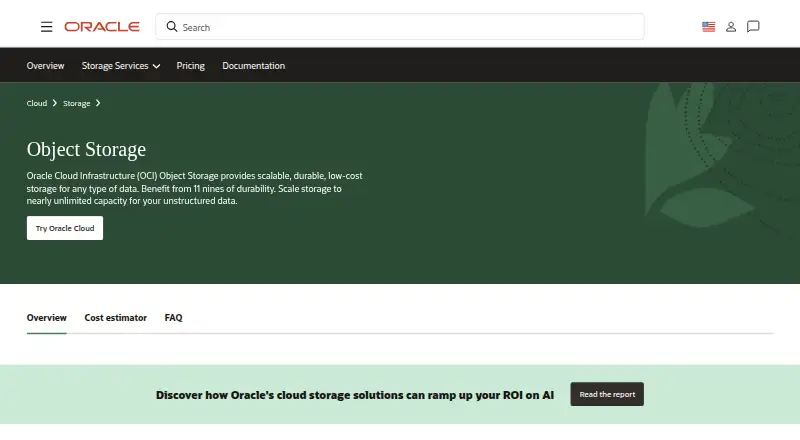
What Oracle Cloud Infrastructure Object Storage is
Oracle Cloud Infrastructure Object Storage stores and retrieves unstructured data such as analytics data, images, and videos. This regional service is accessible over the internet through Oracle’s Console, CLI, API, and SDK. It offers Standard, Infrequent Access, and Archive tiers. Archive data is offline and must be restored before reading; Oracle says retrieving the first byte takes at most an hour. Objects can be replicated between buckets, versioned for recovery, and protected with retention dates or legal holds. Oracle says data is encrypted by default, with customer-provided keys, Vault keys, and client-side encryption also supported. OCI Identity and Access Management controls permissions at object, bucket, and compartment levels. An Amazon S3 Compatibility API supports some S3 APIs, but feature parity with the native OCI API is not guaranteed. Oracle states that buckets can contain unlimited objects and individual objects can be up to 10 TiB. Infrequent Access is listed at $0.01 a month per gigabyte of capacity, with retrieval at $0.01 per gigabyte retrieved per month and a 31-day minimum retention. The service is Always Free eligible; the Free Tier includes a US$300 credit for up to 30 days on eligible services.
Who it suits
It suits organisations storing unstructured data that need tiered storage, object protections, or access through Oracle’s management interfaces and APIs. Teams considering Archive should account for restoration before reading.
What it does well
- Offers Standard, Infrequent Access, and Archive tiers.
- Objects can be versioned and protected with legal holds.
- Data is encrypted by default.
- Buckets can contain unlimited objects.
What to know first
- Archive data must be restored before reading.
- S3 API feature parity is not guaranteed.
- Infrequent Access has a 31-day minimum retention.
- Storage, requests, and outbound transfer are billed.
Limits
Infrequent Access costs $0.01 a month per gigabyte of stored capacity, with retrieval at $0.01 per gigabyte retrieved per month and a 31-day minimum retention. Archive objects need restoration before reading, and the first byte can take up to an hour to retrieve.
Plans
| Plan | Billed and limits | Price |
|---|---|---|
| Always Free Object Storage | unlimited time · 20 GB combined Standard, Infrequent Access and Archive after trial · 50,000 API requests/month | Free |
| Archive pay-as-you-go | per GB/month after first 10 GB · 90-day minimum retention · 10 TB egress included · $0.0034 per 10,000 requests | Free |
| Object Storage - Infrequent Access | Per gigabyte of storage capacity per month; retrieval is $0.01 per gigabyte retrieved per month · 31-day minimum retention · retrieval fee applies | $0.01 a month |
| Standard pay-as-you-go | per GB/month after first 10 GB · 10 TB egress included · $0.0034 per 10,000 requests | $0.03 a month |
| Object Storage - Standard | Pay as you go; storage capacity billed per month · Price not listed on the opened price list · unlimited data and objects per bucket · objects up to 10 TiB | On request |
As oracle.com lists them, read 15 Oct 2026. The maker's own page has the final word.
Getting started
- Visit the Oracle Cloud Infrastructure Object Storage website.
- Choose a storage tier: Standard, Infrequent Access, or Archive.
- Access the service through Oracle’s Console, CLI, API, or SDK.
- Use the Free Tier offer for eligible services, which includes US$300 in credits for up to 30 days.
Oracle Cloud Infrastructure Object Storage is a regional service for storing and retrieving unstructured data such as analytics files, images, and video. It is strongest for organizations already using OCI that need large buckets, granular permissions, and recovery controls. The trade-off is a tier and billing model that demands planning, especially when data is archived or frequently retrieved.
Overview
Object Storage is reached over the internet through the Oracle Console, command-line interface, API, or SDK. Buckets can hold an unlimited number of objects, and each object can be as large as 10 TiB; multipart upload is recommended above 100 MiB. That combination suits large media collections, data lakes, and backup sets rather than small, local-only repositories.
Oracle describes 11 nines of durability and checksum-based integrity monitoring that repairs corrupted data automatically. The service is designed for 99.9% availability, a reasonable target for many applications but not a substitute for a higher availability commitment when downtime is especially costly. Data is encrypted by default, with customer-provided keys, Vault keys, and client-side encryption available for organizations with stricter key-management requirements.
Key features
- Storage tiers: Standard is the general-purpose choice, Infrequent Access lowers storage cost for data read less often, and Archive is intended for material that can remain offline. Archive objects must be restored before reading, and the first byte can take up to an hour to retrieve, so it is unsuitable for immediate-access content.
- Recovery controls: Replication between buckets, object versioning, retention dates, and legal holds cover accidental deletion, rollback, and compliance scenarios. These controls are valuable for important records, although they require deliberate policy choices to avoid retaining data longer than intended.
- Permissions: OCI Identity and Access Management can govern access at object, bucket, and compartment levels. That hierarchy supports separation between teams and workloads instead of relying on one broad bucket permission.
- Interoperability: An Amazon S3 Compatibility API can help S3-oriented applications connect, but parity with the native OCI API is not guaranteed. OCI-native integrations include Autonomous AI Database, MySQL HeatWave, Data Flow, Events, Functions, and Oracle NoSQL Database Cloud, making the service a more natural fit inside an Oracle stack.
- Integrity and encryption: Automatic encryption and corruption repair reduce routine protection work, while customer-managed and client-side encryption options support environments that need control beyond provider-managed keys.
Pricing
Object Storage uses pay-as-you-go billing for storage, requests, and outbound internet transfer. The first 10 TB of outbound transfer is free, and delete requests are free, which helps when exporting moderate volumes or cleaning up obsolete objects. Oracle Cloud Free Tier includes a US$300 credit for up to 30 days on eligible services, and Object Storage is eligible for Always Free use.
Object Storage - Infrequent Access
This tier costs $0.01 a month, billed per gigabyte of storage capacity per month. Retrieval costs $0.01 per gigabyte retrieved per month, and a 31-day minimum retention period applies. It fits backups and reference data that are seldom read; repeated retrieval can erase the storage-rate advantage, and short-lived objects can still incur the minimum-retention condition.
Object Storage - Standard
Standard is billed pay as you go, with storage capacity charged per month. It supports unlimited data and objects per bucket and objects up to 10 TiB. The price is custom pricing, so it is the practical default for active data but requires a usage estimate before costs can be compared confidently.
Platforms
Oracle provides API, Linux, and web access. The Console serves browser administration, while CLI, API, and SDK access supports scripts, applications, and automated pipelines.
Who it's for
Choose Object Storage when your workloads already depend on OCI databases, analytics, events, or functions, or when you need very large object collections with versioning, legal holds, and controlled encryption. It also suits organizations that can separate frequently accessed data from archival material and monitor request and transfer usage.
Look elsewhere if every archived object must be instantly readable, if you need guaranteed S3 feature parity, or if a fixed, easily predictable storage bill matters more than usage-based flexibility.
Pros and cons
- Pro: Unlimited objects per bucket and 10-TiB objects accommodate large datasets without artificial collection-size ceilings.
- Pro: Versioning, replication, retention dates, and legal holds provide several ways to recover or preserve data.
- Pro: Default encryption, customer and Vault keys, and client-side encryption cover different security responsibilities.
- Con: Archive requires restoration and can take up to an hour to return the first byte, ruling it out for urgent access.
- Con: Infrequent Access adds a per-gigabyte retrieval charge and 31-day minimum retention, making it risky for data that is read or deleted often.
- Con: Standard pricing depends on usage, and S3 compatibility does not promise complete feature parity.
Alternatives
For a broader set of gateway products, browse Cloud Storage Gateway Software.
- Infortrend EonCloud Gateway is a self-hosted option with a 90-day trial, cache and sync modes, and limits of five connected folders, five connected volumes, and 1 TB of cache and cloud-volume capacity.
- Synology Active Backup for SaaS is a free self-hosted add-on for Synology NAS covering Microsoft 365 and Google Workspace without a software license.
- CloudMounter suits users wanting freemium desktop access on macOS or Windows, with personal plans priced per year or one-time depending on platform.
- NetApp Global File Cache is a paid Linux, Windows, and self-hosted choice with a $250 a year subscription.
- Hitachi Universal Volume Manager is a paid API, Linux, self-hosted, and web option requiring a license on the local storage system.
- LucidLink is a paid, multi-platform alternative with a Starter plan at $7 a month per member.
- QNAP HybridMount is a free self-hosted and web tool with annual plans for file shares, local cache, and multiple cloud services.
- Panzura CloudFS is a paid API and self-hosted product licensed by capacity.
Verdict
Oracle Cloud Infrastructure Object Storage is a strong choice for OCI-centered teams that need durable, policy-controlled storage with generous object limits and multiple recovery mechanisms. Choose it for its Oracle integrations and protection options; choose another service when instant archive access, complete S3 parity, or a simpler fixed price is the priority.
Verdict
OCI Object Storage offers tiered storage, access controls, encryption, and object recovery options. Archive requires restoration before reading, and Infrequent Access has a listed retrieval fee and minimum retention period.
Questions
Is Oracle Cloud Infrastructure Object Storage free?
It is Always Free eligible. The OCI Free Tier includes a US$300 credit for up to 30 days on eligible services.
How much does Infrequent Access cost?
The listed plan is $0.01 a month per gigabyte of storage capacity. Retrieval costs $0.01 per gigabyte retrieved per month, and a 31-day minimum retention applies.
What platforms are listed?
The listed platforms are API, Linux, and web.
Can it work with Amazon S3 APIs?
An Amazon S3 Compatibility API supports some S3 APIs, but feature parity with the native OCI API is not guaranteed.
What storage tiers are available?
The tiers are Standard, Infrequent Access, and Archive. Archive data must be restored before it can be read.
How is access controlled?
Access integrates with OCI Identity and Access Management and can be controlled at object, bucket, and compartment level.
Facts from Oracle Cloud Infrastructure Object Storage's own pages
- Availability
- The FAQ says the service is designed for 99.9% availability; the Archive tier requires restoration before objects can be read, taking at most an hour to retrieve the first byte. · oracle.com, 4 Oct 2026
- Billing
- Pay-as-you-go charges are based on storage, requests, and outbound internet transfer; the first 10 TB of outbound transfer is free and delete requests are free. · oracle.com, 4 Oct 2026
- Bulk operations
- Oracle advertises bulk operations capable of acting on billions of objects in one task. · oracle.com, 15 Oct 2026
- Capacity limits
- Oracle states that a bucket can contain an unlimited number of objects and that an object can be up to 10 TiB; multipart upload is recommended above 100 MiB. · oracle.com, 4 Oct 2026
- Company facts
- LinkedIn lists Oracle as a public company founded in 1977, headquartered in Austin, Texas, with more than 10,001 employees. · linkedin.com, 15 Oct 2026
- Data protection
- Objects can be replicated between buckets, versioned for recovery, and protected with retention dates or legal holds. · oracle.com, 4 Oct 2026
- Documentation depth
- Oracle documentation includes API references, endpoint details, task guides, tutorials, release notes, troubleshooting and SDK documentation. · docs.oracle.com, 15 Oct 2026
- Durability design
- Objects are redundantly stored across multiple servers, with checksum monitoring and automatic repair or replica creation. · docs.oracle.com, 15 Oct 2026
- Encryption
- Stored data is encrypted by default, with customer-provided keys, Vault keys, and client-side encryption also supported. · oracle.com, 4 Oct 2026
- Extensibility tools
- Developer tooling includes a Terraform provider, Resource Manager, an HDFS connector, Eclipse tooling and Visual Studio tools. · docs.oracle.com, 15 Oct 2026
- Free offer
- Object Storage is Always Free eligible, and Oracle Cloud Free Tier includes a US$300 credit for up to 30 days on eligible services. · oracle.com, 4 Oct 2026
- Integrations
- Oracle describes integrations with Autonomous AI Database, MySQL HeatWave, Data Flow, Events, Functions, and Oracle NoSQL Database Cloud. · oracle.com, 4 Oct 2026
- Integrity and durability
- Oracle says the service provides 11 nines of durability and monitors data integrity with checksums, repairing corrupt data automatically. · oracle.com, 4 Oct 2026
- Interfaces
- Users can manage Object Storage through the browser Console, CLI, REST APIs and SDKs. · docs.oracle.com, 15 Oct 2026
- Interoperability
- An Amazon S3 Compatibility API supports some S3 APIs, but feature parity with the native OCI API is not guaranteed. · oracle.com, 4 Oct 2026
- Legal name and funding
- Crunchbase identifies the legal name as Oracle Corporation and lists public-company status, Austin headquarters and post-IPO debt as the last funding type. · crunchbase.com, 15 Oct 2026
- Lifecycle management
- Lifecycle policies can automatically move objects to Archive or delete objects and versions. · docs.oracle.com, 15 Oct 2026
- Limit: Android app complaints
- Recent Google Play reviewers report that Android navigation bars can hide the agreement buttons and prevent completing first-time setup. · play.google.com, 15 Oct 2026
- Limit: G2 reviewers
- Repeated complaints include high pricing, confusing bucket or folder organization, difficult menus, weaker regional coverage and inefficient big-data migration. · g2.com, 15 Oct 2026
- Limit: Gartner reviewers
- A listed dislike is the time required to implement and get the service operational. · gartner.com, 15 Oct 2026
- Mobile support
- The OCI mobile app supports Android 8 or later and iOS 11 or later and can manage Object Storage buckets. · docs.oracle.com, 15 Oct 2026
- Object limits
- Maximum object size is 10 TiB; PutObject is limited to 50 GiB, multipart parts to 50 GiB and 10,000 parts, with 4,000 bytes of metadata. · docs.oracle.com, 15 Oct 2026
- Permissions
- Access is integrated with OCI Identity and Access Management and can be controlled at object, bucket, and compartment level. · oracle.com, 4 Oct 2026
- Praise: G2 reviewers
- Reviewers repeatedly praise simple uploads, Oracle ecosystem integration, scalability, storage tiers, S3 compatibility, security and support. · g2.com, 15 Oct 2026
Where Oracle Cloud Infrastructure Object Storage stands on Freedom251
- Cloud Storage Gateway Software#2 of 26