Freedom251 › Monitoring Observability

OpenZipkin
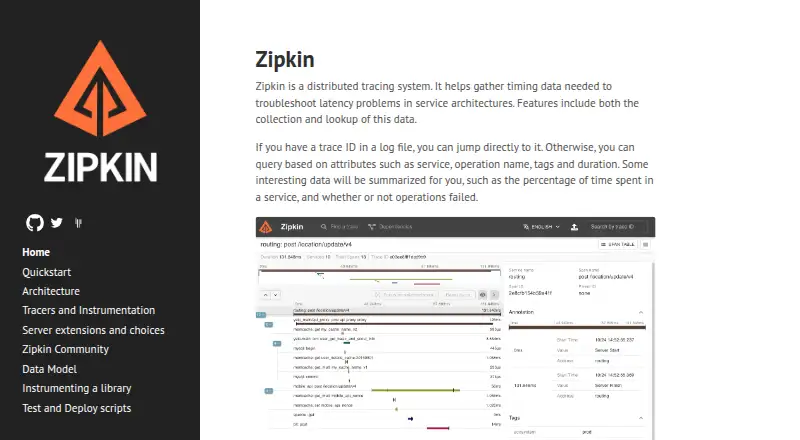
What OpenZipkin is
OpenZipkin is the open-source organization that stewards Zipkin's code, documentation, specifications, and support; Zipkin was originally created at Twitter. The self-hosted tracing system collects and searches trace data to help investigate latency in service architectures. Users can open a trace by ID or query by service, operation name, tags, and duration. Its interface summarizes time spent in each service and whether operations failed, and shows a dependency diagram with the number of traced requests through each application. Applications must be instrumented to report data, using transports such as HTTP, Kafka, ActiveMQ, gRPC, or RabbitMQ. Storage options include in-memory storage and persistent backends such as MySQL, Cassandra, and Elasticsearch. Instrumentation libraries listed for supported and community-supported languages include C#, Go, Java, JavaScript, Ruby, Scala, PHP, Python, and Lua. Zipkin supports OpenTelemetry and can run with Docker, Java, Homebrew, or from source. Its self-contained executable JAR requires Java 17 or higher. The software is listed as free; the web UI has no built-in authentication.
Who it suits
OpenZipkin suits teams investigating latency across service architectures that can instrument applications to send trace data. It may fit organizations prepared to run a self-hosted tracing system and account for the web UI's lack of built-in authentication.
What it does well
- Search traces by ID, service, operation, tags, or duration.
- Summaries show service time and operation failures.
- Dependency diagram displays traced requests through applications.
- Supports OpenTelemetry.
- Storage includes MySQL, Cassandra, and Elasticsearch.
What to know first
- Applications must be instrumented to report trace data.
- The web UI has no built-in authentication.
- Executable JAR option requires Java 17 or higher.
Plans
| Plan | Billed and limits | Price |
|---|---|---|
| Zipkin (open-source software) | Self-hosted tracing system; no hosted plan or price stated | Free |
As zipkin.io lists them, read 2 Oct 2026. The maker's own page has the final word.
Verdict
OpenZipkin provides trace search, summaries, and a service dependency diagram for self-hosted latency investigation. Its lack of built-in UI authentication and the need to instrument applications are important deployment considerations.
Facts from OpenZipkin's own pages
- Data collection
- Applications must be instrumented to report trace data; listed transports include HTTP, Kafka, ActiveMQ, gRPC, and RabbitMQ. · zipkin.io, 2 Oct 2026
- Dependency diagram
- The UI includes a dependency diagram showing how many traced requests went through each application. · zipkin.io, 2 Oct 2026
- Deployment
- The quickstart describes running Zipkin with Docker, Java, Homebrew, or from source. · zipkin.io, 2 Oct 2026
- Instrumentation
- The instrumentation list includes supported and community-supported libraries for languages including C#, Go, Java, JavaScript, Ruby, Scala, PHP, Python, and Lua. · zipkin.io, 2 Oct 2026
- Java requirement
- The quickstart says Java 17 or higher is required for its self-contained executable JAR option. · zipkin.io, 2 Oct 2026
- Maker
- OpenZipkin is the open-source organization that stewards Zipkin code, documentation, specifications, and support; Zipkin was originally created at Twitter. · zipkin.io, 2 Oct 2026
- Purpose
- Zipkin collects and looks up tracing data to help troubleshoot latency in service architectures. · zipkin.io, 2 Oct 2026
- Security limitation
- The architecture page says the web UI has no built-in authentication. · zipkin.io, 2 Oct 2026
- Storage
- The site lists in-memory storage and persistent backends including MySQL, Cassandra, and Elasticsearch. · zipkin.io, 2 Oct 2026
- Support
- The project directs users to its Gitter chat for questions and says the OpenZipkin organization is primarily volunteers. · zipkin.io, 2 Oct 2026
- Trace search
- Users can open a trace by ID or query by service, operation name, tags, and duration. · zipkin.io, 2 Oct 2026
- Trace summaries
- The UI summarizes the percentage of time spent in a service and whether operations failed. · zipkin.io, 2 Oct 2026
Where OpenZipkin stands on Freedom251
- Monitoring Observability#16 of 30
- Distributed Tracing Tools#20 of 32
- Distributed Systems#23 of 30